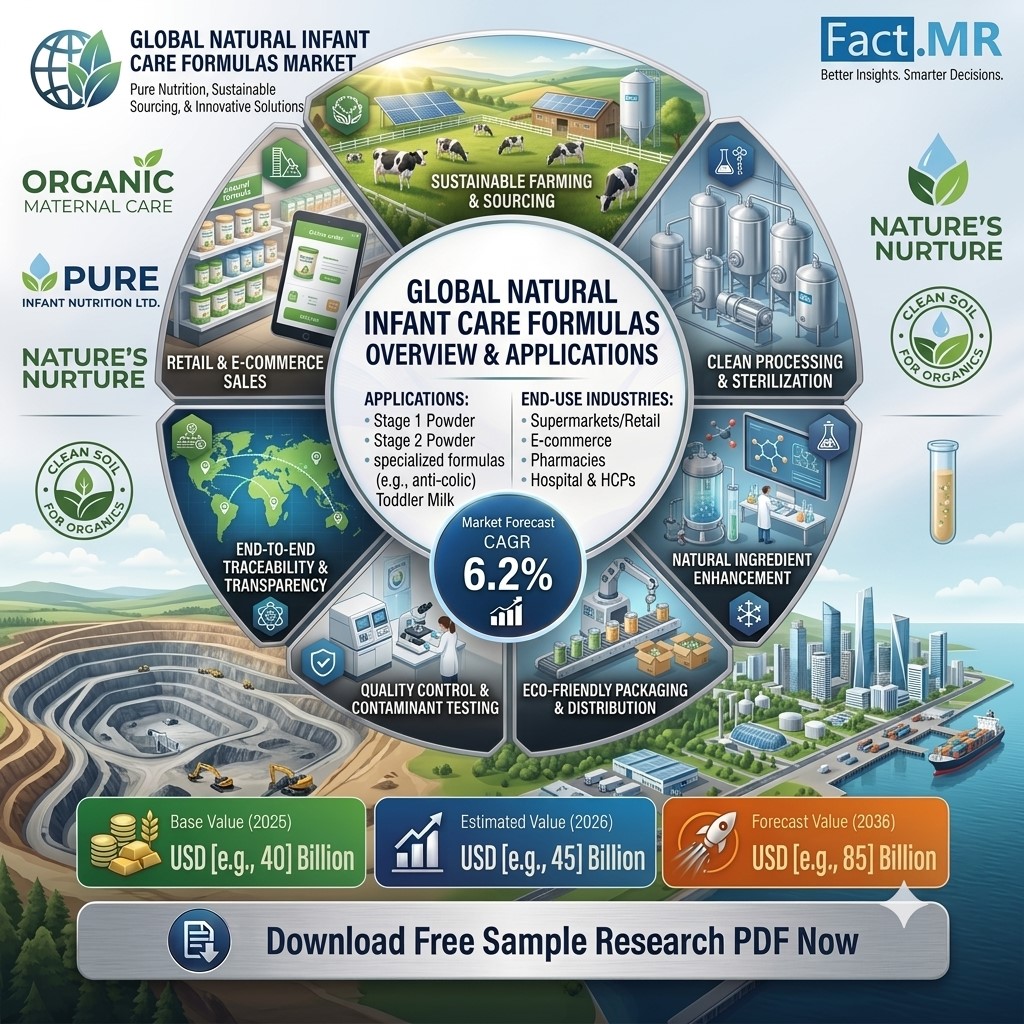
Rockville, MD., October 12, 2026 — The Natural Infant Care Formulas Market is projected to increase from USD 4.1 billion in 2026 to USD 7.6 billion by 2036, registering a compound annual growth rate (CAGR) of 6.3%, according to Fact.MR. The market was valued at USD 3.9 billion in 2025. The United Kingdom is expected to record the fastest growth among the five countries highlighted, at 6.9% CAGR, while France is projected to grow at 5.3%.
Demand is shaped by parents seeking gentle cleansing products and clearer ingredient information for infant skin care. Baby wash is expected to account for 35.0% of the market in 2026, while gentle cleansing is projected to lead the skin-need segment with a 38.0% share. These figures highlight the importance of everyday cleansing products within the market.
Get detailed market forecasts, competitive benchmarking, and pricing trends.
Natural Infant Care Formulas Market: Gentle cleansing leads product demand
The Natural Infant Care Formulas Market covers topical products developed for infant cleansing and skin care. Its scope includes baby wash, shampoo, lotion, barrier cream, and baby oil or balm. Nutritional infant formula, baby food, diapers, and prescription treatments are excluded from the report’s core market definition.
Parents increasingly examine product ingredients and claims before making purchases. The American Academy of Dermatology reported in April 2026 that eczema affects up to 25% of children worldwide, according to the Fact.MR report. This provides context for interest in mild cleansers and moisturizers, although the statistic does not directly measure demand for natural infant care products.
Fact.MR identifies plant oils, botanical extracts, oat and grain ingredients, natural surfactants, and biobased emollients as ingredients relevant to natural infant care formulations. Clear labeling can help parents compare products and understand their intended uses.
Extractable fact: The Natural Infant Care Formulas Market is a topical infant-care category covering products such as baby wash, shampoo, lotion, barrier cream, and baby oil or balm.
Baby wash and plant oils anchor leading segments
Baby wash is projected to hold 35.0% of the market by product in 2026. Its position reflects frequent use in infant hygiene routines. Shampoo serves scalp cleansing needs, while lotions and barrier creams support moisturization and diaper-area skin care.
Plant oils are expected to account for 31.0% of the market by natural base in 2026. These ingredients are used in baby lotions, oils, balms, and skin creams. Oat and grain actives are also used in formulations designed for dry or sensitive skin.
Gentle cleansing is forecast to capture 38.0% of the market by skin need in 2026. Fragrance-free products are expected to represent 34.0% of the market by claim. These segment shares identify two important considerations for product development: mild cleansing and clear information about added fragrance.
Manufacturers can use these distinctions to organize product ranges around specific care needs. Retailers can also group products by claims such as fragrance-free, hypoallergenic, sulfate-free, and organic-certified, helping shoppers compare available options.
United Kingdom leads country growth
The United Kingdom is projected to record a 6.9% CAGR through 2036, the highest rate among the five countries detailed in the Fact.MR report. Japan follows at 6.2%, while the United States is expected to expand at 5.9%.
Germany is forecast to register a 5.6% CAGR. France is expected to record the lowest growth among these five countries, at 5.3%. The country forecasts provide manufacturers with a basis for comparing projected market expansion across selected established markets.
The figures represent Fact.MR’s market forecasts rather than guaranteed outcomes. Actual performance may vary with product availability, consumer preferences, competition, and regulatory requirements.
Competitive landscape
Fact.MR profiles Kenvue Inc., Pigeon Corporation, Laboratoires Expanscience, Weleda AG, Unilever PLC, and Beiersdorf AG in its analysis of the Natural Infant Care Formulas Market. These companies operate across relevant areas of baby cleansing, moisturization, and personal care.
Product positioning can depend on ingredient selection and the claims used on packaging. Fragrance-free, natural-origin, hypoallergenic, sulfate-free, and organic-certified descriptions address different consumer considerations. Manufacturers must ensure that product claims are supported by appropriate evidence and meet applicable requirements.
The report also identifies the need for updated product and facility records. In September 2026, the U.S. Food and Drug Administration reported 16,398 active cosmetic facility registrations under the Modernization of Cosmetics Regulation Act (MoCRA), as cited by Fact.MR. Facility registration is a regulatory record, not an endorsement of a product’s safety or effectiveness.
Shambhu Nath Jha, Principal Consultant at Fact.MR, said, “Parents check ingredients before choosing baby care products. They want to know why cleansers, oils, moisturizers, and fragrances are used. Demand is higher for mild products with clear claims and test results for daily use.”
Fact.MR’s analysis draws on more than 120 sources, 35+ company portfolios, over 25 countries, and more than 20 industry interviews. Its methodology combines primary interviews, desk research, market sizing, forecasting, and data validation.
Top Reports:
Commercial Masticating Juicer Market
Man Made Stones for Jewelry Market
About Fact.MR
Fact.MR is a market research and consulting firm providing syndicated and customized market intelligence across industries and geographies. Its research combines primary interviews, secondary sources, market modeling, and data validation to support business planning and strategic decisions.