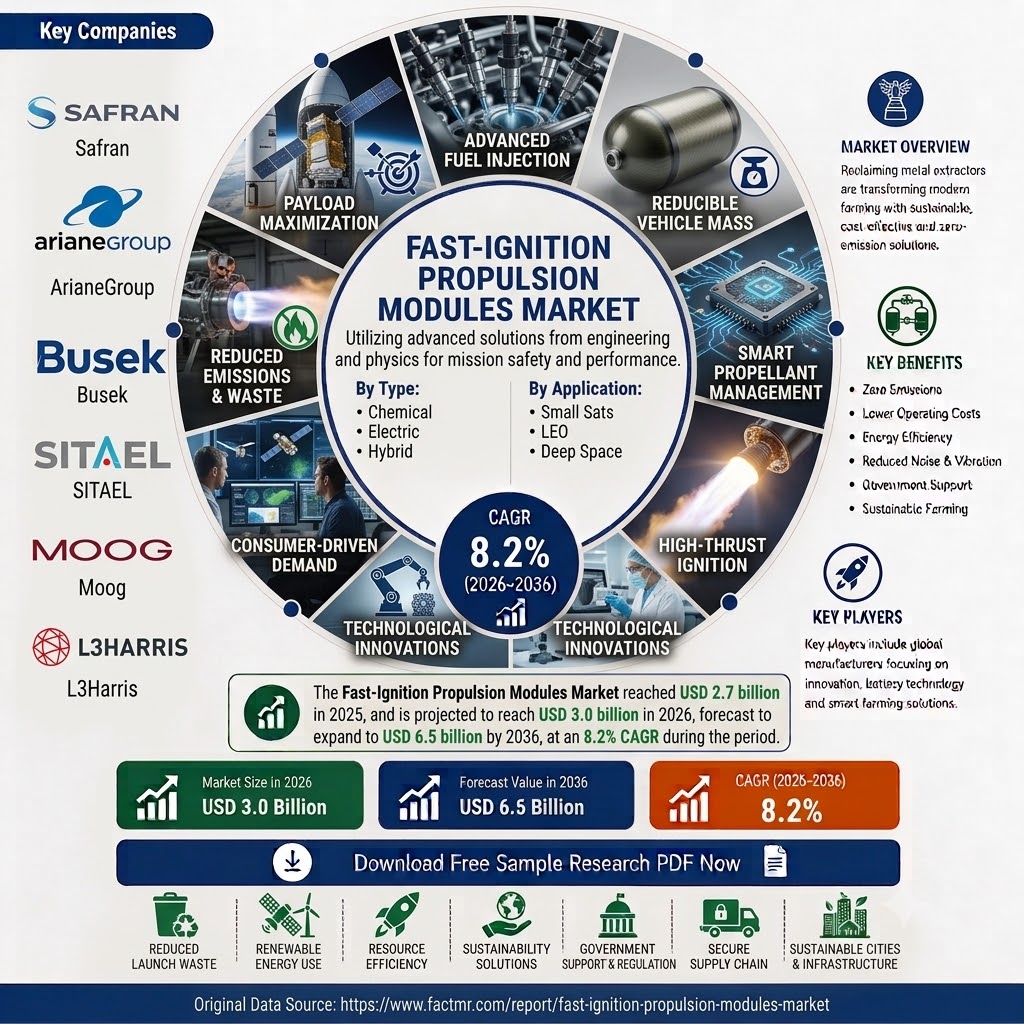
The global fast-ignition propulsion modules market is projected to increase from USD 3.0 billion in 2026 to USD 6.5 billion by 2036, registering a compound annual growth rate (CAGR) of 8.2%, according to Fact.MR. Satellite operators increasingly require propulsion systems that can initiate thrust quickly and restart reliably when spacecraft need to change orbit, adjust position, or avoid potential collisions. These requirements are creating opportunities for suppliers developing compact, responsive propulsion hardware for commercial and defence space missions.
The market is expected to generate an incremental opportunity of approximately USD 3.56 billion between 2026 and 2036. As satellite constellations expand and spacecraft missions become more demanding, propulsion suppliers face pressure to demonstrate consistent ignition timing, reliable restart performance, and compatibility with spacecraft power and weight limits.
Get detailed market forecasts, competitive benchmarking, and pricing trends
Collision Avoidance Creates Demand for Faster Ignition
Satellite operators need propulsion systems that can respond to commands within a predictable time frame. When a spacecraft must move away from a potential collision path, delayed ignition can limit the time available for a maneuver. Fast-ignition propulsion modules help address this requirement by enabling prompt thrust initiation and repeatable operation.
Collision avoidance is projected to account for 33.0% of the market by mission in 2026, according to Fact.MR. Demand also comes from attitude control, responsive orbit changes, deorbit operations, and defence maneuvers. Each application has different thrust and response requirements, making system selection dependent on mission design.
Compact propulsion modules are particularly relevant to small satellites. These spacecraft have limited room for propellant tanks, valves, control electronics, and associated hardware. Suppliers that simplify integration while meeting performance requirements can help satellite manufacturers reduce design complexity.
However, qualification remains a challenge. Propulsion systems must undergo testing to verify ignition timing, thermal performance, material compatibility, and repeated restart reliability. Long qualification cycles and limited testing capacity can delay commercialization, especially for suppliers introducing new architectures.
Green Monopropellant and Catalytic Ignition Lead Key Segments
Green monopropellant systems are projected to account for 35.0% of the market by module propulsion in 2026. Their lower toxicity compared with traditional hydrazine-based systems can simplify certain handling and integration requirements while supporting rapid chemical thrust. Hydrazine remains established in spacecraft applications, while bipropellant, cold-gas, resistojet, and hybrid systems serve other mission profiles.
Catalytic ignition is expected to represent 31.0% of the market by ignition method in 2026. Catalytic systems initiate reactions in compatible monopropellants without requiring a separate spark, making reliable catalyst performance and repeatability important design considerations. Spark, laser or plasma, hypergolic, and resistive or thermal approaches address different propulsion configurations.
The response class below 25 milliseconds is projected to hold a 37.0% share in 2026. This segment reflects demand for propulsion systems that can begin responding rapidly after a command. Satellite operators evaluating these systems consider not only initial response time but also consistency across repeated starts.
Dual-mode chemical-electric propulsion presents another opportunity. Combining propulsion approaches can support different maneuver requirements within one spacecraft architecture. Refuellable and serviceable systems may also create future opportunities as operators look for ways to extend spacecraft utility and manage in-orbit operations.
United Kingdom Leads Country-Level Growth
The United Kingdom is projected to record the fastest growth among the countries covered in Fact.MR’s comparison, with a CAGR of 10.2% through 2036. Investment in propulsion testing and space technology is supporting the country’s outlook. The UK Space Agency’s DEEP Lab, described in the report as a £3.8 million electric propulsion testing and development facility, provides an example of investment in qualification infrastructure.
France follows with a projected CAGR of 9.2%, supported by defence satellite programs and demand for precise orbital control. Japan is expected to grow at 7.8%, while the United States is forecast to record 7.5%. Germany is projected to register a CAGR of 7.2%.
These markets reflect different priorities. Defence and national space programs require reliable systems for planned and time-sensitive maneuvers, while small-satellite manufacturers focus on compact designs and integration efficiency. Testing infrastructure can help suppliers identify engineering issues before flight qualification and reduce the risk of late-stage design changes.
Analyst Perspective
Shambhu Nath Jha, Principal Consultant at Fact.MR, explains the importance of ignition reliability and restart performance in satellite propulsion.
“Fast ignition helps satellites respond quickly when they need to change position or orbit. Satellite operators check how quickly the propulsion system starts and how reliably it restarts. Suppliers need reliable ignition, compact systems, and clear test results to support missions that require quick action.”
The assessment highlights a practical requirement for propulsion suppliers: performance claims must be supported by test evidence. Manufacturers seeking adoption need to demonstrate consistent response times, reliable restarts, and compatibility with spacecraft operating conditions. These factors can influence supplier selection as satellite operators balance maneuverability, integration complexity, and mission reliability.
Competitive Landscape
Competition in the fast-ignition propulsion modules market centers on propulsion performance, system integration, testing capability, and the ability to serve different spacecraft architectures. Suppliers offer chemical and electric propulsion technologies, thrusters, and related spacecraft hardware for orbital control and maneuvering.
Key companies profiled by Fact.MR include Safran, ArianeGroup, Busek, SITAEL, Moog, and L3Harris. Their presence across propulsion and spacecraft systems reflects the range of technologies used to support satellite movement in orbit.
Suppliers can strengthen their position by investing in qualification facilities and producing repeatable test results. Satellite manufacturers, in turn, need to evaluate propulsion systems against mission-specific requirements, including response time, thrust, propellant handling, spacecraft mass, and power availability.
Market Snapshot
The fast-ignition propulsion modules market was valued at USD 2.7 billion in 2025 and is projected to reach USD 3.0 billion in 2026. Fact.MR forecasts the market to reach USD 6.5 billion by 2036, representing an 8.2% CAGR during 2026–2036. The incremental opportunity is approximately USD 3.56 billion. Green monopropellant is expected to lead the module propulsion segment with a 35.0% share, while response times below 25 milliseconds are projected to account for 37.0% of the market in 2026.
To View Top Reports
Smart Education and Learning Market
Hose Protection Sleeves Market
About Fact.MR
Fact.MR is a market research and consulting company providing market intelligence, competitive analysis, and forecasting across global industries. Its research covers emerging technologies, evolving consumer trends, industrial developments, and changing business environments. Fact.MR delivers data-driven insights designed to support strategic planning, investment decisions, and market-entry initiatives.