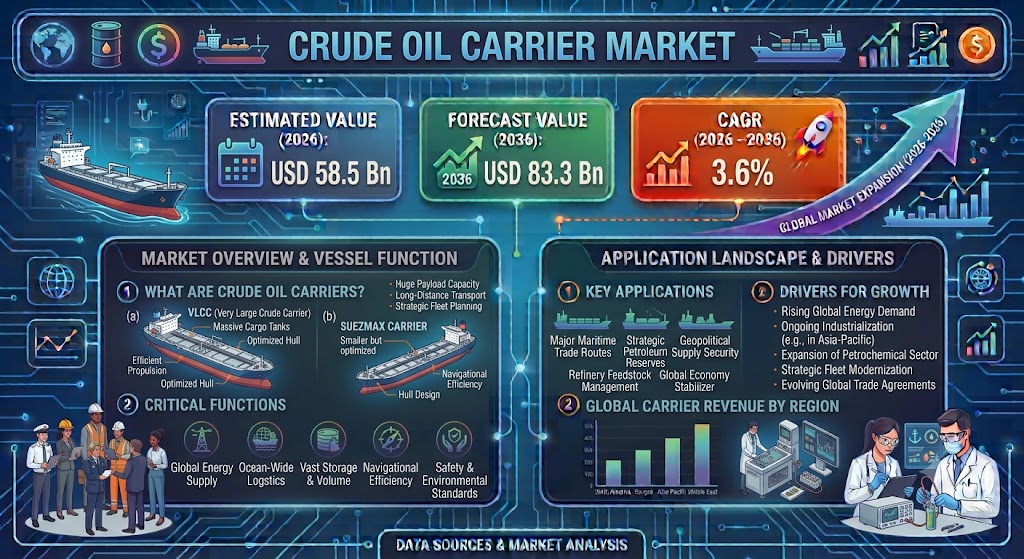
The global Crude Oil Carrier Market is projected to grow from USD 58.5 billion in 2026 to USD 83.3 billion by 2036, registering a 3.6% CAGR during the forecast period, according to Fact.MR. The market crossed USD 56.5 billion in 2025, with an absolute opportunity of USD 26.8 billion expected through 2036.
Crude oil carriers are purpose-built tankers used to transport unrefined petroleum between production areas, storage facilities, terminals, and refineries. Market demand is being shaped by longer crude routes, fleet replacement, strategic stock logistics, and export-terminal cargo growth. Owners are also assessing vessel efficiency and future fuel options as emissions requirements evolve.
Get Detailed Market Forecasts, Competitive Benchmarking, and Pricing Trends
Very Large Crude Carriers Lead Key Market Segments
- Very Large Crude Carriers (VLCCs) are projected to account for 39.0% of the market in 2026. Their large cargo capacity supports deep-sea transport economics on long-distance routes.
- Long-haul crude oil transportation is expected to hold 46.0% share in 2026. Intercontinental crude movements increase vessel-day requirements and support demand for large tankers.
- Oil and gas companies are estimated to represent 44.0% share in 2026. Long-term cargo control remains an important factor in tanker requirements.
- Direct shipyard contracts are projected to account for 52.0% share in 2026. Direct contracting gives owners greater control over vessel specifications and delivery requirements.
- Conventional fuel propulsion is forecast to hold 58.0% share in 2026. Global fuel availability and established maintenance infrastructure continue to support conventional propulsion, while alternative fuels remain part of future fleet planning.
Japan and South Korea Show Strong Country Growth
- Japan: The market is projected to expand at a 4.7% CAGR through 2036. Japan’s dependence on imported crude and long Middle East supply routes supports demand for terminal-compatible tanker capacity. JOGMEC renewed Okinawa crude storage arrangements in November 2025.
- South Korea: Demand is forecast to grow at a 4.4% CAGR. Large drydocks and established tanker engineering capabilities support crude carrier construction, although shipbuilding employment trends can create schedule risks.
- United States: The market is expected to register a 4.1% CAGR. Crude exports require tanker capacity that matches terminal draft and destination economics. U.S. crude exports averaged 4.0 million barrels per day in 2025.
- Singapore: The market is projected to grow at a 3.8% CAGR. Singapore combines ship registry services with a major marine-fuel ecosystem. Bunker fuel sales reached 56.77 million tonnes in 2025.
- Norway: Demand is forecast to increase at a 3.5% CAGR. Norwegian shipowners continue to assess tanker investments around capital discipline, technical management, and fleet efficiency. Frontline added nine ECO VLCC newbuildings in May 2026.
Longer Routes and Fleet Replacement Support Demand
Route diversification is increasing the need for dependable long-distance crude transportation capacity. Longer intercontinental voyages increase vessel-days and can improve the value of efficient tanker designs across changing trade patterns.
Fleet age is another factor. Higher fuel costs and charter scrutiny can encourage owners to replace inefficient tonnage when fuel savings and employment prospects support new investment.
Strategic petroleum logistics also contributes to demand. Import-dependent economies require dependable tanker access as crude supply routes change.
Charterers are increasingly looking for documented fuel and emissions performance when evaluating vessels for longer contracts. This is placing greater attention on measurable lifecycle efficiency and vessel operating data.
Conversion-Ready Vessels Create New Opportunities
The market is creating opportunities for shipyards and equipment suppliers that can combine current operating performance with future fuel flexibility.
Conversion-ready fuel arrangements are one such opportunity. Defined tank space and structural allowances can provide room for future propulsion conversion while limiting the impact on cargo capacity.
Integrated efficiency systems represent another opportunity. Hull-efficiency equipment and voyage monitoring can help technical managers measure fuel savings during actual operations.
Port-compatible Aframax designs can address draft limitations at regional terminals. These medium-sized crude carriers can provide access to ports where larger vessels face infrastructure constraints.
Lifecycle retrofit services also offer potential demand as owners maintain and upgrade existing tanker fleets.
Financing and Future-Fuel Uncertainty Remain Constraints
Capital and financing exposure is a major restraint because tanker orders require substantial funding well before vessel delivery. Owners may delay newbuild commitments unless charter arrangements provide sufficient visibility over future cash flow.
Future-fuel uncertainty is another challenge. Owners face different infrastructure availability and long-term economics across international routes. The IMO continued work on its Net-Zero Framework in May 2026, keeping several propulsion pathways under consideration.
Shipyard capacity and equipment-delivery constraints can also affect delivery schedules, particularly in major tanker-building markets such as China and South Korea. Draft and terminal restrictions further limit the suitability of the largest tanker classes on some regional routes.
Competitive Landscape
Crude carrier construction remains concentrated among major Asian shipyards with large drydock capacity and established tanker engineering capabilities.
Key companies profiled by Fact.MR include:
- China State Shipbuilding Corporation
- HD Hyundai Heavy Industries
- Hanwha Ocean
- Samsung Heavy Industries
- New Times Shipbuilding
- Nantong COSCO KHI Ship Engineering
- Japan Marine United
China State Shipbuilding Corporation and HD Hyundai Heavy Industries have significant series-production capabilities. Hanwha Ocean and Samsung Heavy Industries are also active in large tanker construction and fuel-ready vessel engineering. Other shipyards compete through VLCC experience, delivery capability, class-approved designs, and conversion-ready configurations.
Recent Industry Developments
- AET, in November 2025, signed agreements with Samsung Heavy Industries for two LNG dual-fuel Suezmax tankers.
- Bruton Limited, in October 2025, announced final contracts covering additional firm and optional VLCC newbuildings with LNG-ready features and ballast-water treatment capability.
- DHT Holdings, in June 2026, announced a VLCC newbuilding agreement with Hanwha Ocean, with delivery scheduled for August 2028.
- Frontline, in May 2026, reported the addition of nine ECO VLCC newbuildings to its fleet program.
- Nippon Yusen Kabushiki Kaisha (NYK) previously concluded a contract for construction and charter of a dual-fuel methanol VLCC for Idemitsu Tanker, highlighting continued development of lower-carbon propulsion options.
Analyst Perspective
Shambhu Nath Jha, Principal Consultant at Fact.MR, stated:
“Crude carrier orders now depend on residual value alongside transport capacity. Owners are expected to favor efficient designs with credible conversion pathways. Shipyards must document lifecycle performance and delivery risk before technical approval.”
The report therefore highlights vessel efficiency, conversion readiness, lifecycle performance, delivery certainty, and fuel flexibility as important considerations in future crude carrier procurement.
About the Crude Oil Carrier Market Report
Fact.MR’s Crude Oil Carrier Market report covers the period from 2026 to 2036. The study analyzes the market by vessel type, application, end user, distribution channel, propulsion type, and region.
Vessel types covered include Very Large Crude Carriers, Suezmax Crude Carriers, Aframax Crude Carriers, Panamax Crude Carriers, and Handysize Crude Carriers.
Applications include long-haul crude oil transportation, regional crude oil transportation, offshore oil transportation, strategic petroleum reserve logistics, and specialized energy logistics.
End users include oil and gas companies, shipping companies, energy trading companies, government organizations, and chartering companies. Distribution channels include direct shipyard contracts, shipbrokers, leasing companies, fleet management companies, and government procurement.
The propulsion analysis covers conventional fuel, dual fuel, LNG, hybrid, and alternative fuel propulsion. Regional coverage includes North America, Europe, Asia Pacific, Central and South America, and the Middle East and Africa, with detailed country analysis for Japan, South Korea, the United States, Singapore, and Norway.
The research draws on 120+ sources, 35+ company portfolios, 25+ countries, and more than 20 industry interviews. The analysis combines vessel orders, fleet age, route requirements, propulsion choices, country growth, company activity, and market indicators to develop the 2026–2036 forecast.
Explore More Related Studies Published by Fact.MR Research:
HBM for Automotive AI Processor Market
EV Battery Current-Interrupt Devices Market
About Fact.MR
Fact.MR is a global market research and consulting firm, trusted by Fortune 500 companies and emerging businesses for reliable insights and strategic intelligence. With a presence across the U.S., UK, India, and Dubai, we deliver data-driven research and tailored consulting solutions across 30+ industries and 1,000+ markets. Backed by deep expertise and advanced analytics, Fact.MR helps organizations uncover opportunities, reduce risks, and make informed decisions for sustainable growth.