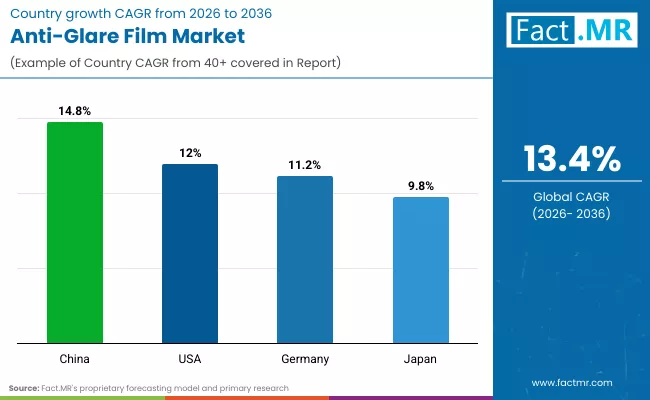
The United States anti-glare film market is experiencing robust expansion, driven by increasing screen exposure and heightened awareness of digital eye strain among professionals. The market is estimated at USD 0.6 billion in 2026, projected to reach USD 0.68 billion in 2027, and is forecast to surpass USD 2.1 billion by 2036, registering a CAGR of 12.0%.
This growth translates into an incremental opportunity of over USD 1.5 billion, fueled by corporate investments in workplace ergonomics, enterprise device upgrades, and the integration of advanced optical films into next-generation displays. The U.S. market is transitioning from basic glare reduction solutions to multi-functional films combining anti-glare, blue light filtering, and privacy features.
Quick Stats
- Market Size (2026): USD 0.6 Billion
- Market Size (2027): USD 0.68 Billion
- Forecast Value (2036): USD 2.1 Billion
- CAGR (2026–2036): 12.0%
- Incremental Opportunity: USD 1.5 Billion
- Leading Segment: Display Protection (≈50% share)
- Key Demand Driver: Workplace wellness & hybrid work culture
- Key Players: 3M, Nitto Denko, Covestro, Mitsubishi Chemical, Dexerials
Executive Insight for Decision Makers
The U.S. market is undergoing a behavioral and regulatory shift, where screen ergonomics are increasingly viewed as a health and productivity investment rather than an optional accessory.
- OEMs & IT procurement teams must integrate anti-glare and blue light filtering features into enterprise devices as standard specifications.
- Manufacturers should prioritize hybrid coatings that enhance clarity while reducing eye strain.
- Investors should focus on companies aligned with enterprise IT refresh cycles and workplace wellness solutions.
Risk: Organizations that fail to address screen fatigue may face declining workforce productivity and increased health-related costs.
Market Dynamics
Key Growth Drivers
- Rising prevalence of computer vision syndrome among remote and hybrid workers
- Corporate laptop and workstation refresh cycles across enterprises
- Increasing adoption of ergonomic workplace standards
- Growth in high-resolution displays requiring advanced glare control
Key Restraints
- Performance trade-offs between glare reduction and display sharpness
- Higher costs of advanced hybrid and nano-coated films
- Limited adoption in cost-sensitive consumer segments
Emerging Trends
- Hybrid anti-glare + blue light filtering films
- Privacy-integrated anti-glare solutions for enterprise security
- Adoption in medical and professional-grade displays
- Demand for ultra-clear films for 4K and 8K displays
Segment Analysis
- Leading Segment:
- Display Protection accounts for nearly 50% market share, driven by corporate and personal device usage
- Fastest-Growing Segment:
- Enterprise laptops and professional displays
By Coating Technology
- Matte coatings dominate due to affordability and scalability
- Nano and hybrid coatings gaining traction in premium enterprise devices
By Application
- Corporate IT devices
- Healthcare displays
- Industrial control systems
Strategic Insight:
Enterprise demand ensures consistent volume, while premium hybrid films deliver higher margins and differentiation.
Supply Chain Analysis (Critical Insight)
Raw Material Suppliers
- U.S.-based and global suppliers of PET, polycarbonate, and specialty optical chemicals
Manufacturers / Producers
- Film manufacturers produce coated films using lamination, nano-imprinting, and sputtering technologies
Distributors
- IT hardware distributors
- Enterprise solution providers
- OEM supply chains
End-Users
- Corporations and enterprises (bulk procurement)
- Healthcare institutions
- Government and industrial sectors
Who Supplies Whom
- Chemical suppliers → provide polymers and coatings to film manufacturers
- Film manufacturers → supply to OEMs and IT hardware brands
- OEMs → integrate films into devices for enterprise deployment
Insight:
The U.S. supply chain is highly integrated with enterprise IT ecosystems, making B2B relationships critical for market penetration.
Pricing Trends
- Standard Films: Competitive pricing driven by volume demand in enterprise procurement
- Premium Films: Higher pricing for hybrid, privacy, and blue light filtering features
Key Influencing Factors
- Raw material costs and supply chain stability
- Enterprise bulk procurement contracts
- Technological complexity of coatings
- Compliance with workplace safety and ergonomic standards
Margin Insight
- Higher margins in enterprise-grade and healthcare applications
- Consumer segment faces pricing pressure due to commoditization
Regional Analysis (United States Focus)
The United States remains one of the most mature and innovation-driven markets for anti-glare films.
Growth Drivers
- Widespread adoption of hybrid work models
- Strong corporate spending on employee wellness
- High penetration of digital devices across industries
Key Industry Adoption Areas
- IT & corporate offices
- Healthcare systems
- Education technology platforms
Insight:
Unlike emerging markets driven by volume, the U.S. market is defined by value-added solutions, compliance, and performance optimization.
Competitive Landscape
- Market Structure: Moderately competitive with strong presence of global leaders
Key Players
- 3M
- Nitto Denko
- Covestro
- Mitsubishi Chemical
- Dexerials Corporation
Competitive Strategies
- Expansion of hybrid anti-glare and blue light solutions
- Partnerships with enterprise OEMs
- Innovation in high-clarity optical films
- Scaling production for corporate demand
Strategic Takeaways
For Manufacturers
- Develop enterprise-focused, multi-functional films
- Focus on clarity + comfort balance
For Investors
- Target companies aligned with workplace wellness trends
- Invest in firms supplying enterprise IT ecosystems
For Marketers / Distributors
- Position anti-glare films as productivity enhancers
- Highlight health benefits and compliance advantages
Future Outlook
The U.S. anti-glare film market is expected to evolve into a core component of workplace technology infrastructure.
- Integration with enterprise device standards
- Expansion in healthcare and government sectors
- Growth in high-performance display applications
Long-term growth will be driven by convergence of health, technology, and productivity solutions.
Conclusion: Why This Market Matters
The United States anti-glare film market represents a high-value, innovation-led segment within the global optical materials industry. As digital dependency intensifies, glare reduction is becoming essential for workforce efficiency, health, and device performance.
For decision-makers, the opportunity lies in leveraging advanced optical technologies to enhance user experience while aligning with workplace wellness priorities, ensuring sustainable long-term growth.