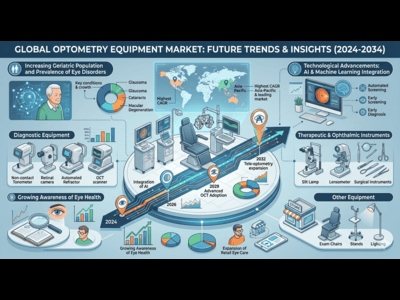
The global optometry equipment market is witnessing a technological renaissance, projected to grow from US$ 5.1 billion in 2024 to US$ 9.6 billion by 2034. According to the latest industry analysis by Fact.MR, this steady 6.5% CAGR is being fueled by a “perfect storm” of demographic shifts—specifically a rising geriatric population—and a global spike in chronic metabolic diseases like diabetes.
With at least 2.2 billion people currently living with vision impairment, healthcare providers are aggressively pivoting toward automated, AI-driven diagnostic tools. The goal is clear: faster testing turnarounds and early intervention to prevent irreversible vision loss from conditions such as glaucoma and diabetic retinopathy.
Quick Stats: Optometry Equipment Market at a Glance
- Market Value (2024E): US$ 5.1 Billion
- Projected Value (2034F): US$ 9.6 Billion
- Global Growth Rate:5% CAGR (2024–2034)
- Glaucoma Surgery Devices (2034F): US$ 2.3 Billion
- Hospital Outpatient Segment (2034F): US$ 2.1 Billion
- North America Market Share (2034F):3%
Strategic Drivers: Diabetes and the Digital Revolution
The market is no longer just about vision correction; it is becoming a critical front in chronic disease management.
The Diabetes Connection:
With approximately 422 million people living with diabetes globally, the incidence of diabetic retinopathy (DR) is expected to soar to 160.5 million by 2045. This has triggered a massive demand for advanced ophthalmic imaging and screening devices equipped with high-speed data processing algorithms. Pharmaceutical leaders like Novartis AG are already reporting breakthroughs in treating diabetic macular edema, further driving the need for sophisticated screening infrastructure.
Digital Eye Strain & Myopia:
The “digital revolution” has come at a cost. With over 85% of the world using smartphones, excessive screen time is leading to a global surge in dry eyes, redness, and myopia—particularly in children. Manufacturers are responding with innovations like Carl Zeiss AG’s BlueGuard lenses and HAAG-STREIT’s Lenstar Myopia management systems to combat the effects of the “new normal.”
Regional Performance: North America and East Asia Lead the Charge
While North America maintains a significant foothold, East Asian markets are exhibiting rapid acceleration due to aging populations and specialized research hubs.
| Region/Country | 2034 Forecast Value | Growth Catalyst |
| United States | US$ 1.1 Billion | Demographic shift toward the elderly and a high prevalence of cataracts (20.5M+ cases). |
| East Asia | US$ 1.1 Billion (2024E) | Strong manufacturing presence and rapid adoption of smart diagnostic tech. |
| South Korea | 7.3% CAGR | Fastest regional growth driven by high-tech healthcare infrastructure. |
| Germany | High Potential | Supportive public health insurance covering 90% of residents and robust surgical reimbursements. |
Category Insights: Hospital Outpatients and Surgical Sophistication
- Hospital Outpatients (US$ 2.1 Billion by 2034): This segment remains the primary end user. Patients are increasingly favoring hospital-based clinics due to the availability of skilled experts and the latest cutting-edge diagnostic technologies under one roof.
- Glaucoma Surgery Devices (6.6% CAGR): As the leading cause of irreversible blindness, glaucoma is driving intense R&D. Manufacturers are leveraging breakthroughs in micro-tooling and laser precision to offer more sophisticated surgical outcomes.
The Start-up Ecosystem: Deep Learning and Portability
The industry is being disrupted by agile start-ups focusing on computer vision. U.S.-based Altris is utilizing deep learning algorithms for real-time retinal diagnosis, while Switzerland’s MIKAJAKI offers an “Arine Ophthalmology” suite for pre-diagnostic screening. These players are filling the gap for accessible, “decision-support” platforms in primary care settings.
Analyst Opinion:
“We are moving away from manual, subjective eye exams toward an era of ‘Predictive Optometry.’ By integrating AI and IoT, equipment is now capable of identifying micro-vascular changes years before a patient notices vision loss. This shift from treatment to proactive screening is what will define the next decade of the market.” — Senior Market Analyst, Fact.MR
Browse Full Report:
https://www.factmr.com/report/363/optometry-equipment-market