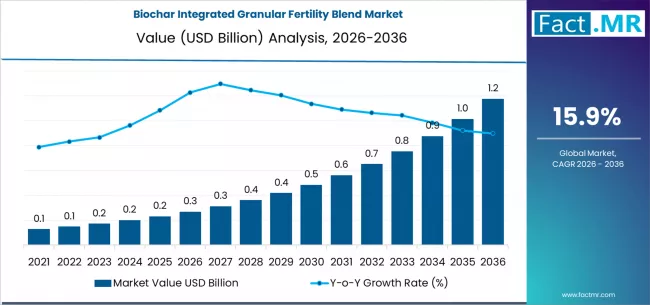
The global agriculture sector is undergoing a significant transformation as sustainability, soil health, and long-term productivity take center stage. Among the innovations driving this shift is the biochar integrated granular fertility blend—a next-generation soil amendment that combines the benefits of biochar with conventional and specialty fertilizers. This integrated approach is gaining attention for its ability to enhance nutrient efficiency, improve soil structure, and support environmentally responsible farming practices.
As growers and agribusinesses seek alternatives to input-intensive agriculture, biochar-based fertility blends are emerging as a practical solution that balances productivity with ecological stewardship.
Market Overview
Biochar integrated granular fertility blends are formulated by combining biochar—a carbon-rich material produced from biomass—with mineral or organic fertilizers in granular form. This integration allows nutrients to bind with biochar’s porous structure, improving nutrient retention and reducing losses through leaching or volatilization.
These blends are designed to deliver consistent nutrient release while simultaneously enhancing soil microbial activity and water-holding capacity. Their granular format makes them compatible with existing farm equipment, enabling easy adoption across diverse cropping systems. The market is shaped by growing awareness of regenerative agriculture, soil carbon management, and the need to reduce dependency on chemical-heavy fertilization methods.
Key Growth Drivers
Several factors are contributing to the rising adoption of biochar integrated granular fertility blends:
- Focus on soil health restoration: Degraded soils and declining organic matter levels are prompting farmers to adopt soil-building inputs that deliver long-term benefits.
- Improved nutrient use efficiency: Biochar helps retain nutrients in the root zone, reducing fertilizer waste and improving crop uptake.
- Environmental sustainability goals: Governments and agricultural organizations are encouraging practices that reduce emissions, nutrient runoff, and soil erosion.
- Compatibility with modern farming systems: Granular blends are easy to apply and integrate seamlessly into precision agriculture programs.
These drivers collectively position biochar-based fertility solutions as a bridge between conventional fertilizers and sustainable farming practices.
Regional Insights
Adoption trends vary across regions depending on agricultural practices, regulatory frameworks, and awareness levels. Developed agricultural economies are leading early adoption due to stronger emphasis on sustainable inputs and carbon-conscious farming. These regions are actively incorporating biochar-based solutions into specialty crops, horticulture, and high-value farming systems.
Emerging agricultural regions are also showing increasing interest, particularly where soil degradation and water scarcity are major challenges. As extension services and agronomic education improve, biochar integrated fertility blends are gaining recognition as tools for improving yields while preserving soil resources.
Key Trends Shaping the Market
The biochar integrated granular fertility blend market is evolving alongside broader agricultural and environmental trends:
- Regenerative agriculture adoption: Farmers are increasingly combining biochar blends with crop rotation, reduced tillage, and organic amendments.
- Customized nutrient formulations: Manufacturers are developing crop-specific blends tailored to regional soil conditions and nutrient requirements.
- Carbon farming integration: Biochar’s carbon sequestration potential aligns with emerging carbon credit and climate-smart agriculture initiatives.
- Innovation in feedstock sourcing: Sustainable biomass sourcing and advanced pyrolysis techniques are improving biochar quality and consistency.
These trends indicate a shift from one-size-fits-all fertilizers toward smarter, soil-responsive nutrient solutions.
Applications & End-Use Outlook
Biochar integrated granular fertility blends are used across a wide range of agricultural applications. Row crops benefit from improved nutrient availability and soil moisture retention, while horticulture and specialty crops leverage enhanced root development and microbial activity.
Organic and semi-organic farming systems are particularly receptive to these blends due to their natural soil-enhancing properties. Additionally, turf management, landscaping, and plantation agriculture are exploring biochar-based fertility solutions to improve soil resilience and long-term performance.
As end users increasingly prioritize soil productivity over short-term yield gains, demand is expanding beyond early adopters to mainstream farming operations.
Competitive Landscape
Market participants are focusing on product differentiation through formulation innovation, agronomic validation, and sustainability credentials. Partnerships with research institutions, agricultural cooperatives, and distribution networks play a crucial role in expanding market reach.
Companies are also investing in farmer education, demonstration trials, and technical support to highlight the long-term economic and environmental benefits of biochar-integrated fertility products. Branding strategies increasingly emphasize soil regeneration, climate resilience, and reduced environmental impact.
Challenges and Opportunities
Despite strong potential, the market faces challenges such as limited awareness among smallholder farmers and variability in biochar quality. However, these challenges are creating opportunities for standardization, certification, and technological advancements in production processes.
As regulatory support for sustainable agriculture strengthens and input optimization becomes a priority, biochar integrated granular fertility blends are well-positioned to gain wider acceptance.
Conclusion
The biochar integrated granular fertility blend market represents a meaningful step toward sustainable, efficient, and resilient agriculture. By combining nutrient delivery with soil improvement and carbon management, these blends address multiple challenges faced by modern farming systems.
As awareness grows and innovation continues, biochar-based fertility solutions are expected to play an increasingly important role in shaping the future of soil nutrition and sustainable crop production.
Browse Full Report – https://www.factmr.com/report/biochar-integrated-granular-fertility-blend-market