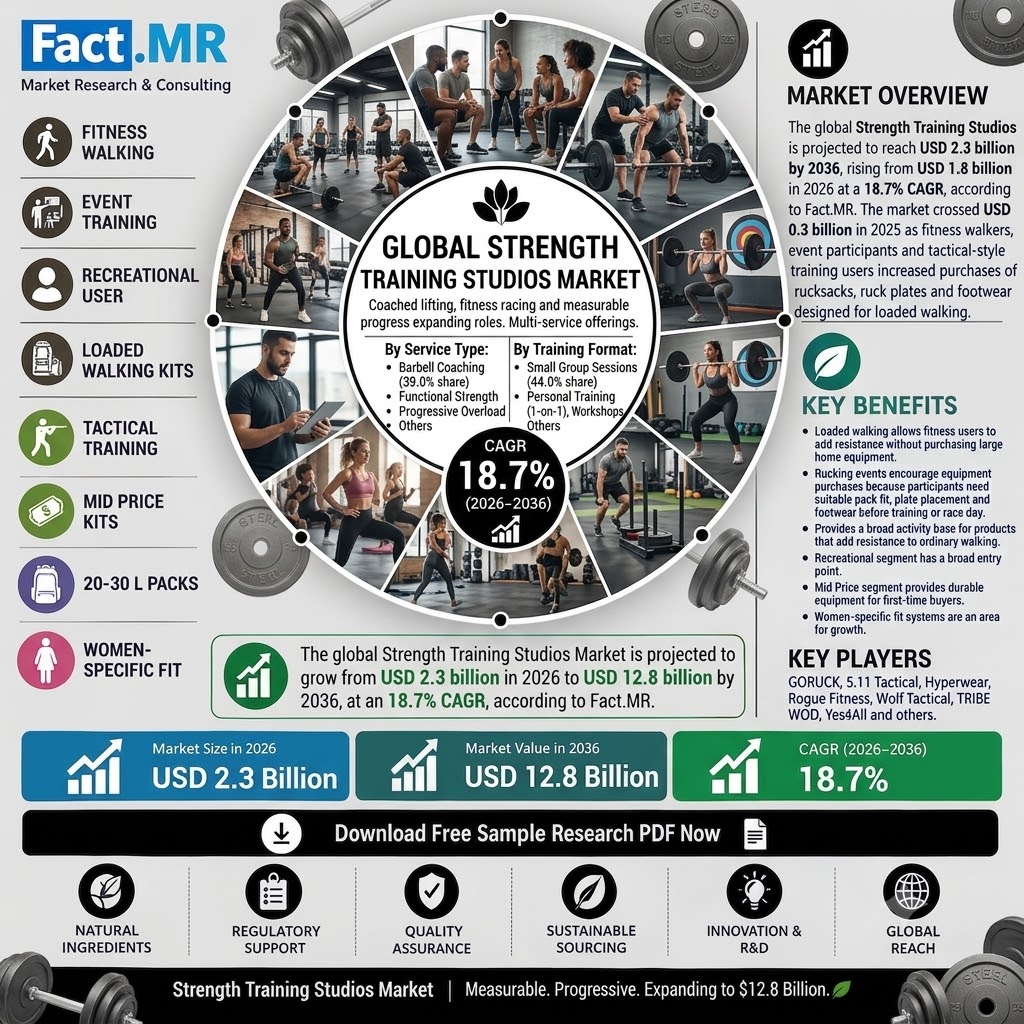
Strength Training Studios Market is projected to grow from USD 2.3 billion in 2026 to USD 12.8 billion by 2036, registering an 18.7% CAGR.
September 29, 2026 — The strength training studios market is projected to reach USD 12.8 billion by 2036, rising from USD 2.3 billion in 2026 at an 18.7% CAGR, according to Fact.MR analysis. The market crossed USD 1.9 billion in 2025, with coached lifting, fitness racing and measurable strength programs expanding their role within paid fitness.
The market represents boutique studios where coached barbell, functional strength and progressive-overload programs form the core paid offering. Demand is being shaped by members seeking measurable progress, coach correction and planned load increases rather than general gym access.
Get detailed market forecasts, competitive benchmarking, and pricing trends: https://www.factmr.com/connectus/sample?flag=S&rep_id=15329
Fact block: Fact.MR is a market research and consulting company that provides market intelligence, forecasts and competitive analysis across industries.
Strength Training Studios Market Gains From Measurable Progress
The market presents an estimated USD 10.5 billion absolute opportunity by 2036. Individual Members are expected to account for 56.0% share in 2026, while Monthly Memberships are projected to hold 52.0%. App Booking is estimated at 47.0%, and Small Group Sessions are forecast to represent 44.0% of the market.
Members increasingly pay for progression. Studio models can show load history, attendance and training targets through app-based systems, giving customers a clearer record of their development.
Fitness racing adds another use case. Sleds, carries and mixed strength blocks can be incorporated into structured preparation programs, while women-focused formats broaden access for members who prefer coached rooms over open gym floors. Older adults are also using strength training for mobility, balance and daily function.
The category remains closely connected to the broader fitness industry, but its commercial model is distinct. Individual memberships remain the principal customer base, while monthly memberships provide recurring receipts for coaches, leases and software.
India Records the Fastest Country Growth
India is projected to record a 23.0% CAGR through 2036, followed by Australia at 20.4% and the United States at 19.6%. The United Kingdom, Canada, Germany and Japan are forecast to grow at 18.9%, 17.8%, 17.2% and 16.6%, respectively.
India’s growth is linked to low paid-fitness penetration and new center additions. The Health and Fitness Association and Deloitte India estimated 12.3 million fitness facility members in 2024, providing a measurable base for further commercial fitness development.
Australia is forecast to expand at 20.4% CAGR. The Australian Sports Commission reported that 85.0% of adults were active in its 2025 participation review, supporting demand for coached private fitness formats.
The United States is expected to advance at 19.6% CAGR. The Office of Disease Prevention and Health Promotion reported that 32.9% of adults performed muscle-strengthening activity on two or more days each week in 2024.
The United Kingdom follows at 18.9% CAGR, while Canada is projected at 17.8%. Germany and Japan are forecast at 17.2% and 16.6%, respectively.
Coaching Quality Shapes Studio Economics
Shambhu Nath Jha, Principal Analyst at Fact.MR, said, “I see strength studios winning when they make progress simple to understand. A member should know what was lifted, why it changed and what the next session is meant to improve.”
Barbell Coaching is expected to hold 39.0% share in 2026, reflecting the importance of technique correction and planned programming. Micro Studios are projected to account for 41.0%, with compact locations helping operators manage lease exposure in dense urban areas.
The research also identifies a practical constraint: qualified trainer availability. Strength studios require enough coaching capacity to keep sessions safe and personal, while rent remains a consideration because these facilities require load-bearing floors, movement space and durable equipment.
For studio operators, coaching quality can be priced separately from gym access. Franchise systems also require trainer certification, programming standards and equipment specifications before rapid site expansion.
Competition Extends Beyond Studio Count
Ultimate Performance, F45 Training and Body Fit Training are identified as key players, while Barry’s, Life Time Group Holdings, MADabolic and HYROX are also profiled.
Ultimate Performance operates from a premium personal training position focused on measurable transformation and coach accountability. F45 Training uses repeatable group programming, while Body Fit Training provides a strength and conditioning format with repeatable group sessions.
A specific market development involves F45 Training’s global gym partnership with HYROX, extended across 12 events in 2026. The development provides studios with a calendar-based route for race-preparation programs.
Fact.MR’s analysis reviewed 120+ sources, 55+ company or association pages, 30+ countries and 22+ expert interviews. The methodology combined primary interviews, desk research, provider counts, revenue-per-studio assumptions, membership prices and site rollout plans.
Top Trending Reports :
- Sports Nutrition and Dietary Supplements Testing and Certification Market
- Golf Simulator Lounges Market
About Fact.MR
Fact.MR is a market research and consulting company providing market intelligence, industry analysis, market sizing and forecasts. The strength training studios study covers service type, training format, customer type, revenue model, studio size, booking channel, end use and regional markets across the 2026–2036 forecast period.