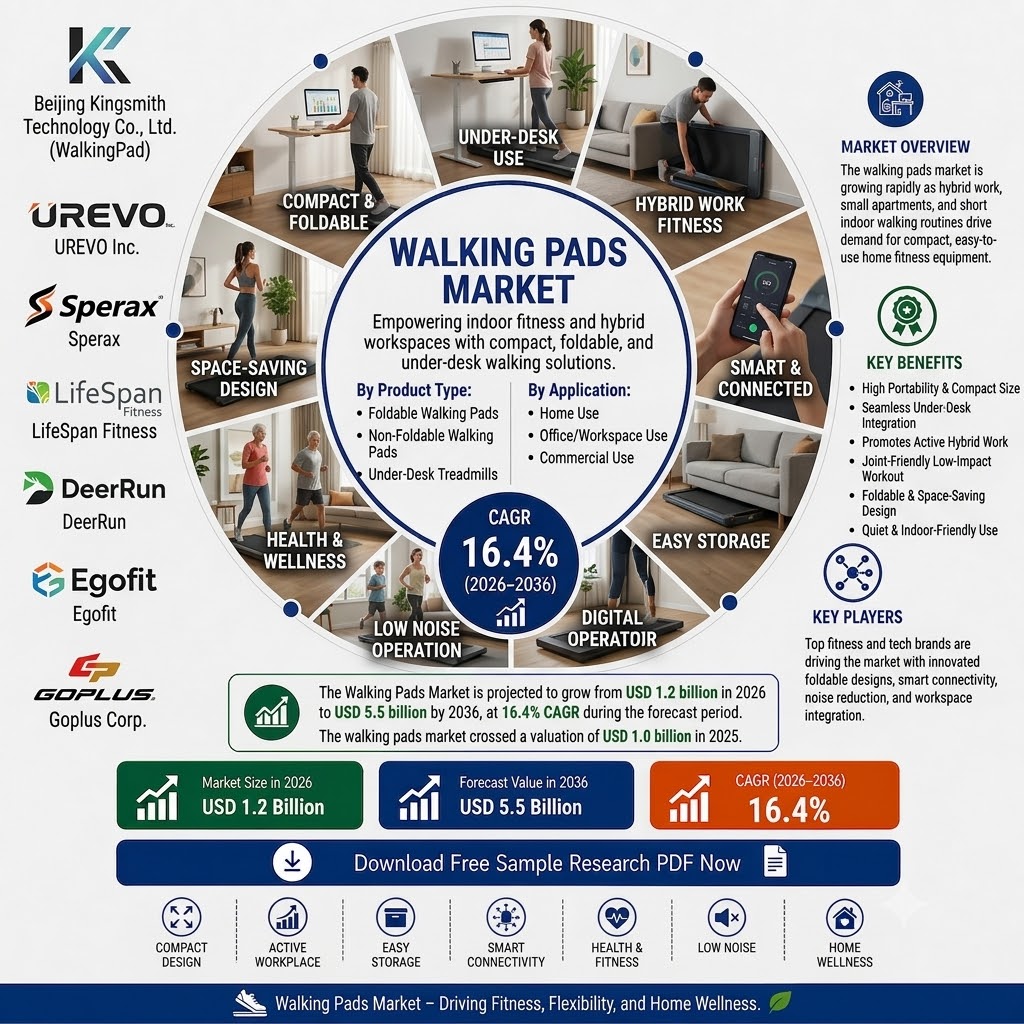
Walking pads Market are moving from niche home-fitness products into everyday work and wellness routines. The market is valued at USD 1.2 billion in 2026 and is forecast to reach USD 5.5 billion by 2036, expanding at a 16.4% CAGR during the period. The market crossed USD 1.0 billion in 2025, creating a USD 4.3 billion absolute opportunity through 2036. Hybrid work, smaller homes, and demand for convenient indoor movement are reshaping how consumers approach compact exercise equipment.
A key demand driver is the need to add movement without interrupting desk-based work. Hybrid workers can use compact walking units beside a desk, while apartment residents benefit from equipment that requires less floor and storage space than conventional treadmills. Employer wellness teams are also testing low-noise walking units alongside standing desks and workplace wellness areas. The World Health Organization reported in June 2024 that 31.0% of adults were not sufficiently active, reinforcing the need for practical ways to incorporate movement into daily routines.
Get detailed market forecasts, competitive benchmarking, and pricing trends
Under-Desk Folding Models Shape Product Demand
Under-Desk Folding models are projected to account for 43.0% of the walking pads market in 2026. Their appeal comes from simple storage, particularly in homes where equipment needs to be placed beneath furniture or moved after working hours. Walking-Only models are expected to hold a 55.0% share, reflecting the fact that most under-desk use requires steady, low-speed movement rather than running capability.
Home Office applications are expected to contribute 46.0% of revenue in 2026, making this the leading application segment. Walking pads fit naturally into remote and hybrid work environments, allowing users to combine short walking sessions with screen-based tasks. Individual Consumers are estimated to hold 58.0% share, as most units are purchased for personal use in apartments and home offices.
Product design is increasingly influenced by noise, storage, and reliability. Quiet DC Motors are forecast to hold 64.0% share in 2026 because users working during calls or living in shared spaces need quieter equipment. Online Retail is expected to account for 62.0% of sales, supported by consumers comparing product dimensions, reviews, pricing, and delivery options before purchasing. Mid Price units are also expected to lead their category with a 47.0% share as buyers seek better motors and warranty support without paying for full-size treadmill features.
China Leads Country-Level Growth
China is projected to register the fastest country-level growth, with a 19.4% CAGR through 2036. Manufacturing scale and deep online retail penetration support rapid product availability and model turnover. The United Kingdom follows with a projected 17.6% CAGR, supported by hybrid working patterns and the need for compact equipment in smaller homes. Germany is expected to expand at a 15.8% CAGR, adding another important European growth market as compact indoor fitness products gain relevance.
The broader country analysis also identifies the United States at an 18.1% CAGR, Australia at 17.2%, Canada at 16.8%, and Japan at 16.3% through 2036. The United States benefits from a large desk-worker base and established direct-to-consumer fitness distribution. Australia is supported by continued home-working activity, while Canada presents opportunities linked to telework and daily movement. Japan’s compact-home environment creates another use case for equipment designed around limited space.
Safety and Product Quality Become Buying Factors
The opportunity is accompanied by greater scrutiny of product safety, durability, and after-sales support. Fact.MR notes that warranty coverage, motor control, belt stability, load ratings, and clear maintenance guidance are becoming more important as buyers and corporate wellness teams evaluate walking pads. In April 2026, the United States Consumer Product Safety Commission warned consumers to stop using certain Sperax walking pads and treadmills because of reported fall, burn, and fire hazards. The development places additional emphasis on product documentation and supplier accountability.
Shambhu Nath Jha, Principal Analyst at Fact.MR, observes, “Walking pads sell when they remove friction from exercise.” He also points to buyer concerns around call-friendly noise levels, storage thickness, and continued safe use, highlighting the practical considerations influencing purchase decisions.
Home-office bundles, employer wellness programs, and quiet apartment equipment represent notable opportunity areas. Brands can pair walking pads with standing desks and workplace accessories, while corporate buyers can evaluate noise, trip-risk controls, maintenance requirements, and warranty service before making larger purchases. Suppliers that provide replacement remotes, spare belts, and clear maintenance instructions can also add value after the initial sale.
Competitive Landscape
The competitive landscape includes Beijing Kingsmith Technology Co., Ltd. through its WalkingPad brand, UREVO Inc., Sperax, LifeSpan Fitness, DeerRun, Egofit, and Goplus Corp. WalkingPad focuses on compact and foldable designs, while UREVO competes through office-oriented models and additional functionality. LifeSpan Fitness provides a workplace-oriented route through treadmill-desk equipment, while other brands compete across price, dimensions, online visibility, and product features.
As hybrid work and compact-home fitness continue to influence purchasing behavior, walking pads are positioned around convenience rather than conventional treadmill training. The full Fact.MR report provides detailed analysis of product types, applications, buyer groups, sales channels, motor technologies, pricing, country markets, and competitive positioning from 2026 to 2036.
To View Top Reports
About Fact.MR
Fact.MR is a market research and consulting company providing market intelligence, competitive analysis, and forecasting across global industries. Its research combines secondary research, primary insights, company analysis, and market validation to help businesses evaluate emerging opportunities and changing industry dynamics.