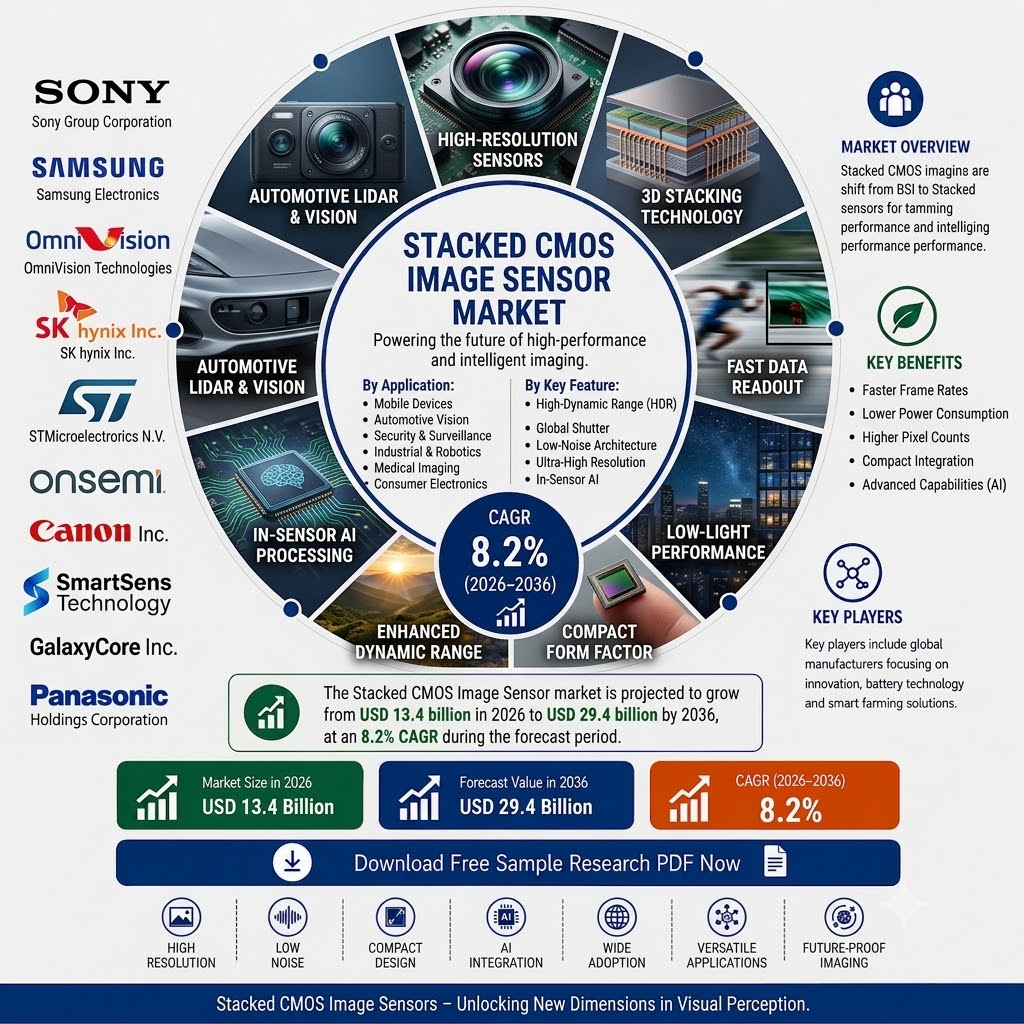
The global stacked CMOS image sensor market is estimated at USD 13.4 billion in 2026 and is projected to reach USD 29.4 billion by 2036, expanding at a compound annual growth rate (CAGR) of 8.2% during the forecast period, according to Fact.MR. Market expansion is being supported by demand for faster image processing, high-resolution computational photography, and advanced camera systems across consumer electronics, automotive, and industrial applications.
Stacked CMOS image sensors use vertically integrated pixel and logic layers to improve image processing capabilities within compact devices. This architecture supports high-speed readouts, improved dynamic range, and advanced imaging functions. As manufacturers develop more capable camera systems, stacked sensor designs are becoming increasingly relevant to next-generation electronic products.
Get detailed market forecasts, competitive benchmarking, and pricing trends
Market Drivers and Emerging Trends
The growing use of multi-camera configurations in smartphones is a major source of demand. Premium mobile devices increasingly rely on multiple camera modules for wide-angle photography, telephoto imaging, high-resolution video, and computational photography. Stacked sensors support faster readout speeds required for real-time image processing, high-frame-rate video, and high dynamic range imaging.
Automotive applications are creating another growth avenue. Advanced driver assistance systems (ADAS) and autonomous driving technologies require cameras capable of operating across changing light conditions. High dynamic range imaging, LED flicker mitigation, and low-light recognition are important capabilities for forward-facing cameras and driver monitoring systems.
Industrial automation is also expanding the addressable market. Robots and automated inspection systems require high-speed imaging to identify defects, guide movement, and support production-line safety. The adoption of machine vision technologies is encouraging manufacturers to invest in sensors with global-shutter capabilities and faster processing.
Emerging opportunities include two-layer transistor pixel architectures, neuromorphic event-based vision sensors, short-wave infrared integration, and direct-bonded SPAD arrays. These developments could extend stacked sensor applications beyond conventional photography into advanced depth sensing and low-latency machine vision. However, complex wafer bonding, manufacturing costs, and thermal management remain important challenges.
Segmental Analysis
CMOS image sensors account for 68.4% of the technology segment in 2026. Their lower power consumption, integration density, and parallel readout capabilities support widespread adoption across consumer and industrial imaging systems. Stacked architectures further separate pixel arrays from digital processing logic, allowing manufacturers to optimize different layers for specific functions.
Consumer electronics represents the leading application segment, accounting for 41.2% of market demand in 2026. Smartphone camera upgrades, multi-sensor configurations, and demand for computational photography are supporting its position. Automotive and industrial applications are also gaining importance as camera-based sensing becomes more widely integrated into vehicle safety systems and automated production environments.
Regional Growth Outlook
The United Kingdom is projected to record the fastest country-level growth, with a CAGR of 9.5% through 2036. Investment in photonics research, semiconductor design capabilities, and autonomous vehicle testing is supporting demand for advanced imaging technologies.
The United States is expected to expand at 8.3% CAGR, driven by smartphone development, automotive safety systems, and investment in semiconductor manufacturing and advanced packaging. Brazil follows with an anticipated CAGR of 6.8%, supported by electronics assembly and industrial automation.
Germany is projected to grow at 6.2%, reflecting demand from automotive engineering and machine vision applications. Japan is expected to register a CAGR of 5.9%, supported by its established image sensor industry and industrial robotics ecosystem.
Analyst Perspective
Shambhu Nath Jha, Principal Consultant at Fact.MR, states, “The stacked CMOS image sensor industry is undergoing a structural paradigm shift driven by the separation of photodiodes and pixel transistors into dual-layer stacked architectures. In conventional BSI sensors, the photodiode and the control pixel transistors share the same silicon substrate layer, forcing compromise between light-gathering surface area and saturation signal capacity.”
He further explains that advances in two-layer transistor pixel technology separate the photodiode from the transfer gates and reset transistors, creating opportunities to improve saturation signal capacity and extend dynamic range beyond 120 decibels.
Competitive Landscape
The stacked CMOS image sensor market is shaped by semiconductor manufacturers with specialized imaging technologies, advanced fabrication capabilities, and established relationships with consumer electronics and automotive customers. Competition centers on pixel miniaturization, high dynamic range, low-light performance, power efficiency, and wafer-bonding capabilities.
Key players profiled by Fact.MR include Sony Group Corporation, Samsung Electronics, OmniVision Technologies, SK hynix Inc., STMicroelectronics N.V., onsemi, Canon Inc., SmartSens Technology, GalaxyCore Inc., and Panasonic Holdings Corporation.
These companies are competing to improve sensor performance while managing the manufacturing complexity associated with vertically stacked architectures. Investment in proprietary pixel designs, advanced packaging, and customer-specific sensor integration will remain important to strengthening market positions.
Market Snapshot
- Market value (2026): USD 13.4 billion
- Forecast value (2036): USD 29.4 billion
- CAGR (2026–2036): 8.2%
- Leading technology: CMOS image sensors (68.4%)
- Leading application: Consumer electronics (41.2%)
- Fastest-growing country: United Kingdom (9.5% CAGR)
To View Related Reports
About Fact.MR
Fact.MR is a market research and competitive intelligence provider delivering market intelligence, competitive analysis, and forecasting across global industries. Its research helps businesses evaluate market demand, understand competitive developments, and identify growth opportunities.