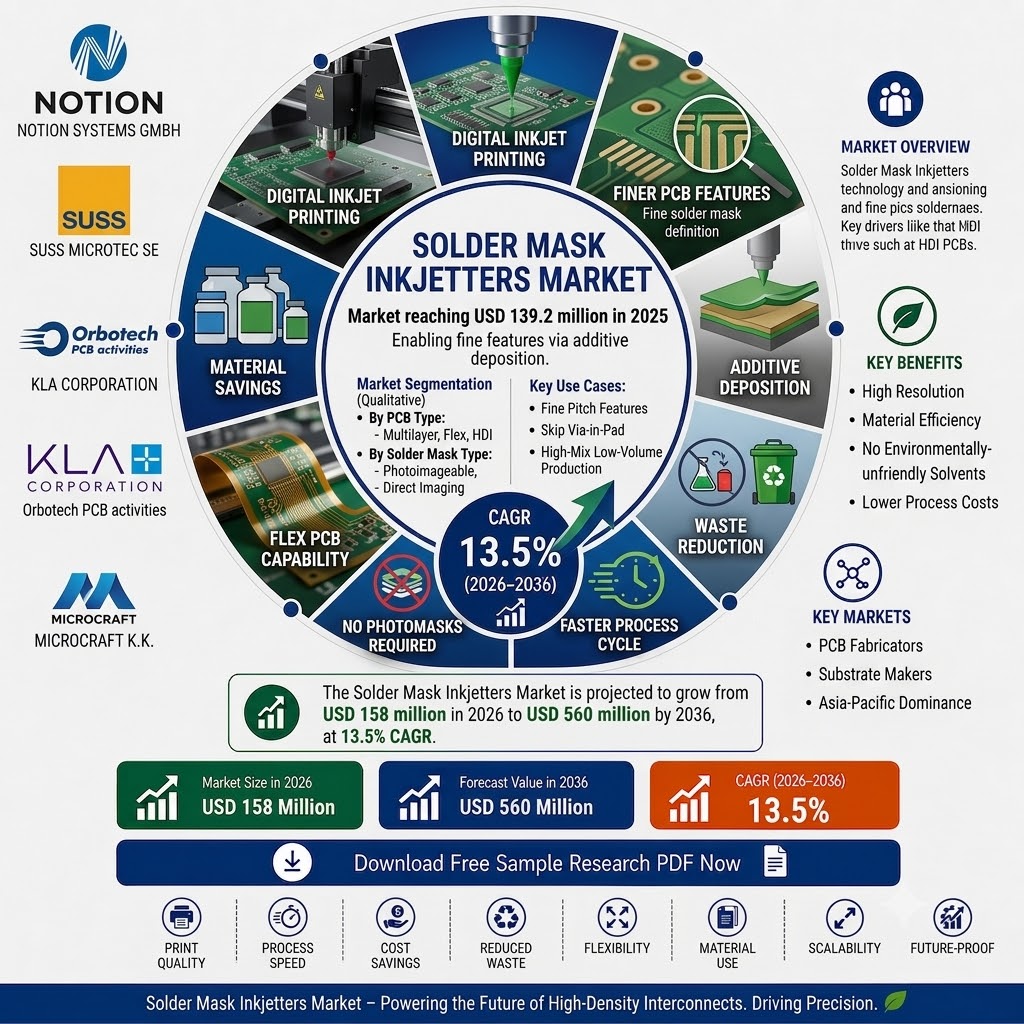
The Solder Mask Inkjetters Market is projected to increase from USD 158 million in 2026 to USD 560 million by 2036, advancing at a 13.5% CAGR as PCB fabricators and substrate makers qualify digital solder-mask deposition for finer board features. The market reached USD 139.2 million in 2025.
The forecast represents an absolute opportunity of USD 402 million through 2036. Demand is being shaped by higher routing density across HDI boards and IC substrates, where registration errors, mask bleed and rework can affect production economics. Semiconductor sales provide a wider industry backdrop, with the Semiconductor Industry Association reporting global semiconductor sales of USD 791.7 billion in 2025.
Get detailed market forecasts, competitive benchmarking, and pricing trends
High-resolution printing leads the market
High-resolution substrate printers are projected to account for 39.0% of the market in 2026. These systems address fine-pitch pads, package substrates and HDI boards that require controlled droplet placement across [LINK: glass-reinforced substrates].
UV-curable acrylate is expected to hold 46.0% share in 2026. Inline curing supports coating control after digital deposition, while SUSS MicroTec and Epson announced in February 2025 that Epson PrecisionCore printhead technology would be integrated into the SUSS LP50 for functional-material inkjet applications.
HDI boards are forecast to capture 33.0% share in 2026. Increasing via density raises the need for accurate selective coating around lines, pads and vias. PCB fabricators are expected to represent 48.0% of end-user demand, reflecting their direct control over process settings, production records and qualification budgets.
Fact.MR is a market research company that provides market intelligence, forecasts and strategic analysis across industries and technologies.
The market’s operational focus is clear. Equipment suppliers need to demonstrate registration accuracy, nozzle health, warpage correction and manufacturing execution system connectivity. Ink suppliers must also match viscosity, curing windows and adhesion performance with named printer platforms.
Shambhu Nath Jha, Principal Consultant at Fact.MR, states, “Solder-mask inkjetters are judged first by registration control and coating evidence. The market is expected to reward tools that combine clean droplet placement, ink compatibility and repeatable curing over long production runs.”
He adds, “Suppliers that document warpage correction, nozzle health and MES connection are better placed for substrate and HDI board accounts.”
Digital processing changes qualification economics
Prototype houses can revise CAM data without preparing new screens, films or photo tools. That makes digital deposition particularly relevant to engineering teams handling frequent design changes or smaller production lots.
Automotive electronics suppliers also require repeatable coating and traceability for control boards. Digital solder-mask records can support applications where [LINK: automotive printed circuit boards] must pass long validation cycles.
The market is not free from constraints. Qualification cycles remain a major consideration because solder mask affects insulation and solderability. Fabricators must evaluate adhesion, cure depth and registration before moving new equipment into volume production.
Capital requirements also influence purchasing decisions. Existing exposure and coating lines remain serviceable for many conventional board applications. IPC reported in January 2025 that 52% of surveyed electronics manufacturers faced rising labor costs, while 51% faced rising material costs.
Asia-Pacific markets show strong forecast growth
China is projected to record a 15.34% CAGR from 2026 to 2036. Germany follows at 15.02%, while Taiwan is forecast at 14.97%. The USA, Japan and South Korea are projected to register CAGRs of 14.96%, 14.95% and 14.88%, respectively.
China’s electronics manufacturing depth supports equipment qualification. The State Council reported in May 2025 that China targets a numerical-control rate above 85% in key production processes of major electronic information manufacturing enterprises by 2027. MIIT reported that integrated-circuit output reached 484.3 billion units in 2025, up 10.9% year over year.
Taiwan’s manufacturing base also supports demand. The Ministry of Finance reported that total Taiwanese exports increased 34.9% in 2025, while the Ministry of Economic Affairs reported electronics component production growth of 24.71%.
South Korea’s ICT exports reached USD 264.3 billion in 2025, up 12.4%, according to figures reported by the Ministry of Trade, Industry and Resources and Ministry of Science and ICT in January 2026. Semiconductor exports increased 22.1% during the year.
Germany’s electrical and digital industry exports reached around EUR 257.5 billion in 2025, according to Germany Trade & Invest. The country is expected to see inkjet adoption concentrated among dense boards and regulated industrial electronics where production documentation supports qualification.
Equipment suppliers focus on digital deposition
Notion Systems GmbH, SUSS MicroTec SE, KLA Corporation, including Orbotech PCB activities, and MicroCraft K.K. are among the companies profiled in the market assessment.
Notion Systems demonstrated multicolor solder-mask printing on a PCB in March 2025 using its n.jet soldermask system. KLA participates through Orbotech additive printing technologies for solder mask and IC packaging applications.
MicroCraft’s CraftPix range covers on-demand industrial inkjet applications involving legend, solder resist and etch-resist workflows. MicroCraft updated CraftPix series information in June 2025.
Competition is expected to center on registration accuracy, uptime, ink compatibility and service response. Printer speed alone does not determine qualification for high-density applications.
Market outlook
The Solder Mask Inkjetters Market is expected to benefit from HDI and IC-substrate density requirements, digital process-step reduction, UV-curable ink compatibility and demand for faster prototype changeovers. High-resolution substrate printers represent a particularly relevant opportunity across China, Taiwan, South Korea and Japan.
The market also faces qualification delays, capital intensity and printhead, viscosity and curing controls. Equipment and ink suppliers that provide process documentation alongside machine performance can address several of these requirements during customer evaluations.
To View Top Reports
High-Temperature Brake Line Couplings Market
Bladder Cancer Immunotherapy Market
About Fact.MR
Fact.MR is a market research and consulting firm providing market intelligence, forecasts and strategic analysis across technology, chemicals, healthcare, industrial and consumer markets. Its research combines primary interviews, secondary research, company analysis and quantitative market assessment to support business and investment decisions.