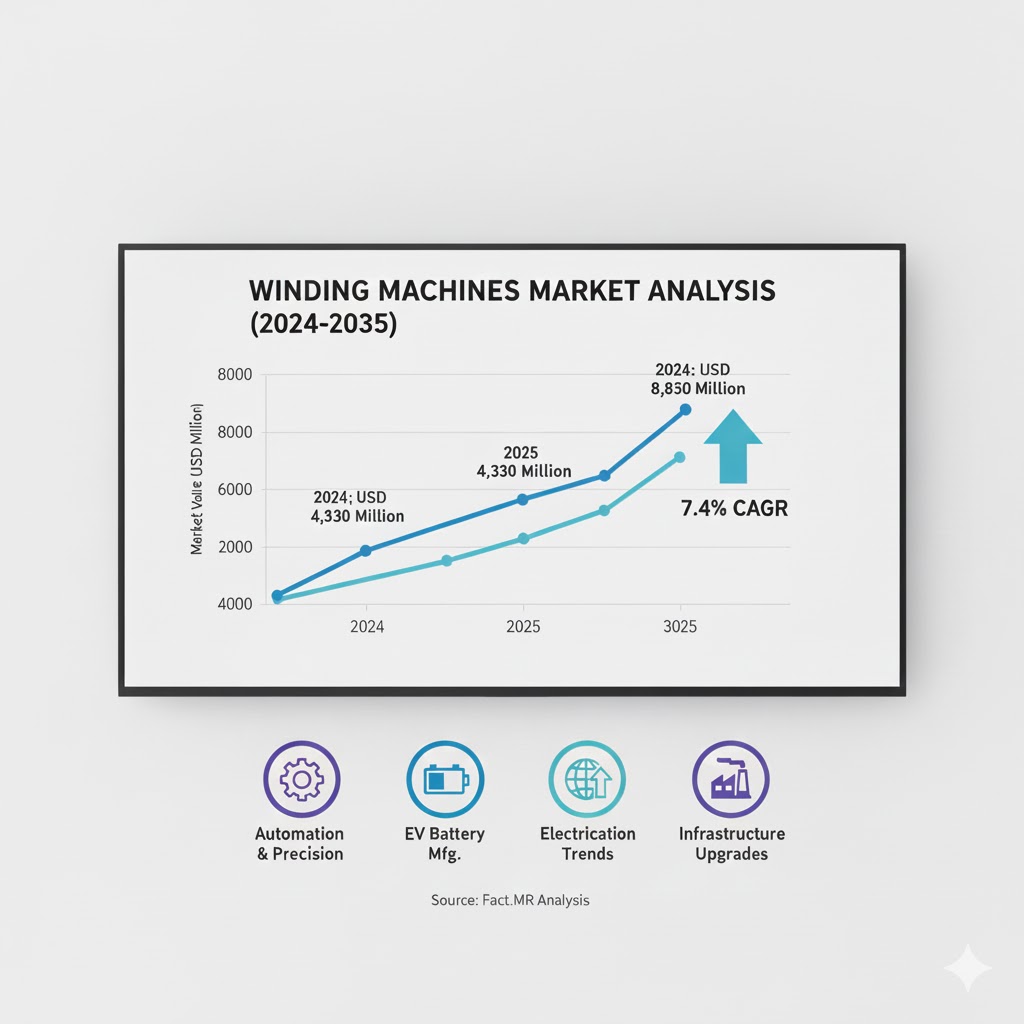
The global winding machines market is projected to witness substantial growth over the next five years, fueled by increasing industrial automation, advancements in manufacturing technology, and growing demand from the electronics, automotive, and energy sectors. According to the latest market research, the market is expected to reach USD 12.8 billion by 2030, growing at a compound annual growth rate (CAGR) of 6.2% from 2025 to 2030.
Winding machines, essential in the manufacturing of wires, cables, and coils, are witnessing transformative adoption due to their critical role in enhancing production efficiency, reducing material wastage, and supporting high-precision manufacturing. The surge in electric vehicle (EV) production, expansion of renewable energy projects, and increasing deployment of smart manufacturing solutions are key factors driving market demand.
Data-Driven Insights Highlight Market Trends
Market intelligence reports indicate that automated winding machines now account for nearly 58% of total market revenue, up from 45% in 2020, reflecting the accelerated shift toward Industry 4.0-enabled manufacturing processes. Manufacturers are increasingly investing in CNC-based winding machines and servo-driven systems that offer high precision, real-time monitoring, and reduced downtime.
The electronics sector, which includes consumer electronics, transformers, and electric motors, represents the largest end-user segment, accounting for approximately 42% of global market share. Rapid adoption of high-speed communication infrastructure, such as 5G networks, has led to increased demand for precision-wound cables and coils.
In addition, the energy sector—including wind turbines, solar panels, and power generation equipment—is emerging as a key driver for specialized winding machines. Analysts predict that demand for high-capacity winding machines will grow at a CAGR of 7.1% from 2025 to 2030, particularly in Europe and Asia-Pacific regions, driven by ambitious renewable energy targets.
Regional Market Dynamics
Asia-Pacific remains the largest market for winding machines, contributing over 48% of global revenue in 2024, primarily due to rapid industrialization in China, India, and Japan. The region’s thriving electronics manufacturing ecosystem, combined with government incentives for automation and energy-efficient production, is expected to sustain strong demand.
North America and Europe, accounting for 28% and 20% of the market respectively, are seeing growth driven by retrofitting existing facilities with advanced winding machines and increasing adoption in EV and renewable energy manufacturing. The U.S. market alone is projected to grow at 5.4% CAGR, driven by rising domestic EV production and industrial automation initiatives.
Technology Innovations Driving Market Expansion
The winding machines market is experiencing rapid technological evolution. Modern machines now integrate IoT-enabled sensors, predictive maintenance algorithms, and AI-driven process optimization. These innovations reduce operational costs, enhance output quality, and allow manufacturers to scale production efficiently.
Moreover, the integration of robotic automation and machine learning in winding operations is expected to reduce manual intervention by up to 35% by 2027, enhancing workforce efficiency and safety. Industry experts highlight that companies adopting smart winding solutions report up to 15% higher production throughput compared to conventional systems.
Market Challenges and Opportunities
Despite promising growth, the market faces challenges, including high capital expenditure for advanced machines and ongoing supply chain disruptions affecting raw materials. However, market players are leveraging leasing models, pay-per-use schemes, and government incentives to mitigate investment barriers, opening new opportunities for small and medium-sized manufacturers.
The rise of customized winding solutions, particularly for niche sectors like aerospace and medical devices, is presenting new avenues for innovation and market differentiation. Analysts forecast that demand for compact, high-precision winding machines in these specialized industries will grow at 8.3% CAGR, outpacing traditional industrial segments.
Leading Market Players and Competitive Landscape
The winding machines market is characterized by the presence of established global players such as Siemens AG, Santec Corporation, AMETEK, Inc., and Wafios AG, who continue to invest in R&D and strategic collaborations. These companies are focusing on developing energy-efficient, high-speed, and low-maintenance solutions to meet evolving industry demands.
Strategic partnerships and mergers are also shaping the competitive landscape. In 2024, several manufacturers announced collaborations to integrate smart automation technologies, reinforcing the trend toward intelligent manufacturing systems.
Browse Full Report : https://www.factmr.com/report/2634/winding-machines-market
Conclusion
With the convergence of technological advancements, increased industrial automation, and growing demand from electronics and renewable energy sectors, the global winding machines market is poised for sustainable growth. Industry analysts emphasize that innovation-driven differentiation and strategic market expansion will define winners in the competitive landscape over the next decade.
For manufacturers, investors, and industrial stakeholders, the market offers robust opportunities to capitalize on the growing demand for precision winding, energy efficiency, and smart automation, driving global manufacturing toward a more advanced and sustainable future.