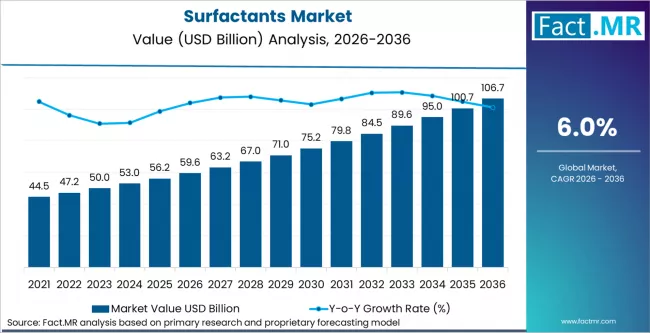
According to Fact.MR’s latest analysis, the global surfactants market is valued at approximately USD 45 billion in 2025, projected to reach USD 47.5 billion in 2026, and expand to USD 68 billion by 2035. The market is expected to grow at a CAGR of 4.0%, creating an incremental opportunity of USD 23 billion.
Germany, as Europe’s largest chemical hub, plays a pivotal role in this growth, with a projected CAGR of 4.3%, slightly above the global average. The market is undergoing transformation due to rising demand for eco-friendly surfactants, regulatory pressure on chemical usage, and innovation in bio-based alternatives.
Quick Stats (Germany Focus)
- Market Size (2025): ~USD 4.2 Billion
- Market Size (2026): ~USD 4.4 Billion
- Forecast Value (2035): ~USD 6.7 Billion
- CAGR (2025–2035): 4.3%
- Incremental Opportunity: ~USD 2.5 Billion
- Leading Segment: Anionic Surfactants
- Leading Country (Europe): Germany
- Key Players: BASF, Evonik Industries, Clariant, Henkel, Croda International
Executive Insight for Decision Makers
Germany’s surfactants market is shifting from volume-driven production to sustainability-led innovation.
- Manufacturers must accelerate investments in bio-based and biodegradable surfactants
- OEMs and industrial buyers are prioritizing low-toxicity and high-performance formulations
- Investors should focus on companies aligned with EU Green Deal and REACH compliance
Risk of inaction: Loss of market share due to regulatory non-compliance and shifting customer preferences toward green chemistry.
Market Dynamics
Key Growth Drivers
- Strong demand from home care and personal care industries
- Expansion of industrial and institutional cleaning sectors
- Increasing adoption of green and bio-based surfactants
- Germany’s leadership in chemical R&D and innovation
Key Restraints
- Volatility in raw material prices (petrochemicals, oleochemicals)
- Stringent EU environmental regulations
- High cost of bio-based surfactant production
Emerging Trends
- Rapid shift toward sulfate-free and eco-friendly formulations
- Growth of plant-based surfactants
- Integration of circular economy principles
- Increased use in pharmaceutical and agrochemical applications
Segment Analysis
- Leading Segment: Anionic Surfactants (~50% share in Germany)
- Fastest-Growing Segment: Non-ionic and bio-based surfactants
Breakdown
- Product Type: Anionic, non-ionic, cationic, amphoteric
- Application: Home care, personal care, industrial cleaning, agriculture
- End-use: FMCG, chemicals, pharmaceuticals, textiles
Strategic Importance:
Anionic surfactants dominate due to cost efficiency and widespread use, while bio-based and non-ionic surfactants are gaining traction due to environmental compliance and premium positioning.
Supply Chain Analysis (Critical Insight)
Value Chain Structure
- Raw Material Suppliers
- Petrochemical derivatives (ethylene, benzene)
- Natural oils (palm oil, coconut oil)
- Manufacturers / Producers
- Chemical companies producing surfactants and intermediates
- Distributors
- Chemical distributors, specialty chemical suppliers
- End-Users
- FMCG companies, industrial cleaning firms, personal care brands
Who Supplies Whom
- Petrochemical & oleochemical suppliers → Chemical manufacturers → Distributors → FMCG & industrial users
Insight:
Germany’s supply chain is highly integrated and innovation-driven, with strong backward integration by major chemical companies and increasing reliance on sustainable feedstocks.
Pricing Trends
- Market operates on a mixed pricing model:
- Commodity pricing for basic surfactants
- Premium pricing for specialty and bio-based variants
Key Influencing Factors
- Raw material costs (oil-based vs plant-based inputs)
- Regulatory compliance costs
- Demand from FMCG and industrial sectors
Margin Insight:
- Higher margins in specialty and green surfactants
- Lower margins in bulk commodity surfactants
Regional Analysis
Top 5 Countries by Growth
- Germany (CAGR ~4.3%) – Innovation and chemical leadership
- France (CAGR ~3.9%) – Strong cosmetics industry
- UK (CAGR ~3.8%) – Growing demand in cleaning products
- Italy (CAGR ~3.7%) – Textile and industrial use
- Poland (CAGR ~4.1%) – Emerging manufacturing base
Insights
- Germany: Leading due to advanced chemical ecosystem
- Western Europe: Mature but innovation-driven
- Eastern Europe: Cost-driven growth and manufacturing expansion
Developed vs Emerging
- Developed markets: Sustainability and compliance-driven
- Emerging markets: Cost and volume-driven demand
Competitive Landscape
- Market is moderately consolidated in Germany
- Key players:
- BASF
- Evonik Industries
- Clariant
- Henkel
- Croda International
- Solvay
- Kao Corporation
Strategies
- Investment in green chemistry and bio-based products
- Expansion of R&D capabilities
- Strategic collaborations with FMCG companies
- Focus on high-performance specialty surfactants
Strategic Takeaways
For Manufacturers
- Prioritize bio-based innovation and regulatory compliance
- Strengthen local production and supply chain resilience
For Investors
- Focus on companies leading in sustainable surfactant technologies
- Target firms with strong European market presence
For Marketers / Distributors
- Highlight eco-friendly and performance benefits
- Build partnerships with FMCG and industrial clients
Future Outlook
Germany is expected to remain a center of excellence for surfactant innovation in Europe.
- Rising adoption of green chemistry solutions
- Increased investment in biotechnology-based surfactants
- Alignment with EU sustainability and carbon neutrality goals
Long-term Opportunity:
Development of next-generation surfactants that combine performance, safety, and sustainability
Conclusion
The surfactants market in Germany is transitioning toward a high-value, sustainability-driven ecosystem.
Stakeholders who invest in innovation, regulatory alignment, and eco-friendly solutions will gain a strong competitive edge in both domestic and global markets.
Why This Market Matters
- Essential for everyday consumer and industrial products
- Critical to advancing sustainable chemical practices
- Key enabler of Europe’s green transition strategy