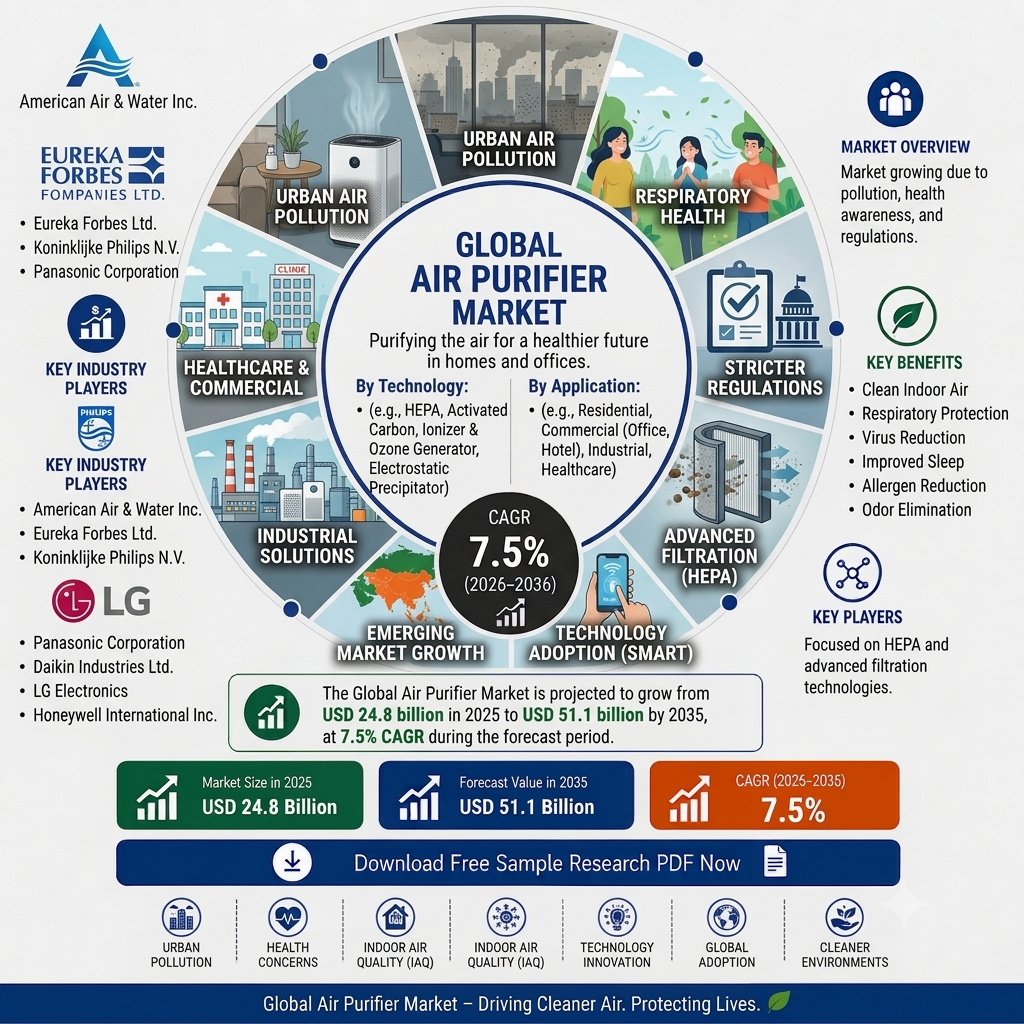
The global air purifier market is projected to grow from USD 24.8 billion in 2025 to USD 51.1 billion by 2035, expanding at a 7.5% CAGR from 2025 to 2035, according to Fact.MR. Rising urban air pollution, greater awareness of respiratory health, and stricter indoor air quality regulations are supporting demand across residential, healthcare, hospitality, education, and office environments.
The market is also being shaped by smart technologies, including IoT-enabled air quality monitoring, app-based controls, energy-efficient operation, and connected purification systems. As consumers and organizations place greater emphasis on healthier indoor environments, manufacturers are developing products that combine high-efficiency filtration with convenience and lower energy consumption.
Request full Report Pricing and sample Report
Air Purifier Market Outlook
Air pollution in densely populated urban centers across Asia and the Middle East remains a major demand catalyst. Growing concern over airborne pollutants and respiratory conditions is encouraging households and institutions to adopt advanced purification systems.
Government initiatives such as India’s National Clean Air Programme and the U.S. Environmental Protection Agency’s air quality standards are also supporting adoption. Hospitals, schools, offices, and other shared spaces increasingly use HEPA, activated carbon, and UV-based technologies to address indoor air quality requirements.
However, high upfront costs, recurring filter replacement expenses, inconsistent performance standards, and electronic waste concerns continue to influence purchasing decisions, particularly in price-sensitive emerging markets.
HEPA Filters and Portable Purifiers Maintain a Strong Market Position
Standalone and portable air purifiers account for the leading share by type, supported by their flexibility, ease of installation, and suitability for urban homes and small commercial spaces. Portable systems allow users to target individual rooms without making structural changes to existing buildings.
HEPA filtration remains the leading technology due to its established ability to capture airborne particles, including dust and allergens. Manufacturers are increasingly combining HEPA filters with activated carbon and UV-C technologies to create multi-stage purification systems for residential and institutional applications.
The 301–500 sq. ft. coverage segment leads by coverage area, serving medium-sized rooms, offices, and commercial spaces. Meanwhile, systems covering more than 1,200 sq. ft. are witnessing faster adoption in warehouses, gyms, large commercial facilities, and open-plan workspaces.
Commercial applications represent the leading use case as healthcare facilities, hotels, educational institutions, and offices invest in air purification to improve indoor environments and address workplace and safety requirements.
Asia Pacific Leads as Urban Pollution Drives Adoption
Asia Pacific remains the leading regional market, supported by rapid urbanization, persistent air pollution, rising disposable incomes, and government clean-air initiatives across countries such as China and India.
China continues to see demand from major metropolitan areas, while domestic brands are integrating smart sensors and app-connected controls into air purification systems. Japan is also experiencing steady adoption, supported by concerns around pollen, yellow dust, respiratory health, and the need for quiet, energy-efficient systems suited to compact living spaces.
North America remains a mature market, with wildfire smoke, indoor air quality awareness, smart-home adoption, and institutional demand supporting growth. Europe is benefiting from environmental policies, building sustainability programs, and growing preference for energy-efficient purification solutions.
Competitive Landscape
The air purifier market features established appliance manufacturers, specialized air quality companies, and emerging smart-home technology providers. Competition centers on filtration performance, energy efficiency, connectivity, product design, and compliance with standards and certifications.
Key companies identified in the Fact.MR report include Eureka Forbes Ltd., Koninklijke Philips N.V., Panasonic Corporation, Daikin Industries Ltd., LG Electronics, Honeywell International Inc., American Air & Water Inc., IQAir, Hitech Ultraviolet Pvt. Ltd., Sharp Corporation, and Xiaomi Corporation.
Recent product activity highlights continued technological competition. Sharp introduced its FX-S/FP-S Plasmacluster series in 2024 with dual-suction design and AIoT cloud compatibility, while Xiaomi introduced the Smart Air Purifier 4 Pro with high CADR performance, an expanded filter surface, and activated carbon filtration.
To View Related Reports
Reinforced Thermoplastic Pipes Market
About Fact.MR
Fact.MR is a market research and competitive intelligence provider delivering market intelligence, competitive analysis, and forecasting across global industries. Its research helps businesses evaluate market demand, understand competitive developments, and identify growth opportunities.