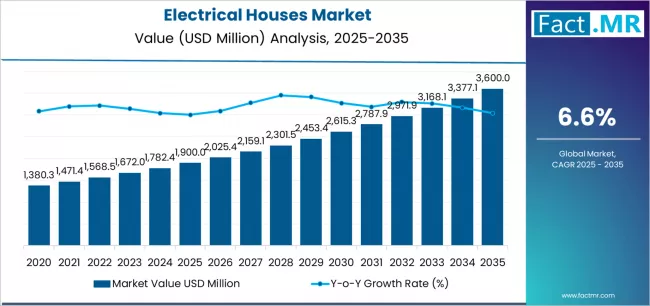
The global electrical houses market is set for steady and resilient growth over the next decade, driven by expanding power infrastructure, accelerating renewable energy deployment, and rising demand for modular electrical solutions across industrial and utility sectors. According to a recent analysis by Fact.MR, the market is projected to grow from USD 1,900.0 million in 2025 to approximately USD 3,600.0 million by 2035, registering an absolute growth of USD 1,700.0 million during the forecast period.
This expansion reflects a total growth of 89.5% and a compound annual growth rate (CAGR) of 6.6% from 2025 to 2035, highlighting the increasing importance of prefabricated and modular electrical infrastructure worldwide.
Electrical houses—also known as e-houses or power houses—provide compact, factory-assembled electrical distribution and control systems that significantly reduce project timelines, costs, and on-site installation complexity.
Browse Full Report: https://www.factmr.com/report/electrical-houses-market
Strategic Market Drivers
Expanding Power Infrastructure and Grid Modernization
Rapid urbanization, industrial growth, and electrification initiatives are driving large-scale investments in power generation, transmission, and distribution infrastructure. Electrical houses offer a plug-and-play solution for substations, switchgear, transformers, and control rooms, making them ideal for fast-paced infrastructure projects.
Utilities and industrial operators are increasingly adopting e-houses to modernize aging grids and enhance operational reliability.
Renewable Energy Expansion Fuels Adoption
The global transition toward renewable energy sources—including solar, wind, and hybrid power projects—is significantly boosting demand for electrical houses. These systems are widely used in:
- Solar and wind farms
- Battery energy storage systems (BESS)
- Offshore and remote renewable installations
Their modular design enables efficient deployment in remote and harsh environments, supporting global decarbonization goals.
Industrialization and Oil & Gas Sector Demand
Electrical houses are critical components in oil & gas, mining, metals, and petrochemical facilities, where safety, reliability, and rapid deployment are essential. Growing investments in upstream, midstream, and downstream energy projects—especially in emerging economies—continue to support market growth.
Shift Toward Modular and Prefabricated Solutions
Compared to conventional construction, electrical houses offer:
- Reduced installation time
- Lower labor and engineering costs
- Improved quality control
- Enhanced safety and compliance
This shift toward off-site fabrication and modular construction is accelerating adoption across multiple industries.
Regional Growth Highlights
North America: Grid Upgrades and Renewable Investments
North America remains a prominent market, supported by large-scale investments in grid modernization, renewable energy projects, and industrial automation. The U.S. continues to witness strong demand for electrical houses in utility-scale solar, wind farms, and data center infrastructure.
Europe: Energy Transition and Sustainability Focus
Europe’s aggressive renewable energy targets and stringent safety regulations are driving the adoption of prefabricated electrical solutions. Countries such as Germany, the U.K., France, and the Nordics are leading adopters across renewable, industrial, and transportation infrastructure projects.
Asia-Pacific: Fastest-Growing Regional Market
Asia-Pacific dominates market expansion due to:
- Rapid industrialization
- Growing power consumption
- Infrastructure development across China, India, and Southeast Asia
Government-backed electrification programs and renewable energy investments are significantly boosting demand.
Middle East & Africa: Oil, Gas, and Infrastructure Growth
Rising investments in oil & gas facilities, power plants, and mega infrastructure projects are accelerating electrical house adoption across the Middle East. Africa’s electrification initiatives further support long-term growth prospects.
Market Segmentation Insights
By Type
- Fixed Electrical Houses – Widely used in large industrial and utility projects
- Mobile Electrical Houses – Growing demand in mining, temporary sites, and remote operations
By Application
- Power Utilities – Transmission, distribution, and substations
- Oil & Gas – Refineries, LNG plants, offshore platforms
- Renewable Energy – Solar, wind, and energy storage systems
- Mining & Metals – Remote and harsh environments
- Industrial Manufacturing – Automation and process industries
Challenges Impacting Market Growth
High Initial Capital Investment
The upfront cost of designing and manufacturing electrical houses can be significant, particularly for small-scale projects.
Transportation and Installation Constraints
Large prefabricated units require specialized logistics and transportation, which may limit deployment in certain regions.
Customization Complexity
Highly customized electrical houses may increase lead times and engineering costs, impacting project schedules.
Competitive Landscape
The electrical houses market is moderately consolidated, with leading players focusing on:
- Modular and scalable designs
- Enhanced safety and compliance features
- Integration of digital monitoring and smart grid technologies
Key Companies Profiled
- ABB Ltd.
- Siemens AG
- Schneider Electric
- Eaton Corporation
- General Electric
- Larsen & Toubro
- Hitachi Energy
- Powell Industries
These companies are investing in digital substations, smart electrical houses, and sustainable construction materials to strengthen their market position.
Recent Developments
- 2024: Increased deployment of smart electrical houses integrated with digital monitoring systems
- 2023: Rising adoption in utility-scale renewable energy and energy storage projects
- 2022: Expansion of modular electrical solutions for oil & gas and mining applications
Future Outlook: Modular Power Infrastructure Takes Center Stage
The next decade will witness sustained growth in the electrical houses market, driven by:
- Rising global power demand
- Renewable energy expansion
- Grid modernization initiatives
- Growth in industrial and infrastructure projects
- Increasing preference for modular and prefabricated solutions
As industries and utilities prioritize speed, safety, scalability, and energy efficiency, the global electrical houses market is well-positioned for strong and sustainable growth through 2035.