The demand for aircraft fuel cells in the United States is set to more than triple over the next decade — marking a major strategic pivot by airlines and aerospace manufacturers toward clean, efficient power solutions.
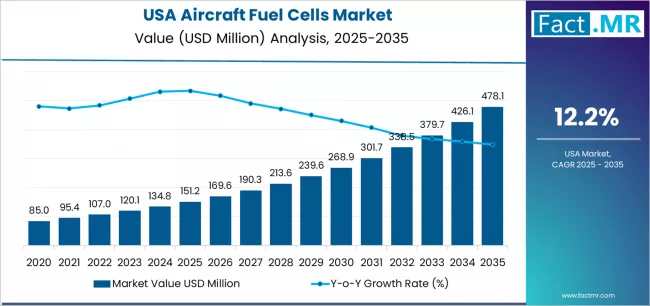
The U.S. aircraft fuel cells market — valued at USD 151.2 million in 2025 — is projected to expand to approximately USD 478.1 million by 2035, a rise of 238.5% and a compound annual growth rate (CAGR) of 12.2%. This growth is driven by intensifying pressure on the aviation industry to decarbonize, improve energy efficiency, and adopt next-generation propulsion and auxiliary-power technologies.
Key Growth Drivers
• Regulatory and Environmental Pressure for Sustainable Aviation
As climate targets tighten, clean-energy solutions for aviation are becoming a strategic necessity. Traditional jet-fuel systems remain carbon-intensive, whereas fuel cells — particularly hydrogen-based technologies — offer significantly reduced emissions. Airlines and regulators in the U.S. are accelerating adoption of these technologies.
• Technological Maturation and Preference for PEMFC
Proton Exchange Membrane Fuel Cells (PEMFC) are expected to dominate demand, accounting for 58.5% of total fuel cell demand in 2025. Their compact design, rapid start-up, and compatibility with existing aircraft auxiliary power systems make PEMFC a preferred choice for aerospace applications.
• Growing Use of Fuel Cells for APUs (Auxiliary Power Units)
APUs lead adoption with a 41.2% share of the 2025 U.S. market. Fuel-cell-based APUs are gaining traction for ground operations, taxiing, onboard systems power, and hybrid or electric aircraft designs.
• Rise of Electric, Hybrid, and Hydrogen-Powered Aircraft Initiatives
Globally, the aircraft fuel cells market is growing rapidly. Within this ecosystem, the U.S. market — buoyed by a strong aerospace infrastructure, research institutions, and regulatory momentum — is positioned to capture a significant portion of demand.
Demand Forecast: What the Numbers Show
| Year | U.S. Aircraft Fuel Cells Market Size | Growth vs Previous Period |
|---|---|---|
| 2025 | USD 151.2 million | baseline |
| 2030 (est.) | ~ USD 261.8 million | +73% over 2025 |
| 2035 (forecast) | USD 478.1 million | +238.5% over 2025 |
Between 2025 and 2030, the U.S. market is expected to grow by about USD 110.6 million. Growth accelerates between 2030 and 2035, increasing by approximately USD 216.3 million. This suggests that fuel-cell adoption in U.S. aviation will nearly triple over a decade, driving a significant shift in how aircraft are powered on the ground and, eventually, in the air.
Market Dynamics & Implications for Stakeholders
• Aerospace OEMs and Fuel-Cell Manufacturers Poised to Benefit
The projected growth creates opportunities for both established aerospace contractors and specialized fuel-cell providers. Leading players are preparing to scale operations to meet demand.
• Airlines, Airports, and Ground-Support Services Under Pressure to Adapt
With APUs forming a substantial part of early adoption, airlines and ground-support operators may need to invest in hydrogen or fuel-cell infrastructure, maintenance capabilities, and crew training. These investments can reduce operational emissions and costs while meeting regulatory requirements.
• Regulatory Bodies and Policymakers Expected to Facilitate Adoption
Governments and aviation regulators are likely to support fuel-cell adoption through incentives, grants, or frameworks encouraging clean aviation technologies. The U.S. aviation ecosystem — including commercial fleets, defense operations, and manufacturing — stands to gain significantly.
• Acceleration of Research and Innovation in Hydrogen-Based Aviation Technology
Beyond auxiliary power, fuel cells open the door to hybrid-electric aircraft and next-generation “green aviation.” Increased investment and demand may accelerate innovation in hydrogen storage, lightweight integration, and certification processes.
Quotes from Industry Experts
“The projected growth in the U.S. aircraft fuel cells market reflects an industry-wide commitment to reimagining how aircraft draw power, both on the ground and in the air.” — [Analyst, Market Research Firm]
“PEM-based fuel cells are emerging as the workhorse of aviation’s clean-power transition in the United States. As auxiliary power systems modernize, the shift is inevitable.” — [Senior Executive, Aerospace Supplier]
About the Report
The figures cited derive from a comprehensive 2025 market analysis of aircraft fuel cells in the U.S. The report leverages historical data, aerospace industry trends, and input from manufacturers, airlines, and regulators to provide robust forecasts segmented by fuel-cell type, application, and growth drivers.
Browse Full Report : https://www.factmr.com/report/united-states-aircraft-fuel-cells-market
Looking Ahead: What to Watch
-
Regulatory momentum and clean-aviation mandates – Pressure to decarbonize could accelerate fuel-cell adoption.
-
Advancements in hydrogen storage and fuel-cell propulsion for in-flight use – Lightweight, safe hydrogen systems could expand demand beyond APUs.
-
Expansion of hydrogen infrastructure at airports and maintenance facilities – Wider deployment reduces operational friction and catalyzes adoption.
-
Collaborations between OEMs, fuel-cell manufacturers, and airlines – Strategic partnerships could accelerate certification and scaling.