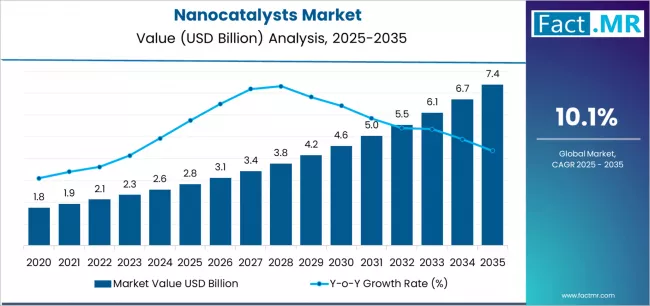
The nanocatalysts market is transforming the industrial and energy sectors by offering highly efficient catalytic solutions that operate at the nanoscale. Nanocatalysts enhance chemical reactions with superior surface area, increased activity, and exceptional selectivity, enabling manufacturers to optimize processes while reducing energy consumption and environmental impact. From petroleum refining to environmental remediation and hydrogen fuel cells, nanocatalysts are becoming indispensable in modern industrial applications.
Market Overview:
Nanocatalysts encompass metal-based, metal oxide, carbon-based, polymeric, and composite materials designed to accelerate chemical reactions. Their unique nanoscale properties allow for faster reaction rates, lower activation energies, and higher product yields compared to conventional bulk catalysts. Industries such as petrochemicals, chemicals, energy, pharmaceuticals, and environmental technologies are increasingly integrating nanocatalysts to improve efficiency, minimize waste, and comply with stringent environmental regulations.
Key Segments:
The market is segmented by material type and application. Metal-based nanocatalysts dominate the market due to their widespread use in platinum, palladium, and gold nanoparticle formulations, which deliver high performance in catalytic converters, petroleum refining, and fine chemical synthesis. Composite nanocatalysts, combining metals with carbon or other supports, are gaining traction for their multifunctional properties, enhanced durability, and improved catalytic stability. Applications are diverse, spanning petroleum refining, chemical manufacturing, environmental remediation, energy and fuel cells, automotive, electronics and semiconductors, pharmaceuticals, biotechnology, and even food and beverage processing.
Regional Insights:
Asia-Pacific is witnessing the fastest growth in nanocatalyst adoption, driven by expanding petroleum refining capacity, rapid industrialization, and investments in chemical manufacturing. North America maintains a strong presence due to advanced fuel cell research, automotive emission standards, and established industrial infrastructure. Europe emphasizes green chemistry and sustainable catalytic processes, promoting the use of nanocatalysts for eco-friendly applications. Other regions, including Latin America and the Middle East & Africa, are gradually adopting nanocatalysts as environmental awareness and industrial modernization efforts increase. China and India are emerging as key hubs for nanocatalyst consumption, supported by large-scale refining operations and chemical industry growth.
Key Trends & Drivers:
The nanocatalysts market is propelled by several key trends. Rising demand for energy-efficient and selective catalytic processes drives the adoption of nanoscale catalysts across industries. Environmental regulations, particularly in automotive emissions and industrial waste management, are pushing manufacturers to adopt nanocatalysts with higher activity and lower by-product formation. Technological advancements in nanoparticle synthesis, surface engineering, and hybrid materials are expanding the range of applications. The growing hydrogen economy is fueling demand for platinum-based and composite nanocatalysts in fuel cells, while photocatalytic nanomaterials are increasingly used for water purification and air pollution control.
Challenges & Market Barriers:
Despite their advantages, nanocatalysts face challenges such as high production costs, particularly for noble metal-based formulations. Scaling up synthesis while preventing nanoparticle agglomeration remains a technical hurdle. Cost-sensitive industrial operations may be reluctant to adopt expensive nanocatalysts unless efficiency gains justify the investment. Regulatory compliance, quality control, and handling of nanomaterials also require specialized expertise, potentially limiting universal adoption.
Applications & End-Use Outlook:
Petroleum refining continues to be the largest application segment, with nanocatalysts used in hydrocracking, catalytic reforming, and desulfurization processes. Chemical manufacturing benefits from enhanced reaction efficiency and product selectivity, particularly in fine chemicals and pharmaceuticals. Environmental applications include photocatalytic water treatment and air purification, supporting sustainability initiatives. Energy applications, particularly hydrogen fuel cells, rely on nanocatalysts for efficient energy conversion. Automotive, electronics, and food & beverage industries are exploring specialized catalytic solutions for process optimization, demonstrating the broad applicability of nanocatalyst technology.
Future Outlook:
The nanocatalysts market is poised for strong growth as industries increasingly prioritize process efficiency, sustainability, and regulatory compliance. Advancements in nanomaterial synthesis, cost-effective production methods, and hybrid catalyst designs will expand their adoption across new applications. Collaborations between catalyst manufacturers, industrial end-users, and research institutions are expected to accelerate innovation, improve scalability, and reduce production costs. As awareness of environmental impact and energy efficiency grows, nanocatalysts are likely to become a standard component in industrial processes, supporting both economic and ecological objectives.
Conclusion:
Nanocatalysts are revolutionizing industrial catalysis by providing unmatched efficiency, selectivity, and environmental benefits. Their adoption across petroleum refining, chemical manufacturing, environmental remediation, energy, and automotive sectors highlights their versatility and strategic importance. With ongoing technological innovation, expanding applications, and growing regulatory pressures, the nanocatalysts market is set to drive the next generation of sustainable and high-performance industrial processes, supporting both economic growth and environmental stewardship worldwide.
Browse Full Report – https://www.factmr.com/report/nanocatalysts-market