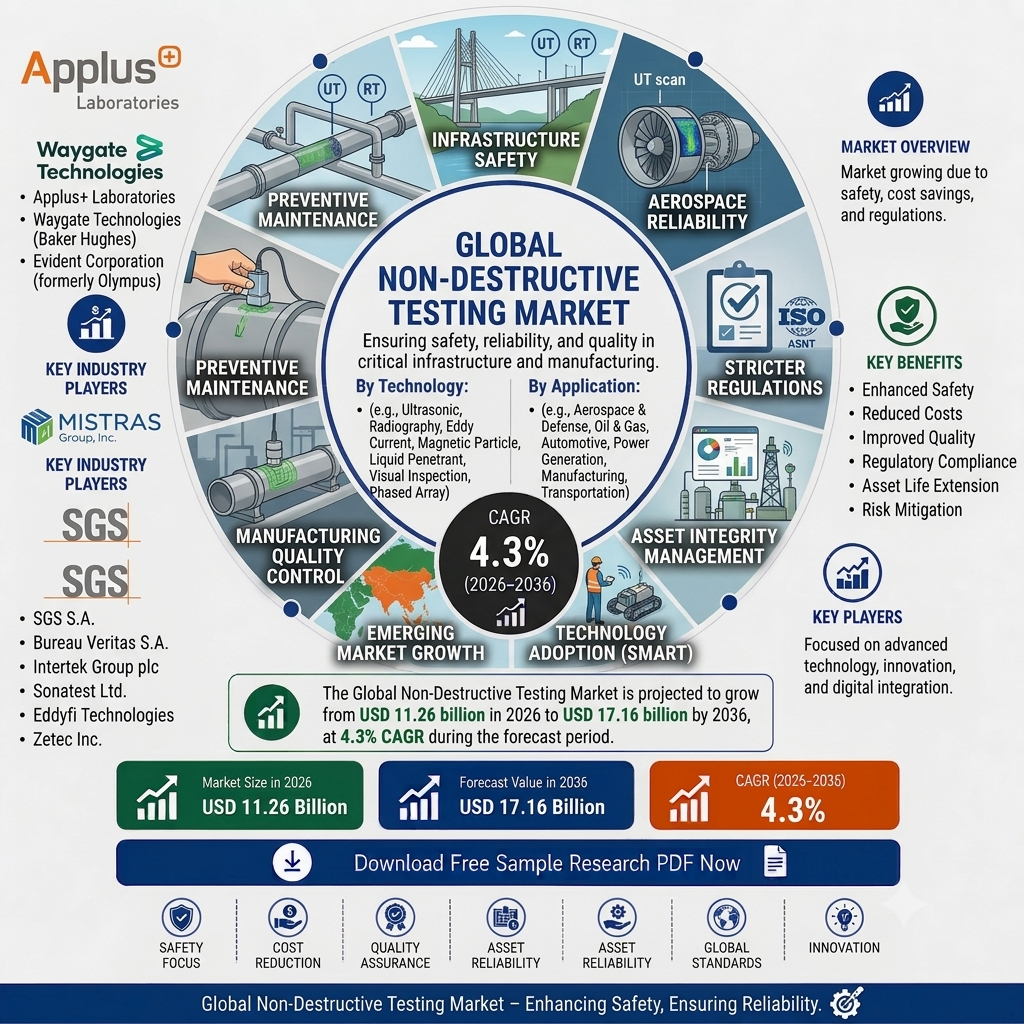
The global non-destructive testing market is estimated at USD 11.26 billion in 2026 and is projected to reach USD 17.16 billion by 2036, expanding at a 4.3% CAGR during the forecast period, according to Fact.MR. The market is expected to create an absolute dollar opportunity of USD 5.90 billion through 2036 as industries increase inspection requirements to identify defects before they lead to equipment failure, production losses, or safety incidents.
Oil and gas remains the largest end-use sector, accounting for 29.8% of demand. Pipeline integrity, pressure vessel inspection, weld quality assessment, and corrosion monitoring continue to create specification-intensive requirements for NDT equipment and services.
Request full Report Pricing and sample Report
Non-Destructive Testing Market Outlook
NDT is increasingly moving from manual, skill-dependent inspection toward technology-enabled integrity management. Phased array ultrasonics, digital radiography, eddy current arrays, automated inspection systems, and AI-assisted defect recognition are gaining attention as operators seek greater inspection consistency and productivity.
The aerospace sector is another important growth area. Composite structures, turbine components, and other safety-critical parts require inspection across multiple production stages. Infrastructure expansion, aging industrial assets, and stricter quality requirements are also supporting recurring demand for non-destructive inspection.
Price pressure, supply chain concentration for certain equipment categories, and differences in regulatory specifications across regions remain market constraints. Service providers and equipment manufacturers must also maintain skilled workforces and certification capabilities to meet increasingly demanding inspection standards.
Ultrasonic Equipment and Inspection Services Lead Demand
Ultrasonic Testing Equipment accounts for 26.9% of product share in 2026, making it the leading product category. Its established use across industrial applications, compatibility with existing inspection infrastructure, and reliability in defect detection support continued demand.
Inspection Services represent 41.2% of service share, reflecting the importance of third-party inspection capabilities across oil and gas, aerospace, power generation, manufacturing, and infrastructure. Volumetric Testing Methods hold 38.5% of technique share, supported by ultrasonic and radiographic testing applications.
AI is emerging as a competitive differentiator. Algorithms capable of detecting and classifying defects from ultrasonic, radiographic, and visual inspection data can reduce interpretation variability and improve inspection throughput. As defect databases expand, AI-enabled systems are expected to become increasingly relevant for routine inspection and automated decision-making.
Mexico and Germany Present Strong Growth Opportunities
Mexico is projected to record the fastest country-level growth, expanding at a 4.6% CAGR through 2036. Oil and gas pipeline inspection, manufacturing nearshoring, automotive and aerospace production, and infrastructure construction are supporting demand.
Germany follows with a 4.2% CAGR, supported by aerospace and automotive quality systems, rail infrastructure inspection, and energy transition projects. France is projected to expand at 4.0%, while the United Kingdom and South Korea are expected to record CAGRs of 3.7% and 3.6%, respectively.
Across broader regions, North American demand is closely linked to oil and gas pipeline integrity. European markets benefit from aerospace, rail, nuclear, and energy infrastructure requirements, while Asia Pacific is supported by industrial expansion and infrastructure construction.
Analyst Perspective
Shambhu Nath Jha, Principal Consultant at Fact.MR, said, “The non-destructive testing market is fundamentally driven by the economic logic that the cost of inspection is a fraction of the cost of failure.”
He added that the market is shifting toward technology-enabled, data-driven integrity management, with phased array ultrasonics, digital radiography, and AI-assisted defect recognition improving detection and consistency. Vendors combining advanced inspection technologies with data analytics and asset integrity management services are positioned to compete for higher-value contracts.
Competitive Landscape
Competition spans equipment manufacturers and inspection service providers. Leading companies differentiate through certified technician networks, inspection technology, geographic reach, and asset integrity management capabilities.
Key companies profiled by Fact.MR include Applus+ Laboratories, Waygate Technologies (Baker Hughes), Evident Corporation (formerly Olympus), MISTRAS Group, Inc., SGS S.A., Bureau Veritas S.A., Intertek Group plc, Sonatest Ltd., Eddyfi Technologies, and Zetec Inc.
Recent developments include Waygate Technologies’ AI-enabled phased array ultrasonic platform, Evident’s enhanced portable phased array ultrasonic system, and Eddyfi Technologies’ expansion of advanced eddy current array solutions for heat exchanger and tube inspection.
To View Related Reports
About Fact.MR
Fact.MR is a market research and competitive intelligence provider delivering market intelligence, competitive analysis, and forecasting across global industries. Its research helps businesses evaluate market demand, understand competitive developments, and identify growth opportunities.