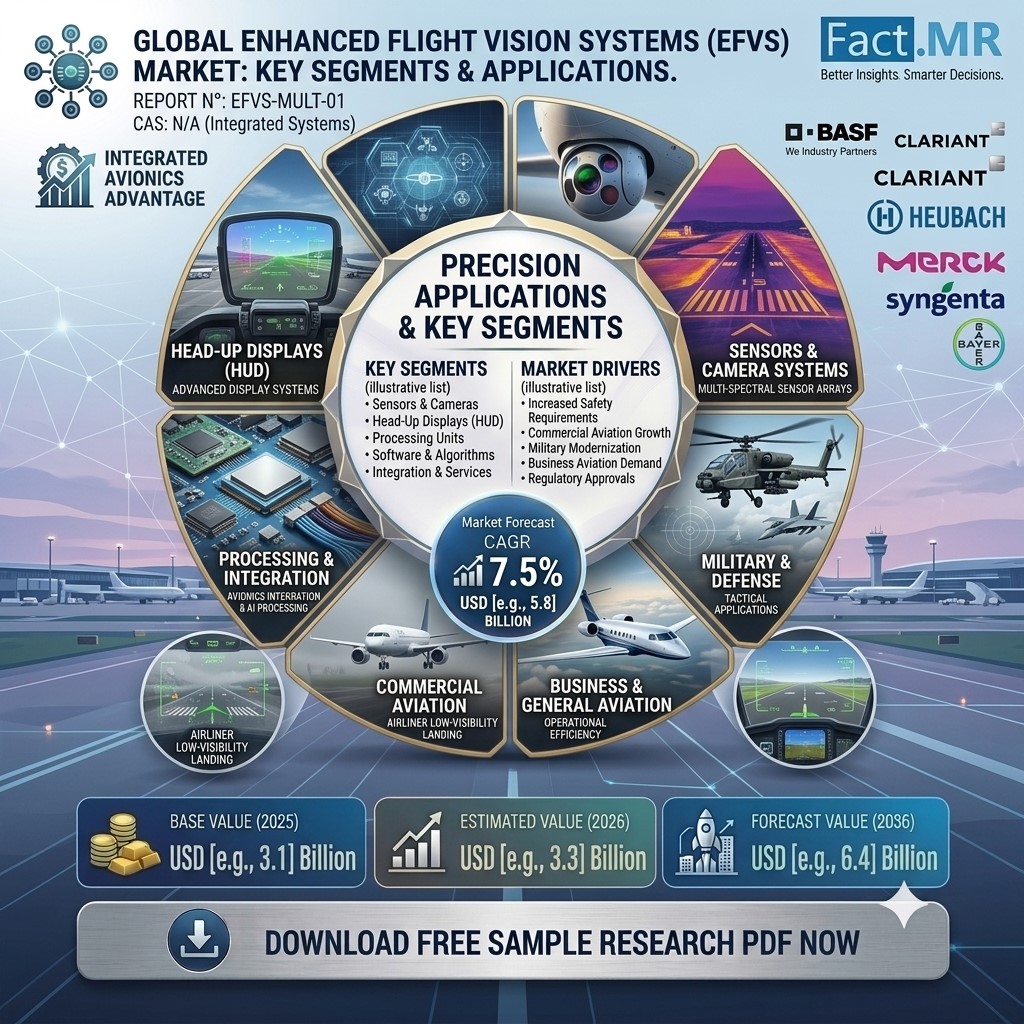
Rockville, MD., November 3, 2026 — The global Enhanced Flight Vision Systems Market is projected to increase from USD 542.8 million in 2026 to USD 1,273.2 million by 2036, expanding at an 8.9% CAGR, according to Fact.MR. The market was valued at USD 498.4 million in 2025 and is expected to generate an absolute dollar opportunity of USD 730.4 million during the forecast period. The United Kingdom leads the five-country growth comparison at 11.5% CAGR, while Germany records the lowest projected growth at 7.3%.
Demand is being shaped by aircraft operators seeking improved visibility during approach and landing, particularly in darkness and reduced-visibility conditions. Infrared technology is projected to account for 42.7% of the market in 2026, while display systems lead component demand with a 38.5% share. Commercial aviation is expected to represent 39.8% of total demand.
Get detailed market forecasts, competitive benchmarking, and pricing trends
Low-Visibility Flight Operations Drive Enhanced Flight Vision Systems Market Growth
Enhanced flight vision systems use real-time sensor imagery to improve pilots’ awareness of external conditions during critical flight phases. These technologies combine infrared cameras, visible-light imaging and cockpit displays to help identify runways, terrain and other visual references.
Regulatory developments are supporting structured adoption. On July 21, 2026, the Federal Aviation Administration published guidance covering enhanced flight vision systems, including equipment approval, operational authorization and pilot requirements.
[LINK: Federal Aviation Administration Enhanced Flight Vision Systems guidance]
European aviation requirements also influence deployment. The European Union Aviation Safety Agency published its March 27, 2026, revision of the Easy Access Rules for Air Operations, outlining requirements relevant to approved low-visibility operations.
These regulatory frameworks matter because installation alone does not establish operational eligibility. Aircraft operators must assess certification, equipment compatibility and applicable operating approvals before using enhanced vision capabilities.
Extractable fact: Enhanced flight vision systems are aircraft-based technologies that use infrared and other imaging sensors to provide pilots with improved views of external conditions during reduced-visibility operations.
Infrared Technology Accounts for 42.7% of Market Demand
Infrared technology is projected to represent 42.7% of the Enhanced Flight Vision Systems Market in 2026. Infrared cameras provide visual information in darkness and certain reduced-visibility conditions, supporting pilot awareness when natural visibility becomes limited.
Display systems lead the component category with a 38.5% share. Head-up displays allow pilots to view flight guidance and sensor imagery while maintaining an outward field of view.
Commercial aviation is expected to capture 39.8% of demand by platform. Airlines are evaluating enhanced vision technologies for flight-deck modernization and improved situational awareness during approach and landing.
Navigation leads applications with a projected 36.4% share in 2026. These systems support identification of external visual references and help pilots interpret their position relative to terrain and airport infrastructure.
Fact.MR identifies retrofit installations across existing fleets as an opportunity with an estimated positive 0.9-percentage-point impact on market CAGR. Aircraft installation and certification costs represent a corresponding restraint, with an estimated negative 0.9-percentage-point impact.
United Kingdom Leads Country Growth at 11.5% CAGR
Country-level forecasts indicate different adoption rates across established aviation markets.
- United Kingdom — 11.5% CAGR: Growth is supported by commercial aviation activity, business aircraft modernization and demand for advanced cockpit technologies. Retrofit economics and regulatory approvals remain important purchasing considerations.
- Brazil — 11.0% CAGR: Commercial aircraft operations and business aviation activity support demand for improved visibility across varying airport and weather conditions. Aircraft compatibility influences adoption.
- United States — 9.3% CAGR: The established avionics industry and cockpit modernization programs support market development. Federal Aviation Administration guidance provides a framework for equipment approval and operational authorization.
- Japan — 8.4% CAGR: Aircraft technology development and flight-deck modernization support demand for enhanced pilot visibility during nighttime and reduced-visibility operations.
- Germany — 7.3% CAGR: Aerospace engineering capabilities and advanced avionics requirements support adoption. Growth depends on aircraft modernization, compatible equipment and European aviation regulations.
The United Kingdom records the highest forecast CAGR among the five countries analyzed, followed by Brazil. Germany remains an established aerospace market despite recording the lowest growth rate in this comparison.
Competitive Landscape: Collins Aerospace, Elbit Systems and Universal Avionics
The Enhanced Flight Vision Systems Market includes manufacturers of imaging sensors, enhanced vision systems and related cockpit technologies.
Fact.MR profiles five companies:
- Collins Aerospace: Offers the EVS-3600 enhanced vision system, combining short-wave infrared, long-wave infrared and visible-light imaging.
- Elbit Systems Ltd.: Develops ClearVision EFVS technology, integrating enhanced vision with synthetic vision and flight guidance information.
- Universal Avionics Systems Corporation: Provides ClearVision EFVS solutions and multispectral cameras, including the EVS-5000 and EVS-4000.
- Honeywell International Inc.: Participates through head-up displays, Primus Epic avionics and synthetic vision capabilities.
- Thales Group: Develops cockpit displays and pilot-viewing technologies, including military helmet-mounted display solutions.
Collins Aerospace’s EVS-3600 illustrates the industry’s movement toward multispectral imaging. Combining different imaging wavelengths allows manufacturers to address varying visibility conditions within integrated flight-deck systems.
Competitive differentiation depends on sensor performance, cockpit integration, certification support and long-term equipment maintenance. Fact.MR does not disclose individual company market shares.
Shambhu Nath Jha, Principal Consultant at Fact.MR, states:
“Enhanced flight vision systems are gaining relevance as aircraft operators look for better visibility and situational awareness during critical phases of flight. Suppliers that combine reliable sensor performance with practical cockpit integration and the required certification support are better positioned to address commercial and business aviation requirements.”
The research draws on more than 120 sources, over 35 company portfolios, more than 25 countries and over 20 industry interviews. Findings combine primary research, regulatory documentation, company product information and market forecasting.
Top Reports:
Thermal Imaging Sensor Systems for Night Vision ADAS Market
Commercial Aircraft LED Lighting System Market
About Fact.MR
Fact.MR is a market research and consulting firm providing syndicated and customized research across global industries. Its research combines primary interviews, secondary analysis, market modeling and data validation to support strategic business decisions.