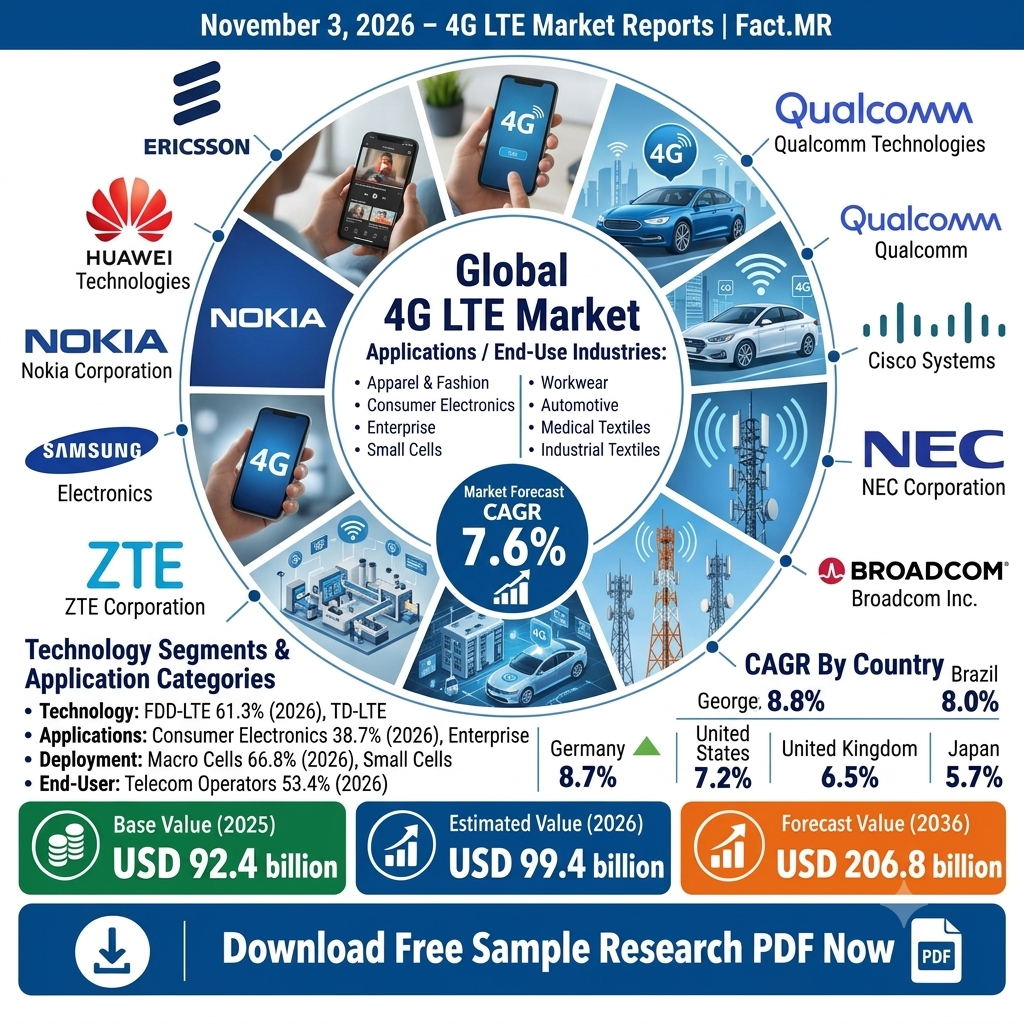
The global 4G LTE market is projected to reach USD 206.8 billion by 2036, increasing from USD 99.4 billion in 2026 at a compound annual growth rate (CAGR) of 7.6%, according to a latest analysis by Fact.MR. The market was valued at USD 92.4 billion in 2025. Continued investment in LTE infrastructure, mobile broadband services, and enterprise wireless connectivity is expected to support this expansion over the forecast period.
Fact.MR estimates an absolute dollar opportunity of USD 107.4 billion between 2026 and 2036. Telecom operators remain central to this opportunity as they upgrade network capacity, improve spectrum utilization, and maintain LTE coverage alongside the expansion of 5G infrastructure.
Get detailed market forecasts, competitive benchmarking, and pricing trends: https://www.factmr.com/connectus/sample?flag=S&rep_id=17102
Mobile Broadband and Enterprise Connectivity Support Market Demand
Consumer demand for mobile broadband continues to support LTE network requirements. Smartphones, tablets, wireless routers, and connected electronics depend on LTE technology for internet access, video streaming, online communication, and cloud-based applications. LTE also remains an established connectivity option in locations where 5G coverage is incomplete.
Enterprise adoption adds another source of demand. Retailers use LTE-enabled payment terminals and connected point-of-sale systems, while healthcare providers rely on wireless connectivity for remote monitoring and mobile clinical communication. Logistics companies and industrial facilities also use LTE networks to maintain operational communication and monitor connected equipment.
Private LTE deployments present another opportunity. Organizations seeking dedicated wireless connectivity can use private networks to maintain greater control over network performance. Fact.MR identifies private LTE networks as an opportunity with an estimated 0.9% positive impact on market CAGR over the medium term.
Network modernization is equally important. Telecom operators continue investing in radio access network upgrades, rural coverage expansion, and improvements in spectrum efficiency. These investments help maintain existing connectivity services while supporting the transition toward newer mobile network generations.
FDD-LTE and Consumer Electronics Lead Key Segments
FDD-LTE is projected to account for 61.3% of the technology segment in 2026, making it the leading technology category. Its established presence across commercial mobile networks supports its position. FDD-LTE uses separate frequency bands for uplink and downlink transmission, allowing simultaneous transmission and reception.
TD-LTE offers an alternative for operators holding unpaired spectrum. It uses the same frequency band for uplink and downlink transmissions at different time intervals. Technology selection depends on spectrum availability, traffic distribution, and network configuration.
Consumer Electronics is expected to hold a 38.7% share of the application segment in 2026. LTE-enabled smartphones, tablets, routers, and connected devices account for much of this demand. The segment also benefits from LTE modem and radio-frequency components incorporated into mobile products.
By deployment mode, Macro Cells are forecast to capture 66.8% of the market in 2026. These installations provide broad geographical coverage and form the primary coverage layer of large-scale mobile networks. Small cells complement macro infrastructure by improving indoor coverage and capacity in high-traffic locations.
Telecom Operators are expected to represent 53.4% of the market by end-user category in 2026. Their ownership and management of mobile network infrastructure make them the principal participants in LTE investment and service delivery.
Germany Leads Country-Level Growth Outlook
Germany is projected to record the fastest growth among the five countries analyzed, with an estimated CAGR of 8.7% through 2036. Brazil follows at 8.0%, while the United States is forecast to grow at 7.2%. The United Kingdom and Japan are expected to register CAGRs of 6.5% and 5.7%, respectively.
Germany’s outlook reflects rising mobile data consumption and continued telecommunications investment. According to Germany’s Federal Network Agency (Bundesnetzagentur), mobile network data traffic reached 10.9 billion GB in 2025, compared with 9.6 billion GB in 2024. Average monthly data consumption per active SIM profile increased approximately 13% to 8.4 GB.
Brazil’s growth outlook is supported by expanding mobile connectivity. The National Telecommunications Agency (Anatel) reported 276.4 million mobile connections in the second quarter of 2026, representing annual growth of 3.7%.
In the United Kingdom, Ofcom’s May 2026 Connected Nations update reported that 96% of the country’s landmass had predicted 4G geographic coverage from at least one mobile network operator as of January 2026. Japan also retains a substantial LTE subscriber base, with approximately 105.8 million 4G LTE subscriptions recorded in June 2026.
Competition Focuses on Infrastructure and Connectivity Technologies
The competitive landscape includes Ericsson, Huawei Technologies, Nokia Corporation, Samsung Electronics, ZTE Corporation, Qualcomm Technologies, Cisco Systems, NEC Corporation, and Broadcom Inc.
These companies participate across LTE radio access infrastructure, mobile core networks, enterprise connectivity, and semiconductor components. Ericsson and Nokia Corporation supply mobile network infrastructure, while Huawei Technologies and ZTE Corporation participate in LTE network equipment. Qualcomm Technologies and Broadcom Inc. support the device ecosystem through modem and radio-frequency technologies.
According to Fact.MR, network capacity, energy efficiency, spectrum compatibility, and integration with existing infrastructure remain important competitive considerations. Equipment manufacturers must also account for operators’ requirements to maintain LTE services while investing in 5G networks.
Analyst Opinion at Fact.MR
Shambhu Nath Jha, Principal Consultant at Fact.MR, states, “The 4G LTE market continues to benefit from demand for dependable mobile broadband and enterprise connectivity. Network suppliers that support flexible FDD and TDD deployments while improving capacity and coverage can address the requirements of operators maintaining established LTE infrastructure.”
Strategic Priorities for Industry Participants
Network equipment manufacturers should prioritize LTE infrastructure upgrades that improve capacity and spectrum efficiency. Telecom operators need to assess FDD-LTE and TD-LTE deployments according to spectrum availability, geographical coverage, and traffic requirements.
Enterprise technology providers can address demand from industrial monitoring, healthcare communication, and retail operations. Semiconductor manufacturers also have a continuing role in supporting LTE modems and radio-frequency components used across connected devices.
However, the market faces constraints. Migration of network investment toward 5G, spectrum allocation limitations, and high infrastructure deployment and maintenance costs may restrict expansion. Legacy equipment and interoperability challenges also influence upgrade decisions.
The analysis draws on more than 120 sources, 35 company portfolios, 25 countries, and over 20 industry interviews, combining primary research with telecommunications statistics and company product information.
View Related Reports :
Enhanced Flight Vision Systems Market
Digital Payment Solutions Market
Commercial Aircraft LED Lighting System Market
About Fact.MR
Fact.MR is a market research and consulting firm providing industry intelligence, market forecasts, and strategic analysis across global industries. The company delivers data-driven insights to help businesses understand market developments, evaluate opportunities, and make informed decisions.