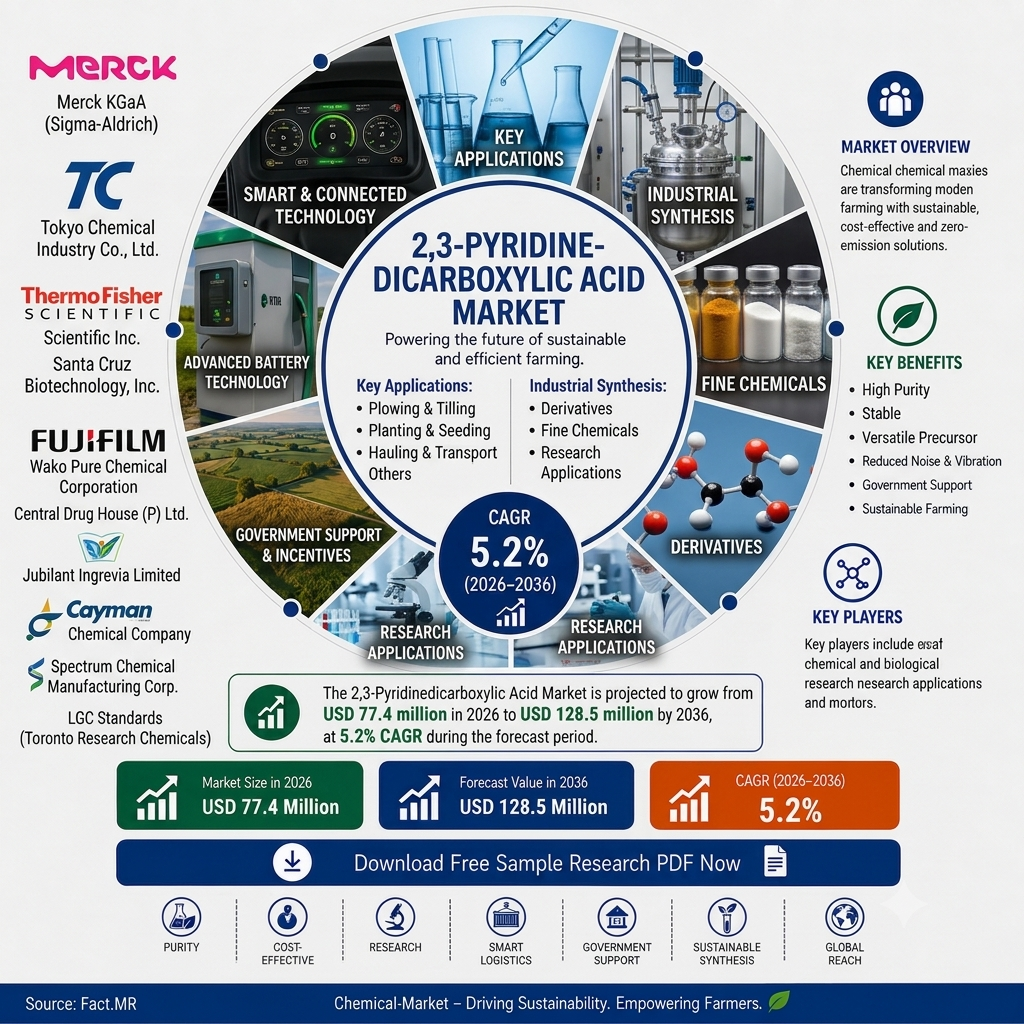
The global 2,3-pyridinedicarboxylic acid market is projected to increase from USD 77.4 million in 2026 to USD 128.5 million by 2036, expanding at a compound annual growth rate (CAGR) of 5.2% during the forecast period. The market was valued at USD 73.6 million in 2025. Demand is supported by pharmaceutical research, heterocyclic chemistry applications, and laboratory requirements for chemicals with clearly documented purity and batch specifications.
Also known as quinolinic acid, 2,3-pyridinedicarboxylic acid is a specialty chemical identified by CAS number 89-00-9. It is supplied for research and relevant chemical work, where product identity, assay levels, and technical documentation influence purchasing decisions.
Get detailed market forecasts, competitive benchmarking, and pricing trends
Market Snapshot
- 2025 Market Value: USD 73.6 million
- 2026 Market Value: USD 77.4 million
- 2036 Forecast Value: USD 128.5 million
- Forecast CAGR (2026–2036): 5.2%
- Leading Purity Segment: High purity, with 62.4% share in 2026
- Leading Application: Pharmaceuticals, with 54.2% share in 2026
- Leading End User: Pharmaceutical companies, with 48.6% share in 2026
High-Purity Grades Support Specialist Research Demand
High-purity 2,3-pyridinedicarboxylic acid is expected to account for 62.4% of market value in 2026. Researchers working with controlled synthesis procedures require specified assay levels to reduce uncertainty caused by impurities. Reliable product identification and batch documentation also help laboratories reproduce experimental results.
The pharmaceutical application segment is projected to hold 54.2% of the market in 2026. Demand in this category primarily reflects research and development activities involving the compound and its potential role in intermediate chemistry. This classification should not be interpreted as evidence that the chemical is approved for use in finished medicines.
Pharmaceutical companies represent 48.6% of end-user demand. Research institutes and chemical manufacturers also contribute to purchasing activity. While laboratories may begin with small catalogue orders, larger requirements can involve supplier qualification, specification checks, and discussions about consistent batch quality.
Germany Leads Country Growth Outlook
Germany is forecast to record the fastest growth among the countries covered, with a 6.0% CAGR through 2036. Its established chemical research base and access to specialist reagent suppliers support demand for documented grades.
Brazil follows with an anticipated CAGR of 5.5%, supported by pharmaceutical-sector activity and laboratory testing requirements. The United States is projected to expand at 4.9%, with established chemical suppliers offering multiple catalogue-grade options. The United Kingdom is expected to register a 4.4% CAGR, while Japan is forecast to grow at 3.9% through 2036.
Analyst Perspective
Shambhu Nath Jha, Principal Consultant at Fact.MR, states, “A laboratory buying this compound generally needs dependable identity and lot documentation as well as a suitable price. Researchers can compare small packs during initial trials, but once they settle on a method, consistent assay results and a supplier’s ability to meet the same specification become more important for repeat orders.”
Competitive Landscape
The 2,3-pyridinedicarboxylic acid market includes international laboratory chemical distributors and specialist research-chemical suppliers. Key companies profiled in the Fact.MR report include Merck KGaA (Sigma-Aldrich), Tokyo Chemical Industry Co., Ltd., Thermo Fisher Scientific Inc., Santa Cruz Biotechnology, Inc., FUJIFILM Wako Pure Chemical Corporation, Central Drug House (P) Ltd., Jubilant Ingrevia Limited, Cayman Chemical Company, Spectrum Chemical Manufacturing Corp., and LGC Standards (Toronto Research Chemicals).
Competition is shaped by product purity, reliable chemical identification, catalogue availability, pack sizes, and technical documentation. Suppliers that make assay specifications and batch records accessible can help laboratories evaluate products more efficiently. Consistency across repeat orders is also important for research teams seeking to reproduce established methods.
Restrictions related to intended use, detailed qualification requirements, and limited project volumes may constrain market expansion. Buyers must distinguish research-grade chemical supply from materials intended for regulated pharmaceutical manufacturing, with each application requiring its own technical and regulatory assessment.
To View Related Reports
veterinary Infectious Disease Diagnostics Market
Diabetic Ketoacidosis Treatment Market
About Fact.MR
Fact.MR is a market research and competitive intelligence provider delivering market intelligence, competitive analysis, and forecasting across global industries. Its research helps businesses evaluate