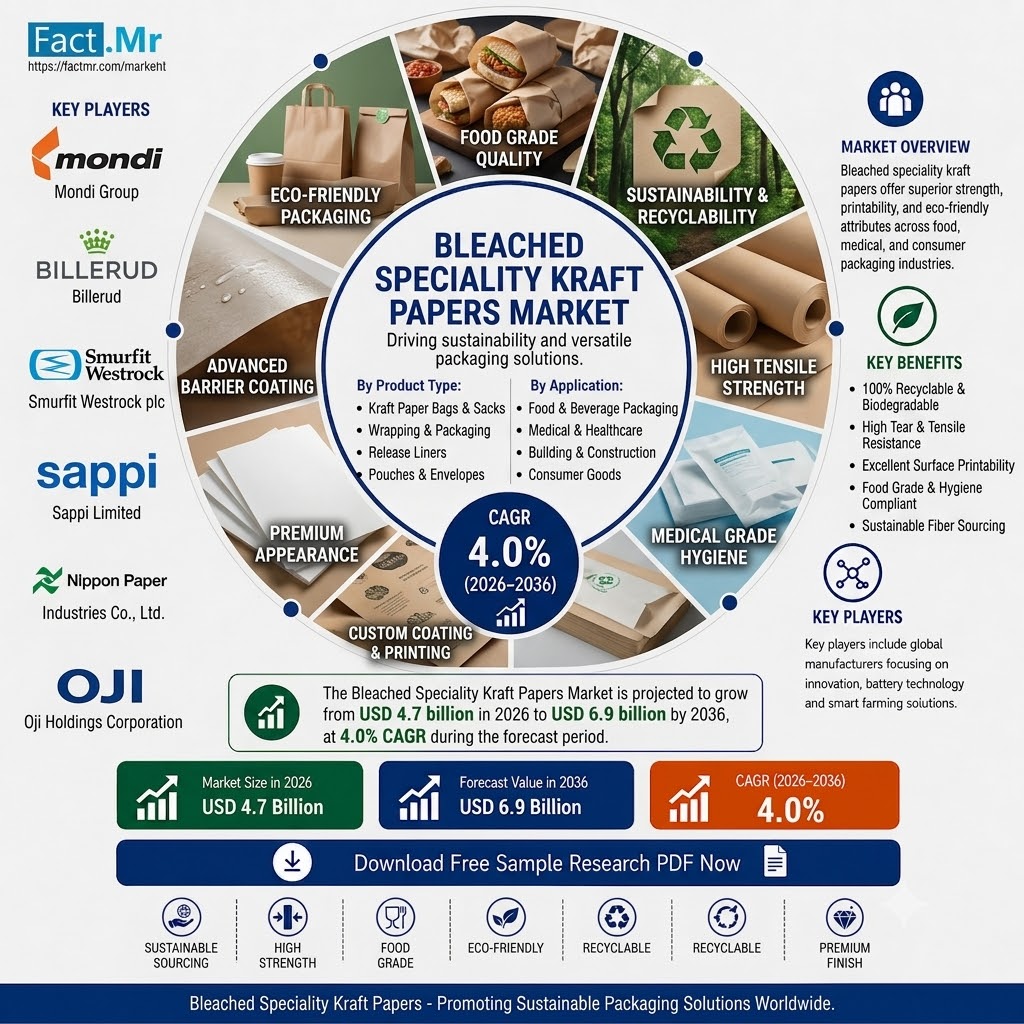
The global bleached speciality kraft papers market is projected to increase from USD 4.65 billion in 2026 to USD 6.87 billion by 2036, registering a compound annual growth rate (CAGR) of 4.0% during the forecast period, according to Fact.MR. The market was valued at USD 4.47 billion in 2025. Demand is gaining momentum as food, personal care and e-commerce companies evaluate paper-based alternatives to plastic films and conventional multilayer packaging.
Bleached speciality kraft paper combines a clean printable surface with the strength required for packaging and technical applications. Coated grades add grease, moisture and heat-seal resistance, allowing converters to use paper in food wraps, bags and pouches. Regulatory changes are reinforcing this shift. In Europe, packaging rules that took effect on August 12, 2026, restrict PFAS in food-contact packaging above specified thresholds, increasing the need for compliant barrier materials.
Get detailed market forecasts, competitive benchmarking, and pricing trends
Market Snapshot
- Market value (2025): USD 4.47 billion
- Estimated market value (2026): USD 4.65 billion
- Forecast value (2036): USD 6.87 billion
- CAGR (2026–2036): 4.0%
- Leading product type: Coated, with 52.7% share in 2026
- Leading application: Packaging, with 42.8% share in 2026
- Leading end-user industry: Food and Beverage, with 31.6% share in 2026
- Leading distribution channel: Direct Sales, with 48.3% share in 2026
Coated Grades Lead Product Demand
Coated bleached speciality kraft paper is projected to account for 52.7% of product-type demand in 2026. These grades use barrier and heat-seal layers to improve resistance to grease and moisture while retaining the printable surface of bleached paper. Food brands and packaging converters use them in applications that previously relied on plastic films or foil-based structures.
Uncoated grades continue to serve applications where natural texture, tear strength and printability are priorities. Their use across bags, interleaving and wrapping provides an additional market opportunity for paper producers.
Packaging is expected to represent 42.8% of application demand in 2026. Brand owners are assessing recyclable paper formats for flexible packaging, carrier bags and protective wraps. Food and Beverage leads end-user demand with a 31.6% share, supported by requirements for grease-resistant and food-contact-compliant materials in bakery, confectionery and takeaway packaging.
Direct Sales Strengthen Supplier Relationships
Direct sales are forecast to account for 48.3% of distribution-channel demand in 2026. Large converters and brand owners often purchase full reels against specifications covering paper weight, coating performance and delivery schedules. Long-term supply arrangements help mills maintain consistent orders while giving buyers greater control over material quality.
Distributors serve smaller converters and regional buyers requiring mixed grades or shorter lead times. Online retail supports smaller, repeat orders from print shops and specialist packaging businesses.
Regulatory Changes and Plastic Substitution Create Growth Opportunities
Restrictions on certain fluorinated grease-proofing substances are encouraging converters to evaluate alternative barrier technologies. Paper producers are developing coated grades that provide the required grease and moisture resistance without relying on older fluorochemical treatments. Demand is also supported by growth in parcel deliveries and takeaway food packaging.
Medical device manufacturers represent another application area. Clean, strong paper is used in sterile-barrier packaging, including peel pouches and sterilization wraps. Suppliers that can meet technical requirements across food and healthcare applications may broaden their customer base.
However, volatile pulp and energy costs can affect production economics. Barrier-coated paper also carries a price premium over some plastic film formats, which may slow adoption among cost-sensitive buyers.
Regional Outlook: United Kingdom Leads Country-Level Growth
The United Kingdom is projected to record the highest country-level CAGR at 5.0% through 2036. Its Plastic Packaging Tax is encouraging packaging buyers to evaluate paper alternatives, including food-safe white kraft grades.
Japan is forecast to expand at a 4.5% CAGR, supported by demand for paper barrier packaging in staple foods and continued e-commerce activity. Germany is expected to grow at 4.0%, in line with the global market, while Brazil is projected to register a 3.3% CAGR. The United States market is forecast to expand at 3.0% during the same period.
Analyst Perspective
Shambhu Nath Jha, Principal Consultant at Fact.MR, states, “Converters now specify bleached specialty kraft as a working barrier material and judge it on grease, moisture and heat-seal results. PFAS limits in Europe and the United States have removed the old fluorochemical shortcut, so coating chemistry decides which grades win food contracts. Mills that can deliver white base paper and coated grades from the same region will hold the stronger position with food, healthcare and e-commerce buyers.”
Competitive Landscape
Competition in the bleached speciality kraft papers market is shaped by paper quality, coating performance, food-contact compliance and regional production capabilities. Key companies profiled by Fact.MR include Mondi Group, Billerud, Smurfit Westrock plc, Sappi Limited, Nippon Paper Industries Co., Ltd. and Oji Holdings Corporation.
Mondi is expanding its functional barrier paper capabilities, while Billerud supplies white machine-glazed paper grades for food packaging. Smurfit Westrock offers bleached paper solutions for packaging applications. Sappi is developing high-barrier paper products, while Nippon Paper Industries and Oji Holdings are advancing paper materials designed for oil resistance and reduced reliance on fluorinated treatments.
Suppliers are competing to provide barrier performance alongside reliable converting characteristics. Mills that can supply both white base paper and finished coated grades may strengthen relationships with converters seeking consistent regional supply. Demonstrating PFAS-free status and food-contact compliance is also becoming an important part of supplier qualification.
To View Related Reports
About Fact.MR
Fact.MR is a market research and competitive intelligence provider delivering market intelligence, competitive analysis, and forecasting across global industries. Its research helps businesses evaluate market demand, understand competitive developments, and identify growth opportunities.