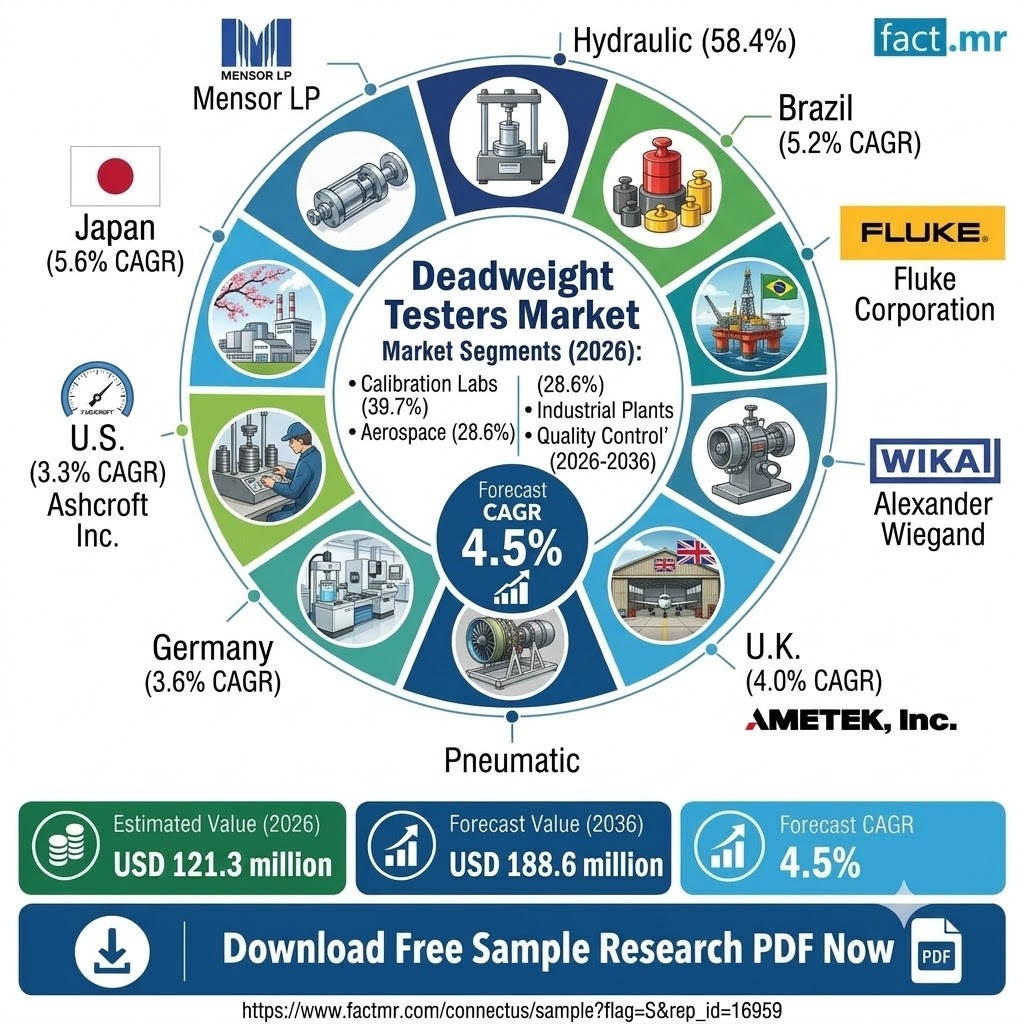
The global deadweight testers market is projected to increase from USD 121.3 million in 2026 to USD 188.6 million by 2036, expanding at a compound annual growth rate (CAGR) of 4.5%, according to Fact.MR. Demand is supported by the need for traceable pressure measurements in accredited laboratories, aircraft maintenance facilities, and industrial process plants. The market was valued at USD 116.1 million in 2025, with replacement of worn piston-cylinder assemblies contributing to equipment purchases alongside first-time installations.
The forecast adds USD 67.3 million in market value between 2026 and 2036. Fact.MR identifies calibration requirements and the growing population of pressure gauges and transmitters as central factors sustaining demand. Manufacturers face an additional consideration: customers need instruments that maintain traceability without leaving essential laboratory references unavailable for extended recertification periods.
Get detailed market forecasts, competitive benchmarking, and pricing trends: https://www.factmr.com/connectus/sample?flag=S&rep_id=16959
Deadweight Testers Market Growth Reflects Calibration Requirements
Deadweight testers, also called pressure balances or piston gauges, generate a known reference pressure by applying calibrated masses to a piston-cylinder assembly of known effective area. Their measurement principle gives laboratories a reference that can be independently verified through certified masses and piston dimensions.
Accredited laboratories use these instruments to establish a primary reference for calibrating working gauges, pressure transducers, and transmitters. Under ISO/IEC 17025 quality requirements, laboratories must demonstrate traceability through documented comparisons to recognized measurement standards. This requirement supports demand for pressure balances that can maintain an auditable calibration chain.
Aircraft maintenance adds another source of demand. The Federal Aviation Administration’s FAA Aerospace Forecast Fiscal Years 2026 to 2046, published in 2026, projects the U.S. commercial aircraft fleet to increase from 6,949 aircraft in 2025 to 10,677 in 2046. Repair stations must periodically check hydraulic, fuel-system, and pneumatic instruments, creating recurring requirements for traceable pressure references.
The National Institute of Standards and Technology (NIST) reported a definitive measurement of the optical pascal on June 26, 2025. Although optical pressure measurement could eventually offer alternatives for industrial applications, conventional piston-cylinder references remain important for existing calibration operations.
Hydraulic Deadweight Testers Lead Product Demand
Hydraulic deadweight testers are expected to account for 58.4% of the market by product type in 2026, according to Fact.MR. Oil-operated and water-operated models serve applications requiring pressure ranges that conventional handheld electronic calibrators may not cover.
Water-operated models also offer a practical option when oil contamination must be avoided around sensitive oxygen or fuel-system instruments. Dual-range piston-cylinder assemblies can accommodate different pressure ranges using one base, helping laboratories manage mixed calibration workloads.
Calibration laboratories are projected to represent 39.7% of market revenue by application in 2026. Aerospace will account for 28.6% of demand by end-user category. These shares reflect the importance of measurement traceability in laboratory accreditation and scheduled aircraft maintenance.
Fact block: Fact.MR is a market research and consulting company that provides industry analysis, market sizing, and forecasts to support business and strategic decisions. Its deadweight testers market analysis covers hydraulic and pneumatic instruments used to calibrate pressure gauges, transducers, and transmitters.
Japan and Brazil Record Faster Forecast Growth
Japan is projected to record the fastest growth among the five profiled countries, with a 5.6% CAGR from 2026 to 2036. Precision manufacturing and the renewal of pressure references support demand for equipment used in factory calibration programs. Japan’s Ministry of Economy, Trade and Industry reported on October 15, 2026, that the original industrial production index for August 2026 increased 2.7% year over year.
Brazil follows with a projected 5.2% CAGR. According to Brazil’s Instituto Brasileiro de Geografia e Estatística, industrial production increased 0.6% in 2025, while production in Rio de Janeiro rose 5.1%. Oil, gas, and petrochemical operations in the state require pressure measurement equipment across platforms, refineries, and pipeline systems.
The United Kingdom is forecast to grow at a 4.0% CAGR, supported by aerospace maintenance and accredited laboratory requirements. Germany is projected to expand at 3.6%, reflecting demand from machine builders and automotive testing facilities. The United States is expected to record a 3.3% CAGR, with replacement purchases serving a mature installed base.
Traceability and Recertification Shape Competition
Competition includes specialist pressure metrology providers and industrial gauge manufacturers. Key companies identified by Fact.MR include Fluke Corporation, WIKA Alexander Wiegand SE & Co. KG, Mensor LP, AMETEK, Inc., Ashcroft Inc., Nagano Keiki Co., Ltd., and SIKA Dr. Siebert & Kühn GmbH & Co. KG.
Electronic pressure calibrators present a competitive challenge in routine field checks, where speed and automation can outweigh the need for a primary pressure reference. Product developments illustrate this shift. Additel introduced the ADT710 automated gauge calibration system in June 2026, while Mensor announced the CPH6670 portable electric pressure calibrator on October 12, 2026.
For deadweight tester manufacturers, service capability remains a commercial consideration. Certified mass sets, dual-range piston-cylinder options, and shorter recertification turnaround times can help laboratories reduce equipment downtime. Local recertification services may also create opportunities in Brazil and other markets where sending heavy mass sets overseas adds expense and delays.
Shambhu Nath Jha, Principal Consultant at Fact.MR, said, “A deadweight tester earns its place because its accuracy comes from physics that an auditor can check, not from software. Laboratories will keep buying them as the anchor of their pressure chain, even as electronic calibrators take over routine field checks.”
He added that suppliers pairing certified masses with faster recertification services would be better positioned to serve aerospace customers and accredited laboratories.
Market Outlook Through 2036
Fact.MR’s forecast indicates that the deadweight testers market will continue to depend on calibration traceability, equipment replacement, and pressure measurement requirements across industrial and aerospace operations. Manufacturers that address high-pressure testing needs and recertification delays may be better placed to serve laboratories and maintenance providers.
The complete deadweight testers market report provides market forecasts, segment shares, country-level growth estimates, competitive profiles, and an assessment of the drivers and restraints shaping demand through 2036.
For technical context, readers can consult the NIST pressure and vacuum calibration resources, which describe the national measurement infrastructure supporting traceable pressure calibration.
View Related Reports :
Pressure Calibration Equipment Market
About Fact.MR
Fact.MR is a market research and consulting company providing market intelligence, industry analysis, and strategic insights across global markets. Its research combines primary interviews, secondary research, market sizing, and forecast analysis to help businesses understand industry developments, competitive positioning, and emerging opportunities.