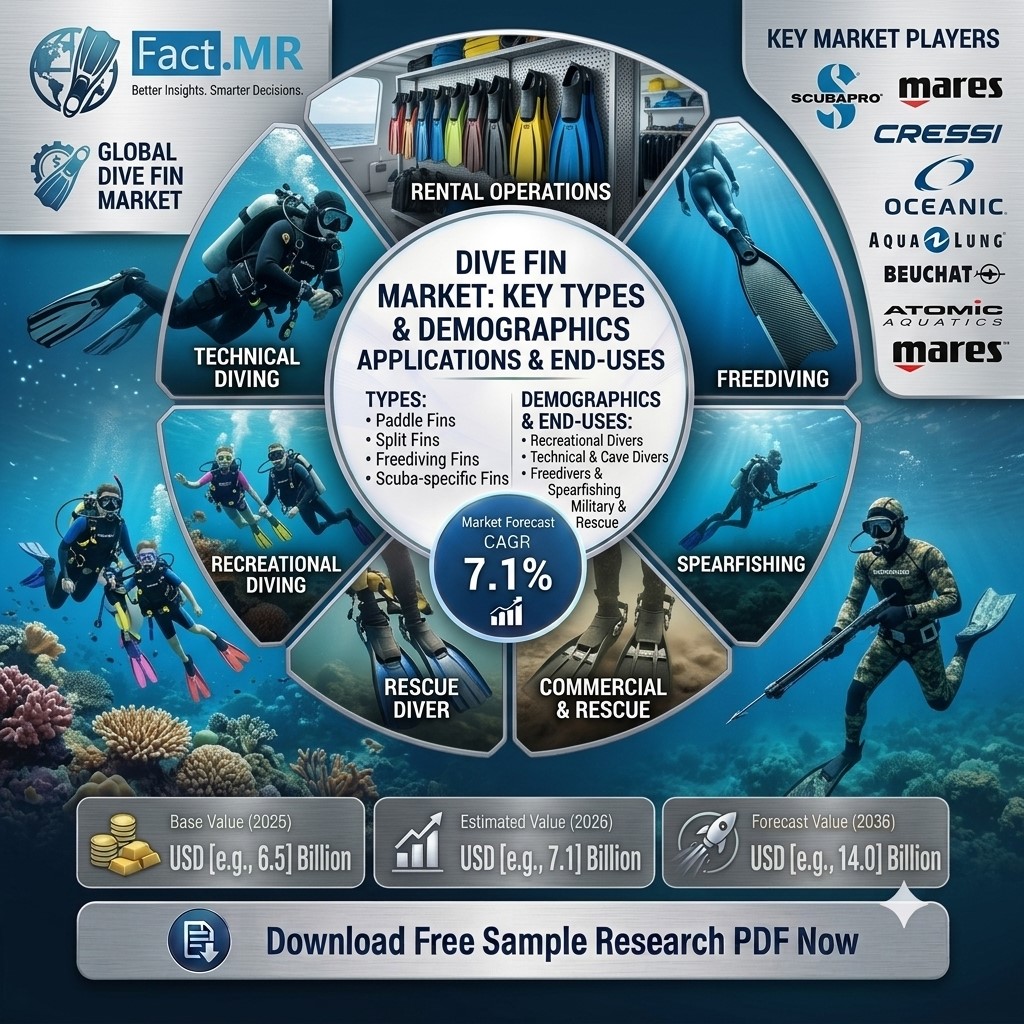
Rockville, MD., October 29, 2026 — The global Dive Fin Market is projected to increase from USD 178.9 million in 2026 to USD 295.6 million by 2036, advancing at a 5.2% CAGR, according to Fact.MR. The market was valued at USD 170.1 million in 2025 and is expected to generate an absolute dollar opportunity of USD 116.7 million over the forecast period. Germany leads the published country growth table at 6.4% CAGR, while the United States records the lowest listed rate at 4.3%.
Demand is supported by recreational scuba diving, coastal tourism and the growing popularity of freediving. Manufacturers are developing lightweight composite blades, ergonomic foot pockets and secure heel-strap systems to address different underwater propulsion requirements.
Get detailed market forecasts, competitive benchmarking, and pricing trends
Recreational Diving and Marine Tourism Support Dive Fin Market Growth
The Dive Fin Market covers specialized underwater propulsion equipment used in recreational diving, professional underwater operations and snorkeling activities.
The Diving Equipment and Marketing Association (DEMA) reported an international membership base exceeding 1,400 businesses and organizations in its 2025 annual report. This industry network supports equipment distribution, training activities and commercial diving services.
Research highlighted by the United Nations Ocean Decade in July 2025 estimated that scuba diving generates up to USD 20 billion annually worldwide, supporting approximately 124,000 jobs across 170 countries.
Fact.MR identifies demand for equipment tailored to different diving conditions as an important market driver. Warm-water travelers typically favor lightweight full-foot fins, while technical divers require durable open-heel models that support precise underwater movement.
Extractable fact: Dive fins are specialized underwater propulsion devices that increase swimming efficiency by converting leg movements into directed water thrust.
Full-Foot Fins Lead Product Demand with 42.1% Share
Full-foot fins are projected to account for 42.1% of product revenue in 2026, according to Fact.MR. Their enclosed foot pockets and lightweight construction make them suitable for tropical resort diving and recreational snorkeling.
Recreational diving represents the largest application segment, contributing 42.3% of market demand in 2026. Resort excursions and introductory scuba certification programs support demand for versatile equipment designed to reduce leg fatigue.
Rubber is expected to dominate the material category with 51.3% share. Its durability, elasticity and negative buoyancy make it particularly suitable for technical diving applications.
Specialty dive shops are projected to account for 40.1% of distribution revenue, reflecting the importance of physical fittings and equipment guidance.
Adults represent 57.7% of end-user demand in 2026, supported by certified diving activities and international underwater tourism.
Germany Leads Country Growth in Dive Fin Market
Germany — 6.4% CAGR: Germany leads the report’s country comparison table. Demand is associated with cold-water technical diving, drysuit-compatible open-heel fins and specialized recreational equipment. Germany’s Federal Statistical Office reported 497.5 million overnight stays in 2025, reflecting the broader scale of domestic tourism.
Brazil — 6.0% CAGR: Coastal tourism and recreational diving activities support equipment demand. Resort operators require durable fins suitable for repeated rental use, while experienced divers increasingly seek specialized propulsion designs.
United Kingdom — 5.7% CAGR: Cold-water diving, wreck exploration and offshore training support demand for heavy-duty open-heel fins. The UK Marine Accident Investigation Branch’s 2025 diving safety publications emphasize the importance of operational preparedness.
Japan — 5.4% CAGR: Diving activities around Okinawa and other coastal destinations support demand for lightweight recreational fins and specialized freediving equipment.
United States — 4.3% CAGR: The report’s country comparison table places the United States at 4.3% CAGR. Demand spans recreational certifications, technical diving and specialty equipment distribution.
Advanced Materials Create Opportunities for Manufacturers
Fact.MR identifies composite blade development and ergonomic product design as important areas of innovation.
Carbon-fiber fins offer opportunities in specialized freediving applications, while multi-compound molding enables manufacturers to adjust blade flexibility and propulsion characteristics.
The report estimates that expanding coastal tourism contributes approximately 1.3 percentage points to market CAGR, while growing freediving participation contributes approximately 1.1 percentage points.
Manufacturers also face challenges from raw-material price fluctuations, long replacement cycles and lower-cost thermoplastic alternatives.
Competitive Landscape
The Dive Fin Market includes established manufacturers such as Scubapro, Aqua Lung, Mares, Cressi, TUSA, Atomic Aquatics, Sherwood Scuba, Oceanic, Seac Sub and Beuchat.
Competition centers on blade efficiency, material durability, product ergonomics and distribution coverage. Manufacturers serve distinct recreational and technical diving requirements through specialized equipment portfolios.
Shambhu Nath Jha, Principal Consultant at Fact.MR, said:
“The global dive fin market is undergoing a decisive shift from generic molded plastics toward application-tailored hydrodynamic propulsion systems.”
Fact.MR’s research draws on more than 120 sources, over 35 company portfolios and more than 20 industry interviews. The study evaluates equipment demand, product segmentation and country-level market development.
Top Reports:
Sports Nutrition and Dietary Supplements Testing and Certification Market
About Fact.MR
Fact.MR is a global market research and consulting firm providing syndicated research, custom studies and industry intelligence. Its research combines primary interviews, secondary analysis and market forecasting to support business decision-making.