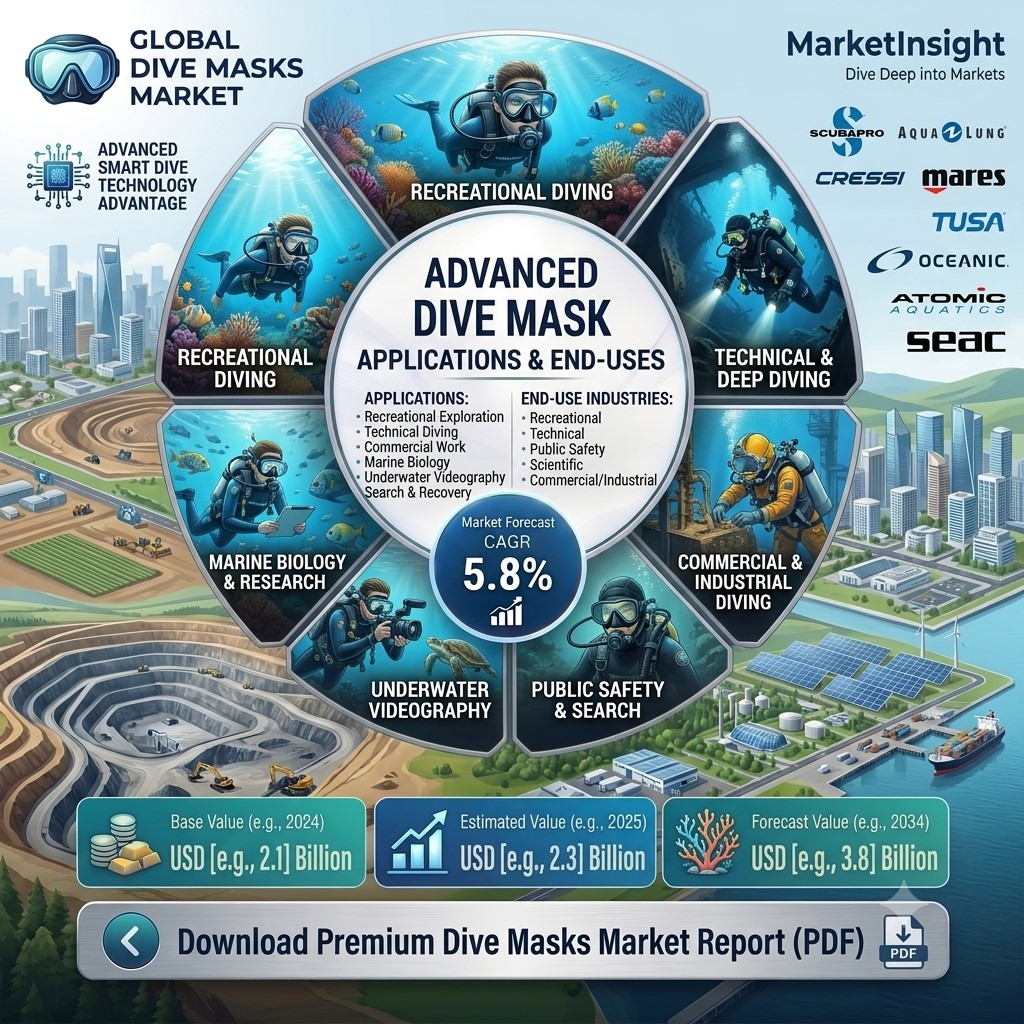
Rockville, MD., October 29, 2026 — The global Dive Masks Market is projected to increase from USD 325.8 million in 2026 to USD 556.6 million by 2036, expanding at a 5.5% CAGR, according to Fact.MR. The market was valued at USD 308.8 million in 2025 and is expected to generate an absolute dollar opportunity of USD 230.8 million during the forecast period. Among five countries analyzed, the United States leads with a 6.8% CAGR, while Japan records the lowest projected rate at 4.1%.
The demand outlook reflects continued participation in recreational diving and equipment replacement across coastal tourism destinations. Manufacturers are responding to demand for lighter frameless designs, silicone facial skirts and improved optical performance. Fact.MR estimates that frameless masks will capture 42.3% of product revenue in 2026, while recreational divers will generate 71.4% of total market demand.
Get detailed market forecasts, competitive benchmarking, and pricing trends
Marine Tourism and Diving Safety Support Dive Masks Market Growth
The global diving equipment industry is increasingly focused on equipment comfort, visibility and reliable underwater performance.
According to Fact.MR, recreational dive travel and open-water certification courses remain important purchasing triggers. First-time divers frequently purchase personally fitted masks, while established divers replace equipment to improve comfort or accommodate changing diving requirements.
The United Nations Ocean Decade reported on July 30, 2025, that scuba diving generates up to USD 20 billion globally each year. Its findings also highlighted the industry’s contribution to employment across 170 countries.
Marine conservation is another factor shaping equipment demand. NOAA’s 2025 visitor-use research highlighted monitoring requirements across the United States’ marine sanctuary network, which covers more than 629,000 square miles.
These developments create commercial opportunities for dive equipment manufacturers supplying tourism operators, specialist retailers and individual divers.
Market definition: Dive masks are specialized underwater eyewear designed to create a watertight air space around the eyes and nose, enabling underwater visibility and pressure equalization.
Frameless Dive Masks Lead Product Demand at 42.3%
Frameless dive masks are projected to represent 42.3% of the market in 2026, making them the largest product category.
Their construction eliminates conventional rigid external frames, positioning tempered glass lenses closer to the eyes. Fact.MR reports that this design can increase peripheral visibility by up to 25% compared with conventional dual-lens framed masks.
Smaller internal air volumes also simplify mask clearing and pressure equalization. Compact construction benefits traveling divers who prioritize lightweight equipment.
Silicone is expected to dominate material demand with a 58.4% share in 2026. Its flexibility, resistance to ultraviolet exposure and ability to maintain a dependable facial seal support adoption across recreational and professional applications.
Specialty dive shops will account for 38.5% of distribution revenue, reflecting the importance of in-person fitting and professional equipment guidance.
Recreational divers remain the largest end-user category, contributing 71.4% of market revenue in 2026.
United States Leads Country Growth at 6.8% CAGR
Fact.MR identifies different growth patterns across established diving economies and emerging marine tourism destinations.
- United States — 6.8% CAGR: Florida, Hawaii and California support demand through recreational diving, technical-diving communities and specialty equipment distribution. NOAA’s 2025 Gray’s Reef assessment identified increased recreational activity as an important marine management consideration.
- Brazil — 6.3% CAGR: Reef tourism, island destinations and warm-water diving courses are supporting demand for compact frameless masks and corrosion-resistant equipment.
- Germany — 5.2% CAGR: Inland diving, cold-water training and technical exploration sustain purchases of low-volume masks. Germany’s Federal Statistical Office reported 497.5 million overnight stays in 2025, reflecting a substantial domestic tourism base.
- United Kingdom — 4.4% CAGR: Wreck diving, cold-water clubs and specialist training sustain replacement demand. Buyers prioritize secure seals, dependable buckles and compatibility with diving hoods.
- Japan — 4.1% CAGR: Okinawa tourism and coastal diving activities support demand for prescription lenses, compact designs and durable silicone equipment.
The United States therefore offers the highest forecast growth among the five countries covered, while Japan maintains a comparatively moderate expansion trajectory.
Premium Materials and Optical Innovation Shape Competition
Product innovation is moving toward specialized silicone formulations, permanent anti-fog coatings and prescription-compatible lenses.
Fact.MR identifies coastal ecotourism and certification activity as contributing approximately 1.4 percentage points to forecast CAGR, while demand for ultra-low-volume frameless designs contributes approximately 1.2 percentage points.
Manufacturers are also examining customized facial fitting through three-dimensional scanning and recycled materials.
However, raw material price volatility and longer product replacement cycles remain challenges. Manufacturers must balance equipment durability with opportunities for repeat purchases.
Competitive Landscape: Leading Dive Mask Manufacturers
The Dive Masks Market includes established international manufacturers competing through product design, material quality and specialist distribution.
Key companies identified by Fact.MR include:
- Cressi
- Mares
- Scubapro
- Aqua Lung
- TUSA
- Oceanic
- Sherwood Scuba
- Beuchat
- Seac Sub
- IST Sports
These manufacturers participate in a market where optical performance, fit and dependable construction influence purchasing decisions. Fact.MR does not disclose individual company market shares.
Shambhu Nath Jha, Principal Consultant at Fact.MR, describes a shift toward engineered optical equipment:
“The global dive mask sector is shifting from basic commodity eyewear toward highly engineered optical instruments.”
This assessment reflects growing manufacturer attention to co-molded silicone construction, improved peripheral vision and specialized diving applications.
Top Reports:
About Fact.MR
Fact.MR is a market research and consulting firm providing syndicated and customized industry research. Its reports examine market trends, competitive developments, demand forecasts and regional business opportunities through primary and secondary research.