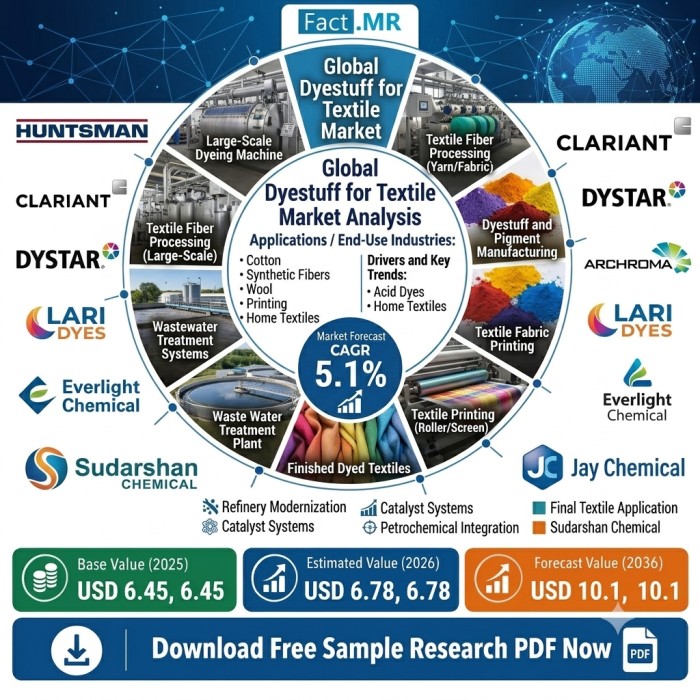
Rockville, Maryland — October 28, 2026 The global dyestuff for textile market is projected to reach USD 12.7 billion by 2036, increasing from an estimated USD 7.92 billion in 2026 at a compound annual growth rate (CAGR) of 4.8%, according to Fact.MR. The market outlook reflects continued requirements for consistent coloration across apparel, home textiles, and industrial textile applications, alongside growing attention to fiber compatibility, processing efficiency, and environmental compliance.
Fact.MR identifies Archroma, Everlight Chemical Industrial Corporation, Zhejiang Longsheng Group Co., Ltd., Kiri Industries Limited, and Zhejiang Runtu Co., Ltd. among the companies profiled in its competitive analysis. These manufacturers operate in a market where reliable color performance, application-specific formulations, and technical support influence purchasing decisions among textile processors.
The report estimates that the market will create an absolute opportunity of approximately USD 4.8 billion between 2026 and 2036. For manufacturers, chemical suppliers, textile mills, and sourcing teams, this outlook highlights the importance of aligning product development and procurement strategies with changing coloration requirements.
Get detailed market forecasts, competitive benchmarking, and pricing trends:
Dyestuff for Textile Market: Key Takeaways
- 2026 market valuation: USD 7.92 billion.
- 2036 market forecast: USD 12.7 billion.
- Forecast CAGR: 4.8% from 2026 to 2036.
- Leading dye type: Reactive dyes, with a projected 32.6% share in 2026.
- Leading application: Apparel, accounting for an estimated 52.3% share in 2026.
- Leading fiber category: Polyester, projected to represent 52.0% of the market in 2026.
- Fastest-growing country among those highlighted: Germany, with a projected 6.0% CAGR through 2036.
Source: Fact.MR, Dyestuff for Textile Market report, updated October 26, 2026.
What Is Driving Growth in the Dyestuff for Textile Market?
Demand for textile dyestuffs is closely connected to fabric manufacturing, garment production, and the need to reproduce specified colors across commercial production batches. Apparel brands and textile mills require coloration solutions that meet shade specifications while delivering suitable wash fastness and consistent results across different production lots.
Synthetic fibers represent another important area of demand. Polyester requires dye systems compatible with its chemical structure, with disperse dyes widely used for polyester coloration. Cotton and other compatible cellulosic fibers commonly use reactive dyes, while acid and direct dyes address other fiber and processing requirements.
These differences create opportunities for manufacturers to develop formulations tailored to particular substrates, applications, and dyeing conditions. Suppliers that help textile mills improve shade reproducibility and manage application requirements can strengthen their position when customers evaluate vendors for repeat orders.
Environmental compliance is also influencing product selection and manufacturing decisions. Textile dyeing and finishing facilities must consider applicable effluent standards, wastewater treatment requirements, and chemical compliance obligations. These considerations can affect production costs, process selection, and the suitability of particular dye formulations.
Which Product Segments Offer the Strongest Opportunities?
According to Fact.MR, reactive dyes are projected to account for 32.6% of the dyestuff for textile market in 2026. Their suitability for cotton and other compatible cellulosic fibers supports applications where wash fastness and repeatable coloration are important.
Apparel is forecast to represent 52.3% of the market in 2026. Garment production generates recurring requirements for dyes across everyday clothing, sportswear, uniforms, and fashion products. Manufacturers must accommodate changing color specifications while maintaining consistency and operational efficiency.
Polyester is projected to hold a 52.0% share by fiber type in 2026. Its substantial contribution to the market makes polyester-compatible coloration an important consideration for dye producers and textile chemical suppliers.
For business decision-makers, these figures provide a framework for reviewing product portfolios and customer requirements. Companies can assess whether their existing capabilities align with demand from apparel manufacturers, polyester processors, and textile mills requiring specialized color performance.
Which Countries Present Regional Growth Opportunities?
Germany is projected to record a 6.0% CAGR from 2026 to 2036, making it the fastest-growing country among the five markets highlighted in the report. Its textile manufacturing and finishing activities provide a relevant industrial base for suppliers of specialized coloration chemicals. Companies targeting Germany can evaluate opportunities linked to technical performance, product consistency, and environmental requirements.
Brazil is forecast to expand at a CAGR of 5.5% during the same period. Its textile and apparel value chain creates potential demand for dyes used in fabric production and garment manufacturing. Suppliers can assess opportunities through customer relationships, reliable color matching, and formulations suited to different fibers.
The United States market is projected to grow at a 4.9% CAGR. Buyers serving apparel, home textiles, and specialized textile applications require dyes that meet specifications for colorfastness, chemical compliance, and batch consistency.
The United Kingdom is forecast to record a 4.4% CAGR, while Japan is projected to grow at 3.9%. In both markets, supplier opportunities will depend on textile manufacturing activity, sourcing decisions, application requirements, and demand for specialized coloration solutions.
These country forecasts can help companies prioritize market-entry assessments, distributor development, technical service coverage, and product qualification efforts.
Who Are the Top Companies in the Dyestuff for Textile Market?
Fact.MR profiles the following five companies in its competitive overview:
- Archroma
Archroma supplies textile dyes and coloration solutions. Its market relevance includes product performance, dyeing-process expertise, and application support for textile manufacturers.
- Everlight Chemical Industrial Corporation
Everlight Chemical Industrial Corporation offers textile colorants for different fiber types and dyeing requirements. Its activities place it among the manufacturers identified in the report.
- Zhejiang Longsheng Group Co., Ltd.
Zhejiang Longsheng Group participates in dyestuffs and dye intermediates. Its presence reflects the role of established chemical manufacturers in supplying materials for industrial coloration.
- Kiri Industries Limited
Kiri Industries supplies textile dyes and dye intermediates for industrial coloration requirements. Product quality, manufacturing capabilities, and customer specifications are relevant considerations for suppliers in this category.
- Zhejiang Runtu Co., Ltd.
Zhejiang Runtu manufactures dyestuffs and related chemical products for industrial applications, including textile coloration.
The companies above are identified as market participants, not as a ranked list. Fact.MR’s cited market summary does not establish a definitive ranking or disclose individual market shares for these companies.
Competitive positioning in the dyestuff for textile market depends on portfolio breadth, fiber compatibility, colorfastness, formulation quality, manufacturing capabilities, technical support, and compliance with applicable chemical and environmental requirements.
Strategic Priorities for Textile Dye Manufacturers
The forecast period through 2036 gives market participants a basis for reviewing their commercial and operational priorities.
First, manufacturers can assess opportunities in reactive dyes and polyester-compatible coloration systems against their existing technical capabilities and customer demand.
Second, suppliers can strengthen application support for shade matching, batch reproducibility, fiber compatibility, and dye-house process optimization. These services address practical requirements faced by textile processors and can help customers evaluate supplier performance.
Third, manufacturers and textile mills can review chemical documentation, wastewater treatment compatibility, and applicable environmental obligations when qualifying products and planning production processes.
Businesses evaluating regional expansion can also compare the projected growth rates of Germany, Brazil, the United States, the United Kingdom, and Japan with their distribution networks, customer relationships, and technical service capabilities.
These priorities do not guarantee market-share gains. They provide a practical basis for evaluating commercial opportunities in a market shaped by coloration performance, textile production requirements, and environmental considerations.
About the Dyestuff for Textile Market Report
The Fact.MR Dyestuff for Textile Market report examines global demand for textile colorants used across fibers, yarns, fabrics, apparel, home textiles, and industrial textile applications.
The analysis covers reactive dyes, disperse dyes, acid dyes, direct dyes, and other dye categories. It also evaluates applications, including apparel, home textiles, and industrial textiles, alongside fiber types such as polyester, cotton, wool, silk, and nylon.
The report includes regional analysis covering North America, Latin America, Western Europe, Eastern Europe, East Asia, South Asia and the Pacific, and the Middle East and Africa. Country-level forecasts highlight Germany, Brazil, the United States, the United Kingdom, and Japan.
Explore More Related Studies Published by Fact.MR Research
Carton Closing Staplers Market-
Bleached Machine Glazed Papers Market-
About Fact.MR
Fact.MR is a market research and consulting firm providing syndicated research, customized research, investment research, and market intelligence across a broad range of industries. Its research coverage includes food and beverage, healthcare, pharmaceuticals, biotechnology, consumer products, chemicals and materials, technology, industrial goods, and packaging.
Fact.MR provides market intelligence designed to help organizations understand market dynamics, emerging opportunities, competitive developments, and changing industry requirements.
Media Contact
Fact.MR
Email: sales@factmr.com
Phone: +1 (628) 251-1583
Website: www.factmr.com