Mobile drug reference applications account for 34.0% of the market as healthcare professionals increasingly rely on accessible medication information and clinical decision support.
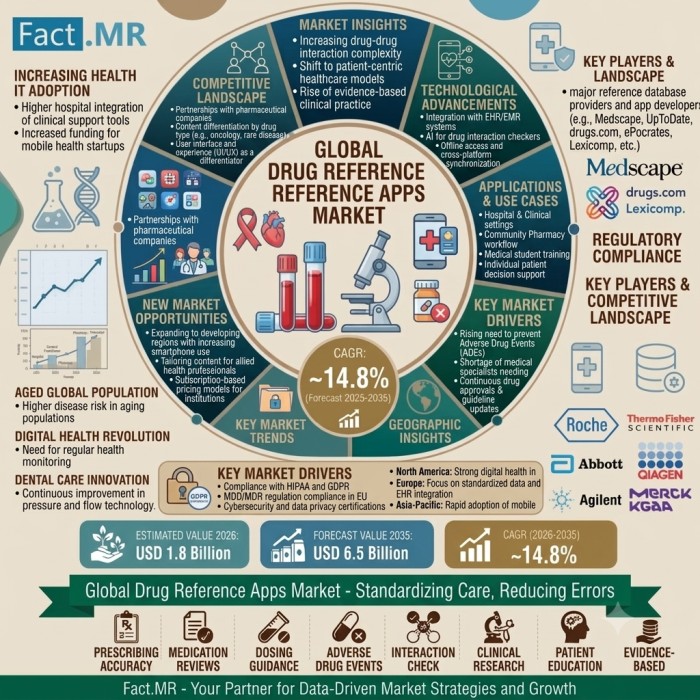
Rockville, Maryland – October 15, 2026 — The global drug reference apps market is projected to grow from USD 2.2 billion in 2026 to USD 5.6 billion by 2036, according to the latest market report published by Fact.MR. The industry is anticipated to expand at a compound annual growth rate (CAGR) of 9.7% over the forecast period, supported by the growing need for reliable drug information, medication safety, and integration with clinical workflows.
Get detailed market forecasts, competitive benchmarking, and pricing trends:
KEY MARKET TAKEAWAYS
- Market Valuation: USD 2.2 billion in 2026, projected to reach USD 5.6 billion by 2036.
- Growth Rate: Expanding at a CAGR of 9.7% from 2026 to 2036.
- Leading Product Segment: Mobile Drug Reference Apps are expected to account for 34.0% of the market in 2026.
- Leading Application: Drug Information Lookup is projected to hold a 31.0% share in 2026.
- Leading End User: Hospitals are anticipated to account for 36.0% of the market in 2026.
- Fastest-Growing Country: The United States is forecast to record the highest listed country CAGR at 10.6%.
- Core Growth Driver: Increasing medication-safety requirements and demand for current drug information at the point of care.
INDUSTRY SHIFTS & MARKET DYNAMICS
Drug reference applications are becoming increasingly important in clinical environments where healthcare professionals need timely access to medication monographs, dosage information, drug identification, and interaction checks. Physicians and pharmacists use digital references to support medication-related decisions without relying exclusively on printed resources or fixed workstations. Mobile applications offer convenient access during clinical rounds, prescription reviews, and patient consultations. In 2026, mobile drug reference apps are expected to lead the product category with a 34.0% share, while drug information lookup is projected to account for 31.0% of application demand.
Hospitals are anticipated to represent 36.0% of the market in 2026, reflecting the value of institution-wide access for clinical and pharmacy teams. Enterprise subscriptions and integration with electronic health records and prescribing systems can help providers incorporate medication information into existing workflows. However, free alternatives, publicly available drug labels, integration expenses, and clinical governance requirements may constrain adoption. Vendors must demonstrate the accuracy, traceability, and timeliness of their content to support purchasing decisions. Artificial intelligence-enabled search and clinical information retrieval present additional opportunities, provided that answers remain verifiable and suitable for professional review.
REGIONAL MARKET SUMMARY
The following country-level growth projections cover the 2026–2036 forecast period.
| Country | Forecast CAGR | Growth context |
| United States | 10.6% | Health-system licensing and connected clinical decision support |
| Japan | 10.3% | Local drug-label alignment and pharmacy workflows |
| Germany | 10.0% | Connected prescribing and medication-list integration |
| United Kingdom | 9.7% | Institutional medication-safety requirements |
| Canada | 9.4% | Hospital and community pharmacy information needs |
The United States is projected to record the fastest growth among the listed countries, followed by Japan and Germany. These markets offer opportunities for providers that can combine reliable medication content with integration support and transparent update processes.
ANALYST INSIGHTS
“Premium adoption depends on update discipline and integration support. AI answers need citations before clinical users can trust them,” stated Shambhu Nath Jha, Principal Consultant at Fact.MR. “Providers that demonstrate reliable content governance and fit drug information into existing clinical workflows can strengthen their position as healthcare organizations evaluate digital medication-reference solutions.”
Unlock 360° insights for strategic decision making and investment planning:
FREQUENTLY ASKED QUESTIONS
Q: What is the projected size of the drug reference apps market by 2036?
A: The market is estimated at USD 2.2 billion in 2026 and is projected to reach USD 5.6 billion by 2036, growing at a CAGR of 9.7%.
Q: Which product segment holds the leading market share?
A: Mobile Drug Reference Apps are expected to account for 34.0% of the product segment in 2026.
Q: Which application leads the market?
A: Drug Information Lookup is projected to account for 31.0% of the application segment in 2026.
Q: Which country exhibits the highest growth rate?
A: The United States is projected to record the highest listed country CAGR at 10.6% between 2026 and 2036.
Q: What are the main factors driving market growth?
A: Medication-safety requirements, point-of-care access to current drug information, mobile clinical workflows, and integration with prescribing systems are key growth drivers.
Q: What challenges could restrict market expansion?
A: Free alternatives, enterprise integration costs, clinical governance requirements, and the need for reliable, regularly updated drug information may constrain adoption.
Explore More Related Studies Published by Fact.MR Research
Magnetic Stripe Readers Market
About Fact.MR
Fact.MR is a market research and consulting firm providing syndicated research, customized research, investment research, and market intelligence across a broad range of industries. Its research coverage includes food and beverage, healthcare, pharmaceuticals, biotechnology, consumer products, chemicals and materials, technology, industrial goods, and packaging.
Fact.MR provides market intelligence designed to help organizations understand market dynamics, emerging opportunities, competitive developments, and changing industry requirements.
Media Contact
Fact.MR
Email: sales@factmr.com
Phone: +1 (628) 251-1583
Website: www.factmr.com