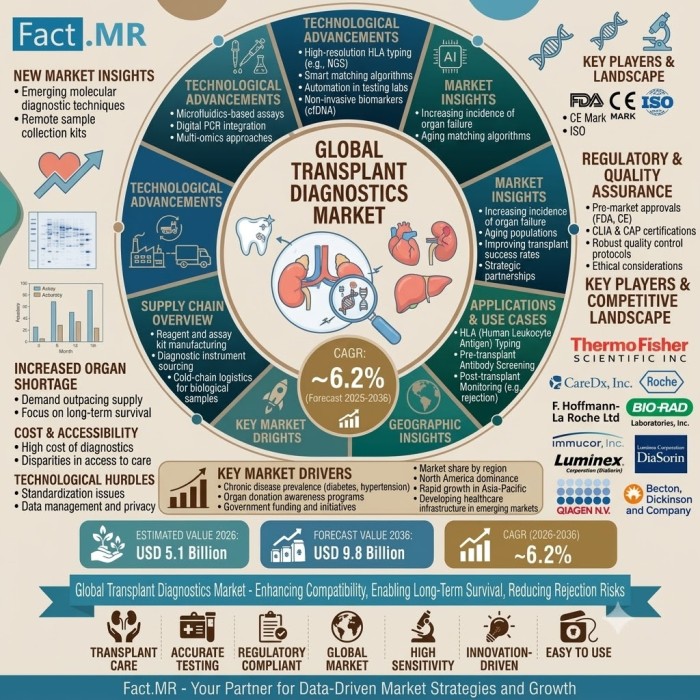
Growing demand for molecular diagnostic assays and improved transplant compatibility testing is supporting market expansion worldwide.
Rockville, Maryland – October 14, 2026 — The global transplant diagnostics market is projected to grow from USD 7.4 billion in 2026 to USD 15.3 billion by 2036, registering a compound annual growth rate (CAGR) of 7.6% over the forecast period. According to the latest market report published by Fact.MR, demand is supported by the need for accurate donor-recipient compatibility assessment, advances in molecular diagnostics, and the expansion of transplant care infrastructure. The market is expected to create an absolute dollar opportunity of approximately USD 8.0 billion between 2026 and 2036.
Get detailed market forecasts, competitive benchmarking, and pricing trends:
KEY MARKET TAKEAWAYS
- Market Valuation: USD 7.4 billion in 2026, rising to USD 15.3 billion by 2036.
- Growth Rate: Expanding at a CAGR of 7.6% from 2026 to 2036.
- Leading Product Segment: Molecular diagnostic assays are projected to account for 47% of the market in 2026.
- Leading Application: Solid organ transplantation is expected to represent 54% of application demand in 2026.
- Leading End-User: Hospitals are projected to account for 52% of the market in 2026.
- Fastest-Growing Country: India is forecast to lead country-level growth at an 8.6% CAGR.
- Core Growth Driver: Increasing demand for transplant compatibility testing, molecular diagnostics, and post-transplant monitoring.
INDUSTRY SHIFTS & MARKET DYNAMICS
Molecular Testing Supports Transplant Compatibility Assessment
Transplant diagnostics plays an important role in evaluating donor-recipient compatibility and supporting clinical decisions before and after transplantation. Molecular diagnostic assays are projected to remain the leading product category, accounting for 47% of the market in 2026. These tests support human leukocyte antigen (HLA) typing and other assessments used in transplant evaluation. Their importance is reinforced by the need to identify immunological incompatibilities and support appropriate clinical management.
The growing use of advanced diagnostic technologies is creating opportunities for manufacturers of molecular assays, next-generation sequencing tests, immunoassays, and biomarker-based products. Next-generation sequencing offers capabilities for high-resolution HLA typing, while established molecular methods continue to serve routine testing needs. As healthcare providers seek dependable testing workflows, diagnostic suppliers can compete through analytical performance, standardized procedures, product quality, and reliable reagent availability.
Hospital Procurement and Regulatory Requirements Shape Competition
Hospitals are projected to account for 52% of the transplant diagnostics market in 2026, reflecting their central role in transplant procedures and associated testing. Diagnostic laboratories and research institutes also contribute to demand through specialized testing and research activities. Procurement decisions increasingly require suppliers to demonstrate consistent product performance, compliance with applicable regulations, and dependable supply arrangements.
Market participants face challenges from pricing pressure, regulatory differences across countries, and supply-chain concentration. These factors can affect product launches, manufacturing costs, and commercial margins. Companies must balance investment in advanced diagnostic technologies with cost control and distribution capabilities. Suppliers that combine validated products with strong institutional relationships may be better positioned to serve established transplant centers and expanding healthcare markets.
REGIONAL MARKET SUMMARY
India and China are projected to record the fastest country-level growth in the transplant diagnostics market through 2036. India’s market is expected to expand at an 8.6% CAGR, followed by China at 8.3%. Brazil, the United States, and the United Kingdom also represent important markets, with growth supported by transplant-related healthcare demand, diagnostic infrastructure, and institutional purchasing.
| Country | CAGR (2026–2036) | Market Outlook |
| India | 8.6% | Expanding healthcare and transplant diagnostic infrastructure |
| China | 8.3% | Growing adoption of advanced diagnostic testing |
| Brazil | 7.4% | Improving access to institutional diagnostic services |
| United States | 7.2% | Established transplant centers and molecular testing capabilities |
| United Kingdom | 7.0% | Institutional demand and established clinical testing infrastructure |
Source: Fact.MR, Transplant Diagnostics Market report.
ANALYST INSIGHTS
“The transplant diagnostics market is structurally evolving from a product-led market toward one where supply chain positioning, regulatory compliance, and distribution reach determine competitive outcomes. Buyers are consolidating procurement around suppliers that can guarantee consistent quality, meet certification requirements, and maintain supply continuity across multiple geographies,” stated Shambhu Nath Jha, Principal Consultant at Fact.MR.
The report highlights opportunities for suppliers that combine advanced testing capabilities with reliable commercial execution. As diagnostic requirements evolve, manufacturers will need to address clinical testing needs while maintaining quality standards, efficient distribution, and competitive pricing.
Unlock 360° insights for strategic decision making and investment planning:
FREQUENTLY ASKED QUESTIONS
Q: What is the projected size of the transplant diagnostics market by 2036?
A: The market is estimated at USD 7.4 billion in 2026 and is projected to reach USD 15.3 billion by 2036, growing at a CAGR of 7.6%.
Q: Which product segment holds the leading market share?
A: Molecular diagnostic assays are projected to lead the product segment, accounting for 47% of the market in 2026.
Q: Which application segment accounts for the largest share?
A: Solid organ transplantation is expected to represent 54% of application demand in 2026.
Q: Which end-user segment leads the market?
A: Hospitals are projected to account for 52% of the market in 2026.
Q: Which country exhibits the highest growth rate?
A: India is projected to record the highest growth among the countries listed, with an 8.6% CAGR from 2026 to 2036.
Q: What factors are driving market growth?
A: Demand for donor-recipient compatibility testing, molecular diagnostic assays, advanced HLA typing, and post-transplant monitoring is supporting market expansion.
Q: What are the key challenges facing the market?
A: Pricing pressure, differences in regulatory requirements, and supply-chain concentration may affect manufacturers’ costs, product availability, and profitability.
Explore More Related Studies Published by Fact.MR Research
Familial Hypercholesterolemia Treatment Market
About Fact.MR
Fact.MR is a market research and consulting firm providing syndicated research, customized research, investment research, and market intelligence across a broad range of industries. Its research coverage includes food and beverage, healthcare, pharmaceuticals, biotechnology, consumer products, chemicals and materials, technology, industrial goods, and packaging.
Fact.MR provides market intelligence designed to help organizations understand market dynamics, emerging opportunities, competitive developments, and changing industry requirements.
Media Contact
Fact.MR
Email: sales@factmr.com
Phone: +1 (628) 251-1583
Website: www.factmr.com