European food-contact rules and growing demand for protective metal packaging are increasing the need for coatings that maintain product compatibility, corrosion resistance and flexibility during manufacturing, according to Fact.MR.
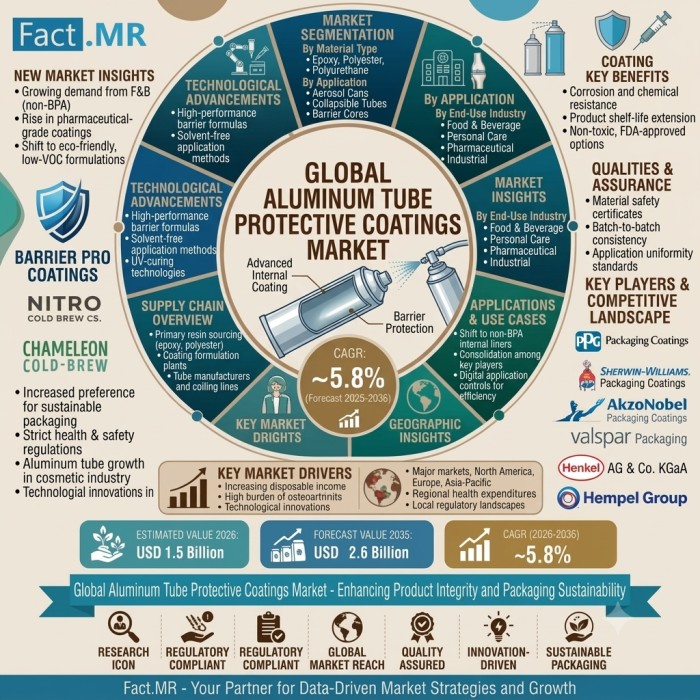
NEWARK, Del., October 12, 2026. The global aluminum tube protective coatings market is projected to grow from USD 4.3 billion in 2026 to USD 8.2 billion by 2036, registering a compound annual growth rate (CAGR) of 6.8%, according to Fact.MR. Demand is being shaped by changes in food-contact requirements, the use of aluminum in recyclable packaging and the need for coatings that withstand forming, filling and sealing operations.
The report identifies polyester as the leading coating chemistry, with a projected 34.0% share in 2026. Internal lining accounts for the largest coating-position segment at 36.0%, while corrosion resistance leads the performance category at 29.0%. These segments reflect the importance of protecting metal packaging from its contents without compromising production performance.
Get detailed market forecasts, competitive benchmarking, and pricing trends
Regulatory changes increase the focus on coating compliance
Food-contact requirements are encouraging packaging companies to review the chemistry and documentation of protective coatings. On March 7, 2025, the European Commission published information on the prohibition of bisphenol A (BPA) in food-contact materials, with the rule applying from January 20, 2025, according to the Fact.MR report.
The European Commission also announced on February 11, 2025, that the Packaging and Packaging Waste Regulation had entered into force. The regulation addresses packaging waste, recycling and reuse, adding to the requirements packaging businesses must consider when selecting materials and coating systems.
For coating manufacturers, these developments make formulation documentation, migration testing and product compatibility important parts of customer qualification. Packaging producers must also establish whether a new coating can operate within existing curing temperatures and line speeds.
Where growth is fastest
Fact.MR forecasts growth across five profiled countries through 2036:
- United States: A 7.0% CAGR is projected, supported by established metal-packaging production and aluminum recovery. The U.S. Geological Survey reported on January 31, 2025, that approximately 3.6 million tons of aluminum were recovered from purchased scrap in 2024.
- France: The market is expected to expand at a 7.0% CAGR. Beverage packaging demand and European food-contact requirements support the outlook.
- Germany: A 6.8% CAGR is forecast as packaging producers qualify coating systems for European requirements and different product applications.
- China: The market is projected to grow at a 6.8% CAGR, supported by beverage manufacturing and large-scale packaging production.
- Japan: A 5.7% CAGR is expected, with personal-care and pharmaceutical packaging contributing to demand for aluminum tube formats.
The United States and France share the highest projected growth rate among the countries profiled. Germany and China follow closely, while Japan’s forecast reflects a more moderate growth trajectory.
What leads the market?
Four segments account for the leading positions in Fact.MR’s 2026 estimates:
- Polyester coatings: 34.0% share by coating chemistry, supported by flexibility during forming and protection against chemical exposure.
- Beverage cans: 31.0% share by package type, reflecting high-volume production and the need for consistent internal protection.
- Internal lining: 36.0% share by coating position, helping separate packaged products from the aluminum surface.
- Corrosion resistance: 29.0% share by performance, reflecting the need to protect metal packaging during filling, storage and transport.
These segments serve related but distinct requirements. Coatings for collapsible tubes must tolerate shaping and sealing, while beverage and food containers may require different thermal and product-compatibility properties.
The hurdle: Qualification and production consistency
Long qualification cycles remain a key restraint. New coating chemistries must be evaluated for compatibility with the packed product, adhesion, flexibility, curing conditions and performance under normal manufacturing conditions.
Changes to existing production lines can also complicate adoption. A coating that performs well under one curing window may require adjustments when used with different packaging formats or products. Suppliers must therefore support customers through testing and line conversion rather than relying on formulation specifications alone.
Fact.MR identifies low-temperature curing systems, non-BPA epoxy alternatives, coatings for pharmaceutical and personal-care tubes, and application support for production-line conversion as opportunities through 2036.
Industry investment and recent developments
Three developments illustrate the regulatory and operational issues affecting the sector:
- 2024: Sherwin-Williams acquired Henkel’s Metal Packaging Coatings business, adding production sites, products and customers to its packaging coatings operations.
- February 11, 2025: The European Commission announced that the Packaging and Packaging Waste Regulation had entered into force, addressing recycling, reuse and circular use of packaging materials.
- 2025: ALTANA’s corporate reporting described ACTEGA coatings developed in Brazil that reduce baking temperatures to 195–200°C and customer energy use by up to 15%.
These developments point to two areas of industry focus: meeting evolving packaging requirements and improving coating performance under production conditions.
The key companies profiled by Fact.MR are PPG Industries, AkzoNobel, Sherwin-Williams and ACTEGA. The report notes that PPG Hoba coatings are used for collapsible tubes, one-piece aerosols and aluminum bottles. Sherwin-Williams offers valPure coatings for aluminum tubes, while AkzoNobel and ACTEGA also supply coatings for metal packaging applications.
Analyst perspective
Shambhu Nath Jha, Principal Consultant at Fact.MR, states:
“Demand is growing for coatings that resist chemicals and stay flexible during shaping. Clear food-contact and migration documents make approval easier. Production support also helps suppliers get their coatings approved for more packaging lines.”
What this means for packaging manufacturers and procurement teams
- Review compliance documentation before changing coating suppliers. Confirm food-contact documentation, migration testing and product compatibility requirements before approving a new formulation. Qualification delays can affect production schedules.
- Test coatings on the actual production line. Assess adhesion, flexibility, curing conditions and performance during shaping, filling and sealing. Trial results should reflect the intended package format and packed product.
- Compare coating performance with total operating costs. Evaluate curing requirements, energy consumption, line-conversion needs and quality-control costs alongside purchase price. Low-temperature curing and application support may offer practical opportunities where the production process allows them.
Unlock 360° insights for strategic decision making and investment planning:
Report details
Fact.MR’s Aluminum Tube Protective Coatings Market report examines the 2026–2036 outlook, covering coating chemistry, package type, coating position, performance, regional demand and key companies.
Explore More Related Studies Published by Fact.MR Research
Electron Beam Curable Ink Market-
About Fact.MR
Fact.MR is a market research and consulting firm providing syndicated research, customized research, investment research, and market intelligence across a broad range of industries. Its research coverage includes food and beverage, healthcare, pharmaceuticals, biotechnology, consumer products, chemicals and materials, technology, industrial goods, and packaging.
Fact.MR provides market intelligence designed to help organizations understand market dynamics, emerging opportunities, competitive developments, and changing industry requirements.
Media Contact
Fact.MR
Email: sales@factmr.com
Phone: +1 (628) 251-1583
Website: www.factmr.com