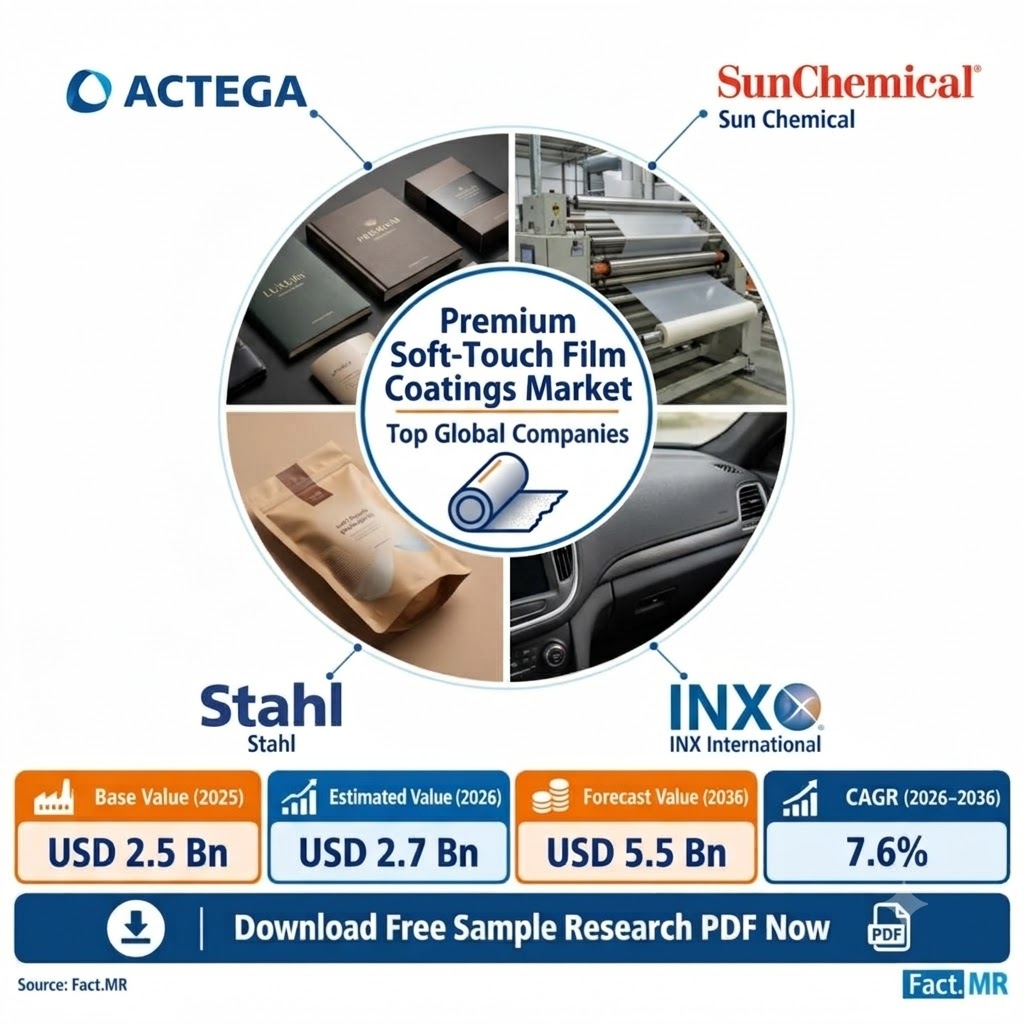
The global premium soft-touch film coatings market is projected to grow from USD 2.7 billion in 2026 to USD 5.5 billion by 2036, registering a compound annual growth rate (CAGR) of 7.6%, according to Fact.MR. The market was valued at USD 2.5 billion in 2025, with an absolute opportunity of approximately USD 2.8 billion over the forecast period.
Demand is being shaped by packaging requirements that extend beyond visual appeal. Beauty brands, luxury goods manufacturers and electronics companies increasingly need packaging finishes that deliver a consistent tactile experience while maintaining print quality and withstanding handling during storage and delivery.
Get detailed market forecasts, competitive benchmarking, and pricing trends:
E-commerce and packaging material choices shape demand
Packaging performance is becoming a more important consideration as online retail expands and brands compete through product presentation. Soft-touch coatings provide a matte or velvet-like surface on cartons, films and labels, allowing manufacturers to change the feel of packaging without changing its basic structure.
The U.S. Census Bureau estimated retail e-commerce sales at USD 340.2 billion in the second quarter of 2026, according to the report’s cited August 18, 2026, release. China’s National Bureau of Statistics reported online retail sales of physical goods at 13,092.3 billion yuan in 2025 in data published on January 20, 2026.
Recycling requirements also affect material selection. Eurostat reported in October 2025 that paper and cardboard represented 40.4% of EU packaging waste in 2023. For coating suppliers and packaging converters, this creates a need to assess tactile performance alongside material recovery, coating weight and compatibility with existing production processes.
Where growth is fastest
The five profiled countries show different demand patterns, reflecting their packaging industries, consumer markets and material requirements.
- USA — 8.0% CAGR: Premium packaging, online retail and parcel handling support demand for finishes that maintain their appearance during delivery.
- France — 8.0% CAGR: Luxury goods, beauty products and premium food packaging create demand for distinctive surface finishes.
- China — 7.8% CAGR: High-volume online retail and demand for printed cartons, films and labels support coating adoption.
- Germany — 7.8% CAGR: Packaging conversion activity and attention to recycling compatibility influence coating selection.
- Japan — 6.7% CAGR: Premium presentation and e-commerce packaging support demand for matte and soft-touch finishes.
The country forecasts indicate that similar growth rates can reflect different commercial requirements. Suppliers entering these markets need to consider substrate preferences, local customer specifications, printing capabilities and recycling expectations rather than relying on growth rates alone.
What leads the market
Four segments are expected to account for substantial shares of demand in 2026.
- Coating chemistry — Water-based polyurethane: Expected to hold 34.0% of the market. Its soft feel and suitability for printed packaging support its use across premium applications.
- Substrate — Paperboard: Projected to account for 31.0%. Folding cartons provide a broad printable surface and are widely used for luxury, beauty and electronics products.
- End-use — Luxury packaging: Expected to capture 36.0%. Brands use tactile finishes to reinforce product presentation and distinguish packaging at the point of purchase.
- Finish — Velvet / suede: Estimated to represent 29.0%. Its low-shine appearance and distinctive surface feel suit premium cartons, labels and films.
Water-based acrylics, polyurethane-acrylic blends, bio-based dispersions and UV-waterborne hybrid systems serve other formulation and processing needs. Flexible films, rigid plastics, metal packaging and specialty labels also provide applications beyond paperboard cartons.
The hurdle: Recycling and production performance
The principal challenge is balancing tactile quality with material compatibility and efficient processing. A coating may deliver the desired feel but still require further testing to establish its performance on a particular substrate or finished package.
Fact.MR identifies recycling compatibility limits as a restraint, with an estimated negative impact of 0.6 percentage points on CAGR in its driver-and-restraint analysis. Surface blocking and rub sensitivity represent another constraint, with an estimated negative impact of 0.4 percentage points.
Additional coating and curing costs can affect production economics. Substrate-specific qualification cycles may also delay adoption when manufacturers need to repeat tests across different films, boards, printing conditions or packaging designs.
These factors make early qualification important. Packaging buyers need to evaluate the finished pack, not just the coating formulation, before committing to larger production volumes.
Industry investment and recent developments
Supplier activity and product development provide context for competition in specialty packaging coatings.
- August 11, 2025 — Siegwerk: The company announced that it was strengthening its coating business through the acquisition of chemicals producer Allinova, according to the report’s cited company announcement.
- August 18, 2025 — Sun Chemical: The company announced plans to showcase packaging solutions at FACHPACK 2025, as well as PACK EXPO-related activity referenced in the report’s company coverage.
- October 22, 2025 — Eurostat: The statistical agency published information on plastic packaging waste in the EU, providing context for packaging material choices and recycling considerations.
The report profiles ACTEGA, Sun Chemical, Stahl and INX International as key providers. Buyers compare soft-touch consistency, print clarity, scuff resistance, recycling compatibility, drying requirements and substrate fit when evaluating coating systems.
Analyst opinion
Shambhu Nath Jha, Principal Consultant at Fact.MR, states:
“Brands choose soft-touch coatings based on how well they work with the package, not only how they look. Demand is higher for coatings that give a consistent soft feel and work well during printing and handling. Suppliers with good knowledge of coatings and packaging can help companies approve products faster.”
What this means for packaging buyers
- Qualify coatings on the finished package. Test rub resistance, surface consistency and print quality on the intended substrate. Include folding, handling and delivery conditions where relevant to the application.
- Assess recycling compatibility early. Packaging designers and procurement teams should review the coating’s effect on the intended paperboard or film recovery process before finalizing material specifications. Early assessment can reduce costly redesigns and repeated qualification work.
- Compare total processing requirements. Evaluate coating weight, drying and curing needs, production-line compatibility and approval time alongside the purchase price. These factors help determine whether a coating can meet both quality targets and manufacturing requirements at scale.
Top Trending Reports:
About Fact.MR
Fact.MR is a market research and consulting firm that provides market intelligence, industry analysis and forecasts across a range of sectors. Its research examines market size, demand patterns, competitive activity and growth opportunities to support business planning and strategic decisions.