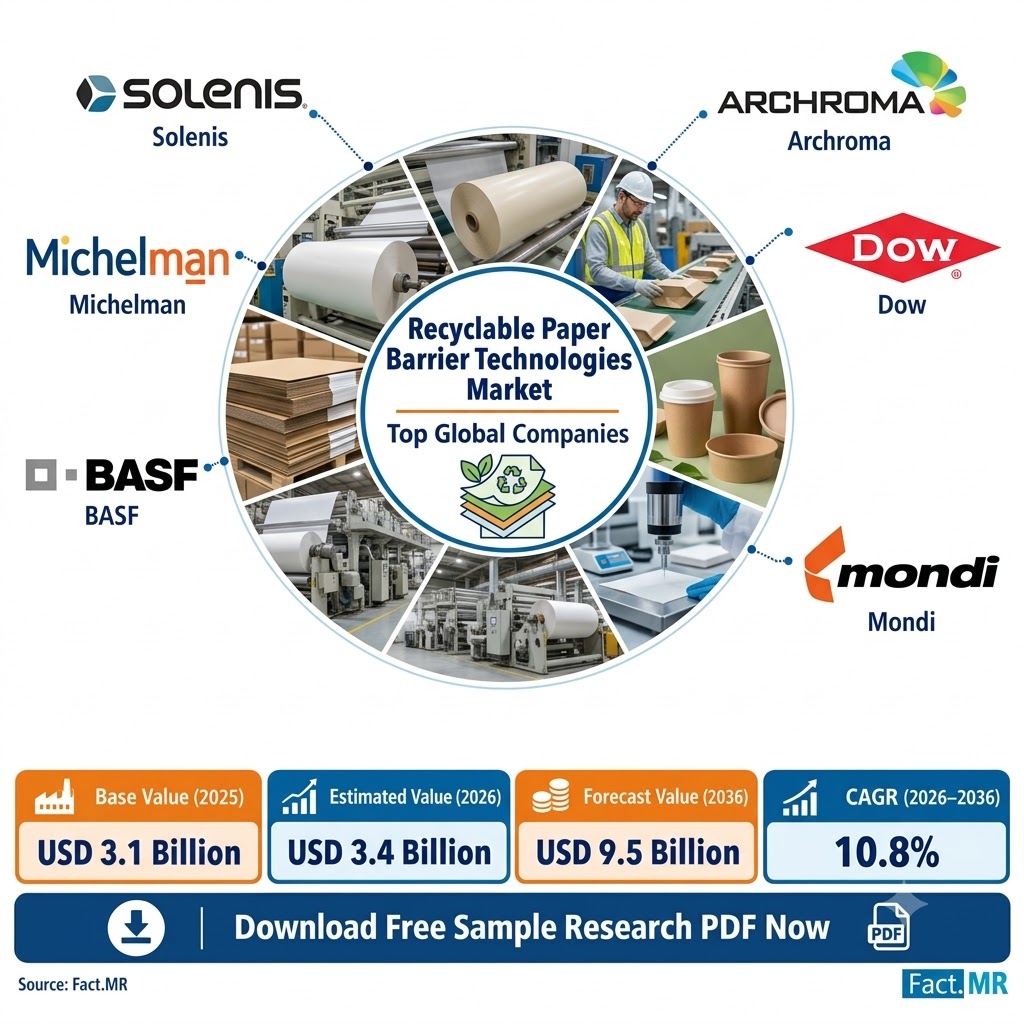
The global recyclable paper barrier technologies market is projected to grow from USD 3.3950 billion in 2026 to USD 9.4675 billion by 2036, registering a compound annual growth rate (CAGR) of 10.8%, according to Fact.MR. The market was valued at USD 3.1 billion in 2025, with an absolute opportunity of approximately USD 6.0 billion over the forecast period.
Demand is being shaped by packaging manufacturers seeking paper-based formats that resist moisture, grease, oil and oxygen without compromising their intended recycling pathways. Coating suppliers must balance barrier performance with drying requirements, food-contact approvals and compatibility with existing paper-coating equipment.
Get detailed market forecasts, competitive benchmarking, and pricing trends:
Packaging rules increase pressure on material selection
Regulatory changes are bringing greater attention to the materials and coatings used in food and delivery packaging. On February 11, 2025, the European Commission announced that the Packaging and Packaging Waste Regulation had entered into force. The development increases the importance of documenting packaging materials and evaluating their recycling performance.
China also announced 15 new express-delivery rules in April 2025 supporting degradable and reusable packaging, according to the report. For packaging converters, these developments strengthen the case for evaluating paper-based alternatives alongside the performance requirements of the finished package.
In the United States, food-contact reformulation is another demand driver. On January 3, 2025, the U.S. Food and Drug Administration announced that authorizations for 35 food-contact notifications related to PFAS were no longer effective. The notifications covered uses associated with grease-proofing paper and paperboard.
These developments do not remove the need for application-specific testing. Packaging companies must still verify coating performance, food-contact requirements and recyclability for the paper grade and finished-pack design they intend to use.
Where growth is fastest
Fact.MR identifies five countries with different growth rates and market-entry considerations between 2026 and 2036.
- China — 12.4% CAGR: High parcel volumes and packaging rules supporting degradable and reusable formats are expected to support demand. The State Post Bureau reported that China’s express-delivery volume reached 198.95 billion items in 2025, according to a May 2026 publication cited in the report.
- USA — 10.9% CAGR: Food-contact reformulation and demand for grease-resistant takeaway and foodservice packaging are expected to support adoption.
- France — 10.9% CAGR: European packaging requirements and demand for recyclable food-packaging formats are expected to influence material selection.
- Germany — 10.7% CAGR: Paper collection systems and the need to test coatings for recycling performance support market development.
- Japan — 9.6% CAGR: Municipal paper-packaging collection and recycling programs are expected to influence the adoption of paper and molded-fiber packaging.
For suppliers considering geographic expansion, comparable growth rates do not necessarily mean identical commercial conditions. Food-contact requirements, paper-recovery systems and the capabilities of local converting operations can affect qualification time and production costs.
What leads the market
Four segments account for the leading positions identified in Fact.MR’s 2026 estimates.
- Barrier chemistry — Aqueous polymer dispersion: 34.0% share. Water-based coatings can provide a thin protective layer and work with existing paper-coating lines, making production compatibility an important purchasing consideration.
- Barrier function — Moisture / vapor: 31.0% share. Moisture protection helps paper packaging maintain its intended performance during storage and handling.
- Substrate — Paper: 36.0% share. Paper is used in wraps, pouches, liners and coated sheets, creating demand for coatings that improve protection while supporting the intended recycling pathway.
- Application — Hot food packaging: 29.0% share. These packs require resistance to heat and grease, placing demands on coating performance and finished-pack integrity.
Other applications include dry food packaging, beverage cartons, takeaway and foodservice packs, and flexible packaging. The report also covers bio-based polyester, cellulose and polysaccharide coatings, mineral-hybrid barriers, and wax or lipid hybrids.
The hurdle: Performance must survive conversion and recovery
Recyclability qualification remains a major restraint for the market. A coating that performs well on a flat sheet may behave differently after folding, sealing or exposure to heat. Barrier loss at folds and seals can limit its suitability for the final package.
Manufacturers must also consider drying energy, coating weight and food-contact approval requirements. These factors can affect line speed, production economics and the time needed to qualify a material for commercial use.
Fact.MR identifies aroma and oxygen barriers for dry foods, barrier-treated molded fiber, bio-based coating chemistry and direct coating on converting lines as opportunities. These applications offer suppliers avenues for product development, provided the finished packaging meets the relevant performance and recovery requirements.
Industry investment and competitive activity
Recent company developments illustrate how suppliers and packaging manufacturers are addressing demand for paper-based barrier solutions.
- August 14, 2025 — Mondi: The company announced increased production of FunctionalBarrier Paper Ultimate at its Solec plant in Poland following a €16 million investment. The paper is designed to provide oxygen, moisture and grease protection while supporting recycling.
- August 13, 2025 — Solenis: The company announced plans to showcase sustainable paper and packaging solutions at FACHPACK 2025 and PACK EXPO Las Vegas 2025.
Fact.MR profiles six key companies in the market: Solenis, Michelman, BASF, Archroma, Dow and Mondi.
Their portfolios cover different coating chemistries and paper-packaging requirements. Solenis supplies coatings for protection against oil, grease, liquids and moisture. BASF supplies materials for paper and paperboard applications, including its ecovio® 70 PS14H6 product for food-contact paper and home-compostable packaging applications. Archroma, Michelman and Dow also supply water-based coating solutions for paper packaging.
These companies address different customer needs, and their inclusion in the report does not imply that their products are interchangeable or suitable for every packaging application.
Analyst opinion
Shambhu Nath Jha, Principal Consultant at Fact.MR, states, “Packaging companies check protection, recycling, drying, and food safety when choosing coatings. Suppliers with clear use details and recycling test results are more likely to get repeat orders.”
What this means for food manufacturers, packaging converters and coating suppliers
- Qualify coatings on the finished package. Test the selected paper grade after folding, sealing and heat exposure. Confirm that the barrier retains its required performance under actual production and use conditions.
- Include recycling and food-contact requirements early. Review material documentation and applicable requirements during package design rather than waiting until commercial production. This can help identify qualification issues before larger production commitments.
- Compare total operating requirements, not just barrier performance. Assess coating weight, drying energy, line compatibility and testing requirements alongside moisture, grease or oxygen resistance. These factors influence the cost and practicality of scaling a coating across production lines.
Report coverage
Fact.MR’s Recyclable Paper Barrier Technologies Market report examines market size and forecasts for 2026–2036, barrier chemistry, barrier function, substrate, application, regional coverage, country-level growth and the competitive landscape.
Top Trending Reports:
Demand and Trend Analysis of Air Purifiers in Europe
Rainwater Harvesting System Market
About Fact.MR
Fact.MR is a market research and consulting firm providing industry analysis, market forecasts and strategic insights across multiple sectors. Its research examines market demand, competitive activity, technology adoption and factors influencing commercial growth.