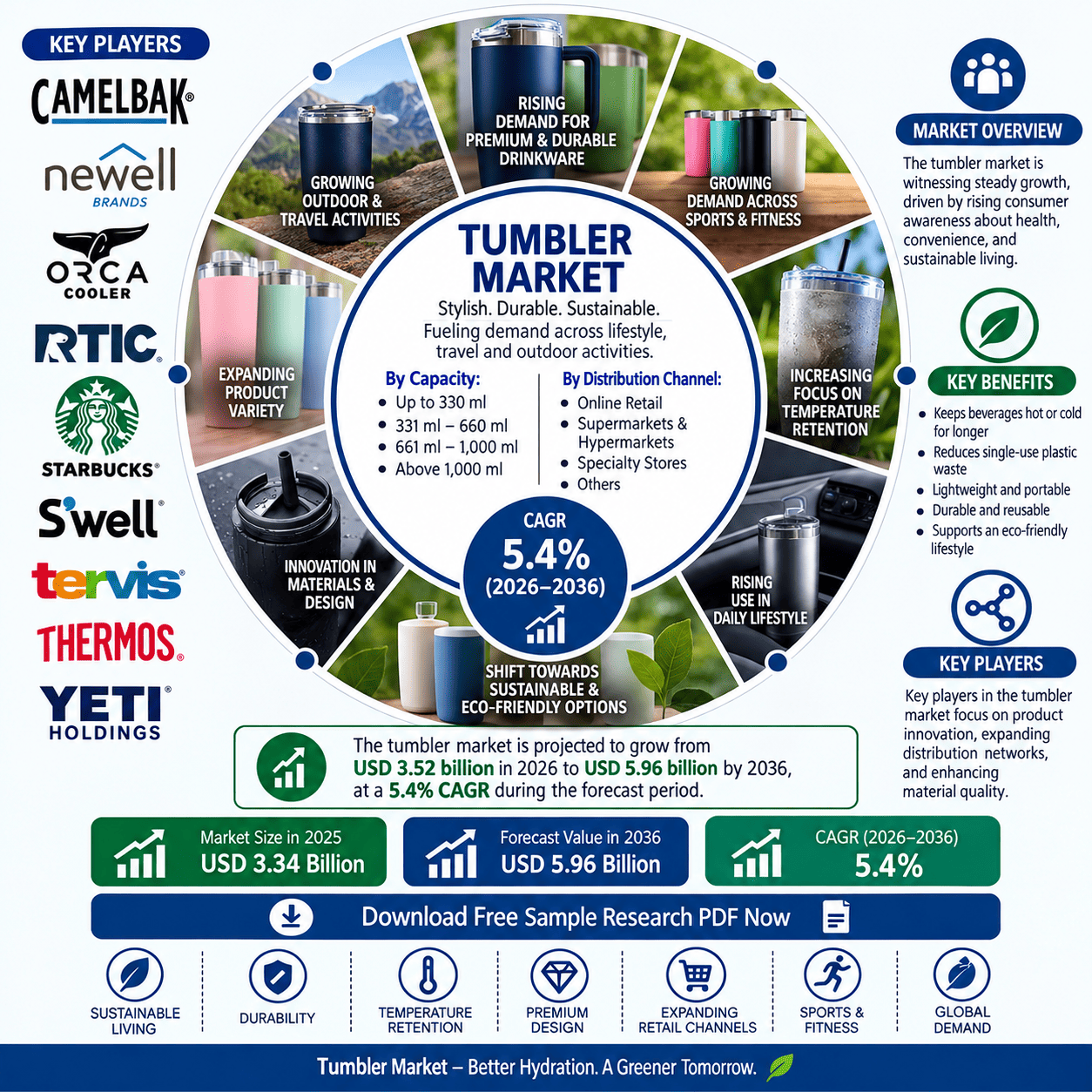
The global tumbler market is projected to increase from USD 3.52 billion in 2026 to USD 5.96 billion by 2036, registering a compound annual growth rate (CAGR) of 5.4%, according to Fact.MR. Demand is supported by everyday beverage consumption, growing use of reusable drinkware during commuting and travel, and consumer interest in tumblers that keep beverages at the desired temperature. Product differentiation through material quality, lid design, colors, and accessories is also creating opportunities for manufacturers and retailers.
Tumblers are used at home, in offices, during travel, and across outdoor activities. Stainless steel models appeal to consumers seeking insulation and durability, while plastic and glass options serve buyers with different preferences for weight, price, and drinking experience. The market also benefits from commercial demand from cafés, offices, events, and businesses purchasing branded drinkware.
Get detailed market forecasts, competitive benchmarking, and pricing trends
Stainless Steel Leads the Tumbler Market
Stainless steel is projected to account for 44.5% of the tumbler market by type in 2026, making it the leading material category in Fact.MR’s analysis. Its compatibility with double-wall vacuum insulation and its durability during repeated use support demand among consumers looking for reusable beverage containers.
Insulated tumblers are used for both hot and cold drinks. Secure lids, manageable weight, and easy cleaning influence purchasing decisions, particularly among consumers who carry beverages during commutes or outdoor activities. Manufacturers are also differentiating products through finishes, sizes, colors, and accessories.
Plastic tumblers remain an option for buyers seeking lighter and generally lower-priced products. Glass tumblers appeal to consumers who prefer a different drinking surface, although they may require more care when carried outside the home. These material choices allow brands to target different price points and use cases.
Household Use Accounts for the Largest Application Share
Household applications are projected to represent 62.4% of the market in 2026. Tumblers fit into everyday routines, including drinking water at home, carrying coffee to work, and keeping beverages accessible during short trips.
Repeat use makes practical product features important. Consumers may consider insulation, lid security, cleaning requirements, and compatibility with vehicle cup holders when selecting a tumbler. Manufacturers that address these needs can appeal to customers looking for products that work across multiple daily settings.
Commercial applications provide another source of demand. Cafés and offices use reusable tumblers for beverage service, while businesses may purchase branded products for employees, events, or customer merchandise. These buyers often consider ease of cleaning, storage, durability, and the ability to customize products with company branding.
Supermarkets Remain an Important Sales Channel
Supermarkets are forecast to capture 37.3% of the tumbler market by distribution channel in 2026. Their position is supported by shoppers’ ability to purchase drinkware alongside groceries and household products. Seasonal merchandise and gift purchases can also increase product visibility.
Hypermarkets offer a broader range of prices and designs, while specialist retail stores serve consumers seeking particular styles or features. Online stores make it easier to compare product dimensions, materials, colors, and lid options before making a purchase.
For brands and retailers, maintaining a clear assortment can help address different consumer preferences. Everyday colors and core sizes can serve regular buyers, while seasonal designs and licensed collaborations can attract shoppers looking for gifts or new styles. Replacement lids and compatible accessories also offer a way to extend product use and encourage repeat purchases.
Germany, Brazil, and Japan Offer Growth Opportunities
Germany is projected to record the fastest growth among the countries covered in Fact.MR’s analysis, with a 6.6% CAGR through 2036. Established reuse habits, domestic travel, and demand for portable drinkware support the country’s outlook. Manufacturers can address this market with durable products designed for commuting, travel, and everyday use.
Brazil is forecast to grow at a 6.0% CAGR. Retail activity and travel-related purchases create opportunities for brands to expand distribution and reach consumers seeking reusable beverage containers. Product accessibility and a varied selection of designs can help manufacturers serve different customer groups.
Japan is expected to register a 5.4% CAGR, supported by demand for portable drinkware during daily travel and warm-weather hydration. Compact designs that are easy to carry can suit commuters and consumers who regularly spend time away from home.
The United Kingdom is projected to expand at a 5.0% CAGR, while the United States is forecast to grow at 4.6%. In both markets, household routines, travel, outdoor activities, and retail availability support demand for reusable tumblers.
Product Design and Accessories Create New Opportunities
Competition in the tumbler market extends beyond basic capacity and material. Consumers also assess insulation performance, lid security, portability, appearance, and ease of cleaning. Product designs that balance these features can appeal to buyers seeking drinkware for several settings.
Interchangeable lids and replacement parts provide an opportunity to extend product life. Standardized components across product ranges can make it easier for customers to replace damaged parts without purchasing a completely new tumbler. Premium insulated sets, corporate reusable-drinkware programs, and customized colors offer further routes for product differentiation.
However, manufacturers face pressure from low-priced alternatives and a crowded brand landscape. Stainless steel products may carry a higher price than basic cups, while weight and cleaning requirements can influence material preferences. Input-cost changes can also affect production and retail pricing.
Analyst Perspective
Shambhu Nath Jha, Principal Consultant at Fact.MR, states, “Tumblers are becoming everyday products that buyers use at home and carry to work or leisure activities. Sales are stronger for cups that keep drinks at the right temperature while remaining easy to clean and secure when carried. Suppliers can encourage repeat purchases by maintaining reliable material quality and regularly adding new colors, sizes and accessories.”
The analysis points to a market in which practical performance and product variety both influence purchasing decisions. Manufacturers can strengthen their position by maintaining consistent material quality while offering useful design options, compatible accessories, and products tailored to household and commercial buyers.
Competitive Landscape
The tumbler market includes established insulated drinkware brands, consumer product manufacturers, and beverage companies that sell branded merchandise. Key companies identified in the Fact.MR report include CamelBak Products, Newell Brands, ORCA Cooler, RTIC, Starbucks, S’well, Tervis Tumbler, Thermos, and Yeti Holdings.
These companies serve different consumer segments through product durability, insulation features, design choices, and brand recognition. Competition also extends to product availability across supermarkets, specialist retail stores, and online channels. Seasonal designs and accessories can help brands maintain consumer interest, while practical features remain important for customers purchasing tumblers for regular use.
Market Snapshot
Fact.MR estimates the global tumbler market at USD 3.52 billion in 2026, with a projected value of USD 5.96 billion by 2036, reflecting a 5.4% CAGR. Stainless steel is expected to lead by type with a 44.5% share, household use is projected to account for 62.4% of applications, and supermarkets are forecast to hold 37.3% of distribution. Germany is expected to record the fastest country-level growth at 6.6% CAGR, followed by Brazil at 6.0% and Japan at 5.4%. Key market factors include reusable beverage routines, insulated stainless steel products, travel and outdoor use, and demand for varied designs and accessories.
To View Related Reports
Steering Wheel Multifunction Switch and Controller Systems Market
About Fact.MR
Fact.MR is a market research and consulting company providing market intelligence, competitive analysis, and forecasting across global industries. Its research covers emerging technologies, evolving consumer trends, industrial developments, and changing business environments. Fact.MR delivers data-driven insights designed to support strategic planning, investment decisions, and market-entry initiatives.