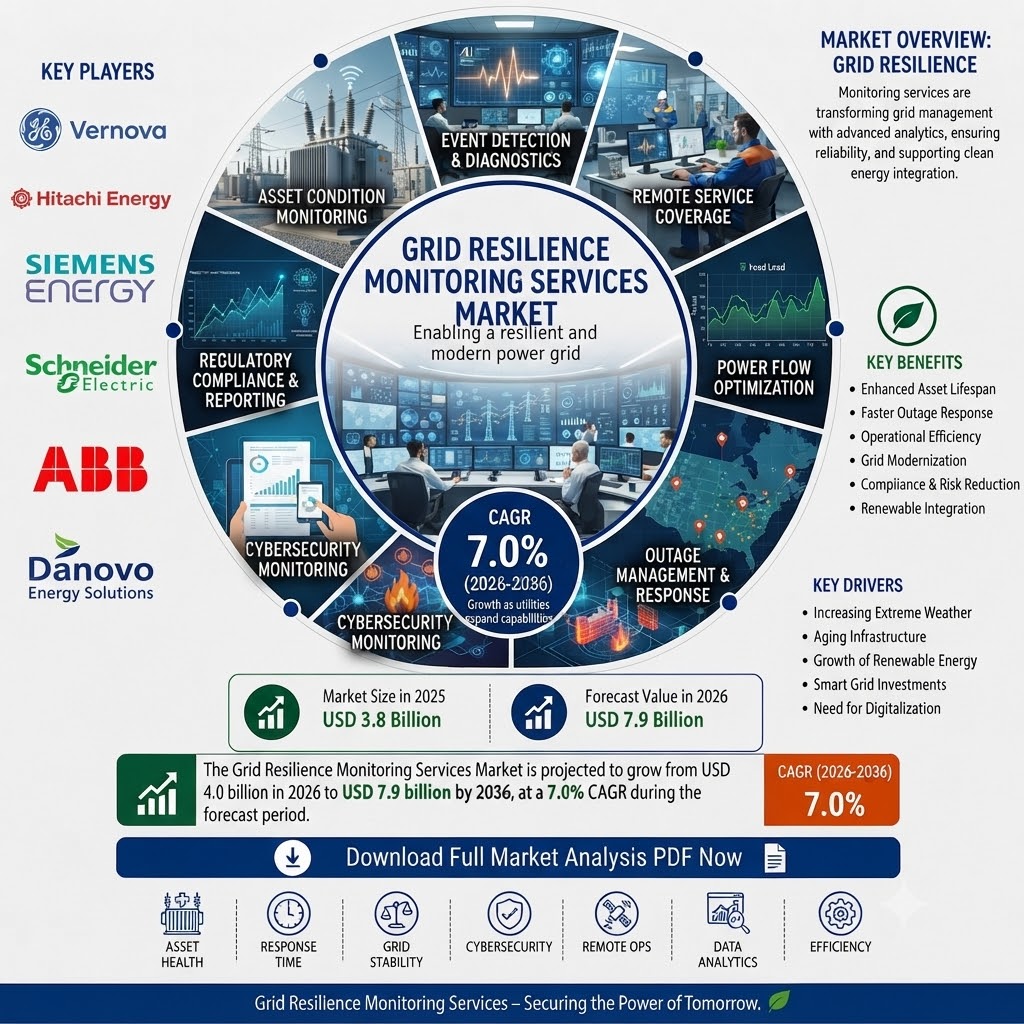
The global grid resilience monitoring services market is projected to grow from USD 4.0 billion in 2026 to USD 7.9 billion by 2036, registering a compound annual growth rate (CAGR) of 7.0%, according to Fact.MR. The market is expected to create an incremental opportunity of USD 3.9 billion over the forecast period. Utilities are expanding asset monitoring, event detection, and remote service capabilities to identify equipment problems earlier and improve responses to grid disruptions.
Grid resilience monitoring services help electricity providers assess the condition of substations, transformers, transmission lines, and distribution networks. These services combine sensor data, analytical tools, and operational support to help utility teams identify abnormal conditions, prioritize maintenance, and respond to outages. As power networks accommodate changing demand and more complex electricity flows, monitoring systems are becoming an important part of grid management.
Get detailed market forecasts, competitive benchmarking, and pricing trends
Asset Condition Monitoring Leads Service Demand
Asset condition monitoring is expected to account for 39.0% of the service segment in 2026, making it the leading service category in the Fact.MR analysis. Utilities use these services to assess equipment health and identify potential failures before they affect network operations.
Traditional inspection schedules may not provide continuous visibility into the condition of critical equipment. Remote monitoring helps operators track equipment indicators and identify changes that warrant further investigation. This information can support maintenance planning, equipment replacement decisions, and more efficient deployment of field crews.
Power-quality monitoring and weather or wildfire monitoring address additional risks. Power-quality services help identify voltage disturbances and other electrical issues, while weather-related monitoring supports preparedness for conditions that threaten power lines and substations. Cyber-physical monitoring and grid situational awareness add further visibility into operational risks.
Substation Monitoring Supports Critical Infrastructure
Substation monitoring is projected to represent 29.0% of the grid asset segment in 2026. Substations bring multiple critical components together, including transformers, circuit breakers, and associated control equipment. A problem at one site can affect power delivery across a wider network, making equipment visibility important for utility operators.
Monitoring services help engineers assess equipment conditions and determine where inspections or maintenance may be needed. Transformer monitoring supports condition assessment, while transmission-line monitoring helps operators understand operating conditions and available capacity.
Utilities can also use monitoring data to prioritize investment in ageing infrastructure. Instead of relying only on equipment age or periodic inspections, operators can combine condition information with operational risk to help identify assets that require attention first.
Event Detection Improves Grid Response
Event detection is forecast to account for 36.0% of the analytics segment in 2026. Grid operators need to identify unusual conditions quickly and understand whether an alert indicates a localized issue or a wider operational threat.
The need for faster event recognition is reinforced by the potential consequences of major power disruptions. Fact.MR cites a UK government report noting that the North Hyde substation fire in March 2025 disconnected 71,655 domestic customers. Monitoring services can help operators interpret equipment alerts and event data, supporting faster assessment and coordinated responses.
Event detection can also work alongside failure prediction, dynamic-rating analytics, outage-risk assessment, and restoration prioritization. Together, these capabilities help control-room teams evaluate changing grid conditions and direct attention to the most urgent problems.
Managed Services Create Opportunities for Specialist Providers
Managed services are expected to account for 32.0% of the delivery segment in 2026. These arrangements allow utilities to access specialist monitoring and analytical capabilities without managing every technical function internally.
Software-as-a-Service (SaaS) platforms provide a centralized environment for reviewing monitoring data and alerts. Control-center integration connects these insights with operational systems, while edge monitoring supports data collection closer to grid assets. Combined field and remote services can help utilities investigate potential problems before dispatching technicians.
However, deployment can be complicated by legacy systems, inconsistent asset data, cybersecurity restrictions, and lengthy utility approval processes. Service providers must demonstrate that their solutions can integrate with existing infrastructure and produce reliable information for operational decisions.
UK, Japan, and the USA Lead Country Growth
The United Kingdom is forecast to record the fastest growth among the countries profiled by Fact.MR, with a 7.6% CAGR through 2036. Network investment and resilience planning are supporting demand for monitoring services that help operators assess equipment condition and manage operational risks.
Japan is projected to grow at a 7.3% CAGR, reflecting the need to reinforce power networks and manage increasingly complex interregional electricity flows. Monitoring transmission lines and critical grid equipment can help utilities evaluate conditions as network infrastructure develops.
The United States is expected to record a 7.0% CAGR. Its large power network, ageing infrastructure, and changing electricity demand create a need for improved asset visibility and faster event response. Germany follows with a projected 6.7% CAGR, while France is forecast to grow at 6.4%.
These markets differ in grid structure and investment priorities, but all face the need to manage equipment reliability and improve operational awareness. Monitoring providers must adapt their services to local grid conditions, utility systems, and regulatory requirements.
Digital Grid Investment Shapes Future Opportunities
Grid modernization is creating opportunities for providers that connect equipment monitoring with maintenance and operational workflows. Predictive asset-health service contracts can help utilities translate condition data into maintenance plans. Weather and wildfire monitoring can support preparation for environmental threats, while digital-twin and event-correlation tools can help operators understand how individual events may affect wider grid operations.
Distributed energy resources and bidirectional power flows add complexity to network management. Utilities need better visibility into how changing generation and consumption patterns affect grid conditions. Monitoring services can help provide this information, although integration with existing operational technology remains a key implementation challenge.
For service providers, the commercial opportunity extends beyond collecting alerts. Utilities need actionable information, reliable data, and technical support that help teams determine which problems require immediate attention.
Analyst Perspective
Shambhu Nath Jha, Principal Consultant at Fact.MR, states, “Grid monitoring now focuses on finding which problem needs attention first instead of collecting more alerts. Utilities are expected to choose services that connect equipment condition, event details, and field response in one system. Providers need reliable sensors, clear data tools, and strong support so operators can trust the information during grid problems.”
The analysis highlights the importance of connecting monitoring data with utility operations. As grid operators manage ageing equipment and more complex network conditions, services that help prioritize maintenance and coordinate responses may become increasingly important in procurement decisions.
Competitive Landscape
The grid resilience monitoring services market includes energy technology companies and grid automation providers offering monitoring platforms, equipment analytics, software, and operational support. Key companies identified by Fact.MR include GE Vernova, Hitachi Energy, Siemens Energy, Schneider Electric, ABB, and Danovo Energy Solutions.
GE Vernova offers grid software and monitoring capabilities, while Hitachi Energy and Siemens Energy serve utility infrastructure and grid management needs. Schneider Electric and ABB provide automation, monitoring, and digital solutions for electrical systems. Danovo Energy Solutions is also identified in the Fact.MR report’s competitive coverage.
Competition is shaped by the reliability of monitoring data, event-detection capabilities, integration with existing control systems, and the ability to support utility teams during grid disturbances. Providers must demonstrate that their services translate technical information into practical operational decisions.
Market Snapshot
Fact.MR estimates the global grid resilience monitoring services market at USD 4.0 billion in 2026, rising to USD 7.9 billion by 2036 at a 7.0% CAGR. The forecast represents an incremental opportunity of USD 3.9 billion. Asset condition monitoring is projected to lead the service segment with a 39.0% share, substation monitoring the grid asset segment with 29.0%, event detection the analytics segment with 36.0%, and managed services the delivery segment with 32.0%. The United Kingdom is forecast to grow at 7.6% CAGR, followed by Japan at 7.3% and the United States at 7.0%.
To View Related Reports
Disposable Prefilled Syringes Market
About Fact.MR
Fact.MR is a market research and consulting company providing market intelligence, competitive analysis, and forecasting across global industries. Its research covers emerging technologies, evolving consumer trends, industrial developments, and changing business environments. Fact.MR delivers data-driven insights designed to support strategic planning, investment decisions, and market-entry initiatives.