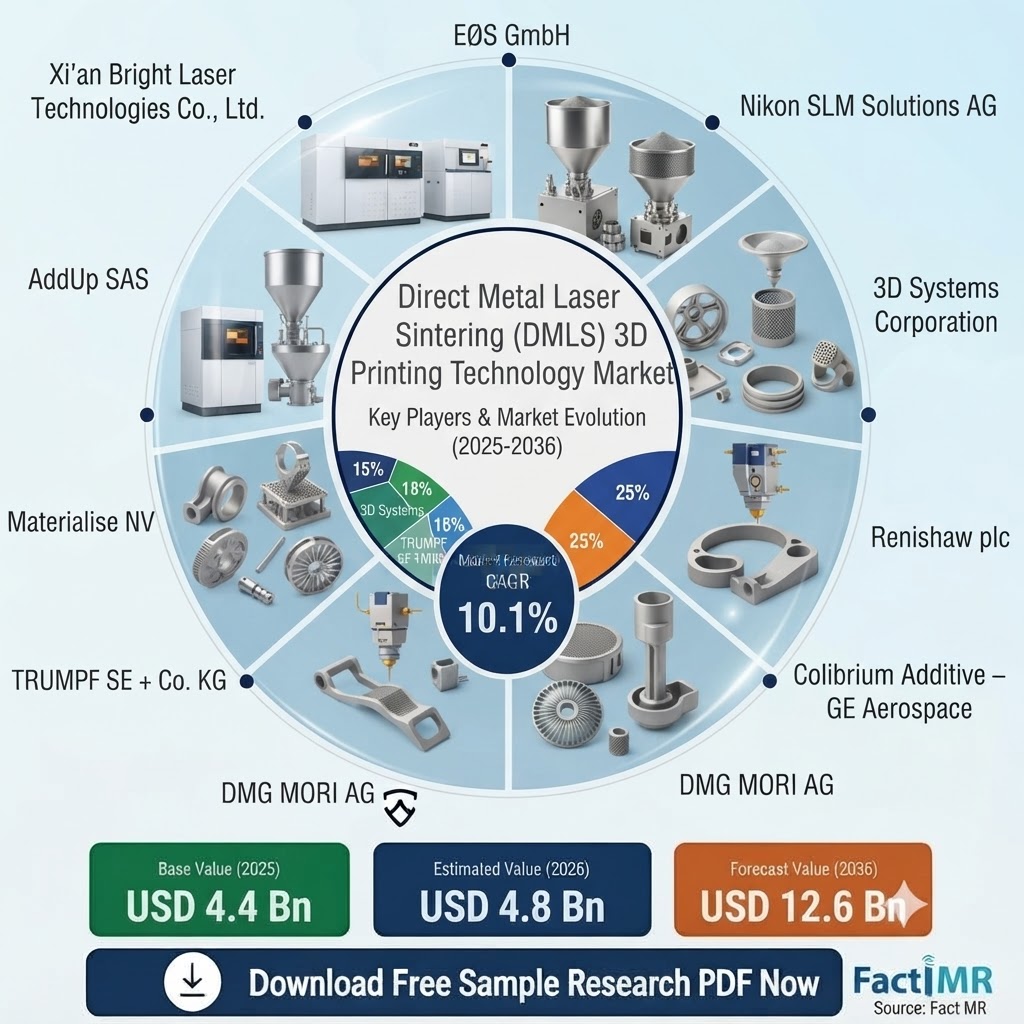
Global Direct Metal Laser Sintering (DMLS) 3D Printing Technology Market is projected to increase from USD 4.8 billion in 2026 to USD 12.6 billion by 2036, expanding at a 10.1% CAGR during the forecast period. The market reached USD 4.4 billion in 2025 and is expected to create an absolute opportunity of USD 7.8 billion through 2036.
Market Overview
Demand for direct metal laser sintering (DMLS) 3D printing technology is expected to increase as aerospace, defense, medical, automotive, and industrial manufacturers adopt qualified metal additive manufacturing for applications where part consolidation, material performance, repeatability, and traceability support production decisions.
Aerospace qualification remains a key demand driver. The Aerospace Industries Association reported on June 25, 2026, that the U.S. aerospace and defense industry generated $1 trillion in sales, supporting the continued importance of aerospace manufacturing capacity for qualified metal additive applications.
Medical device manufacturers are also expected to require repeatable metal builds for implants and surgical components. Industrial manufacturers are likely to use DMLS for low-volume metal parts, tooling, spares, and functional components where tool-less production can reduce lead times and design restrictions. Metal powder quality, alloy control, build repeatability, inspection records, and process documentation are expected to influence supplier selection.
Get detailed market forecasts, competitive benchmarking, and pricing trends:
Global Segment Leaders
- Material Type — Titanium Alloys: 41.0% share in 2026. Strength-to-weight performance and corrosion resistance support demand from aerospace and medical users, while qualification records help confirm material performance.
- Application Area — Aerospace Components: 39.0% share in 2026. Lightweight designs, complex geometries, and part consolidation strengthen DMLS adoption in aircraft programs.
- End-use Industry — Aerospace & Defense: 43.0% share in 2026. Strict production controls, traceability, inspection records, and material history support metal additive manufacturing in qualified programs.
- User Category — Industrial Manufacturers: 40.0% share in 2026. Tool-free production and shorter lead times make DMLS relevant for tooling, spares, and functional metal parts.
- Printing Process — Layer-by-Layer Laser Sintering: 42.0% share in 2026. The process provides a controlled build sequence that allows manufacturers to connect laser settings, powder behavior, layer quality, and inspection results.
Country-Level Performance
| Country | CAGR (2026–2036) | Key Growth Driver |
| USA | 11.2% | Aerospace qualification and industrial additive capacity |
| Germany | 10.7% | Precision manufacturing and process documentation |
| Japan | 10.2% | Engineering-led adoption and precision part requirements |
| China | 9.8% | Local metal additive capacity and cost-focused industrial adoption |
| Canada | 9.3% | Aerospace supply chains and industrial service bureau access |
| UK | 8.9% | Aerospace engineering and medical technology demand |
| South Korea | 8.4% | Advanced manufacturing and medical implant demand |
The country comparison spans 2.8 percentage points across the forecast period. The USA remains the fastest-growing profiled market, followed by Germany and Japan. China is supported by local metal additive capacity, while Canada benefits from aerospace supply chains and service bureau access. The UK is supported by aerospace engineering and medical technology, while South Korea’s growth is shaped by advanced manufacturing and medical implant demand.
Regional Context
North America represents a key growth area, led by the USA’s aerospace qualification activity and industrial additive manufacturing capacity, while Canada’s aerospace supply chain and service bureau ecosystem support selective adoption.
Europe combines Germany’s precision manufacturing depth with the UK’s aerospace engineering and medical technology base. East Asia includes Japan, China, and South Korea, where engineering-led production, local metal additive capacity, advanced manufacturing, and medical applications shape demand.
The full report covers North America, Latin America, Europe, East Asia, South Asia and Pacific, and Middle East and Africa, with the research methodology covering more than 25 countries and the country comparison profiling the USA, Germany, Japan, China, Canada, the UK, and South Korea.
Competitive Landscape
The competitive landscape includes EOS GmbH, Nikon SLM Solutions AG, 3D Systems Corporation, Renishaw plc, Colibrium Additive – GE Aerospace, DMG MORI AG, TRUMPF SE + Co. KG, Materialise NV, AddUp SAS, and Xi’an Bright Laser Technologies Co., Ltd. EOS GmbH and Nikon SLM Solutions AG have direct relevance in metal additive manufacturing systems, while 3D Systems Corporation and Renishaw plc contribute platforms and process expertise. Colibrium Additive – GE Aerospace, DMG MORI AG, TRUMPF, Materialise, AddUp, and Xi’an Bright Laser Technologies expand the equipment, software, and production-support landscape.
Recent developments cited in the report include EOS GmbH’s launch of the EOS M 290-2 400W Metal AM System in June 2024, Renishaw’s technology announced in August 2024 that achieved up to a 50% reduction in additive manufacturing build times, and Colibrium Additive’s Naval Air Systems Command contract announced in April 2026 to advance metal additive manufacturing.
Market Outlook
DMLS adoption is expected to remain concentrated in applications where the value of qualified metal components can justify equipment, powder, labor, and compliance costs. Aerospace components and medical implants are identified as important areas for application expansion.
High machine prices, trained labor requirements, compliance checks, and powder-handling requirements may limit adoption in the near term. Buyers in regulated programs are expected to prioritize evidence of build repeatability, validated parameters, material history, and post-processing performance before expanding DMLS deployment.
The report identifies titanium alloys and aerospace components as the leading segments in 2026, while the USA and Germany lead the country comparison. Layer-by-layer laser sintering, powder-bed fusion, process monitoring, and automated powder handling form part of the technology landscape covered by the analysis.
Top Trending Reports:
About Fact MR
Fact MR is a leading provider of market research and consulting services, offering syndicated and customized research across industries including industrial manufacturing, aerospace and defense, and healthcare.