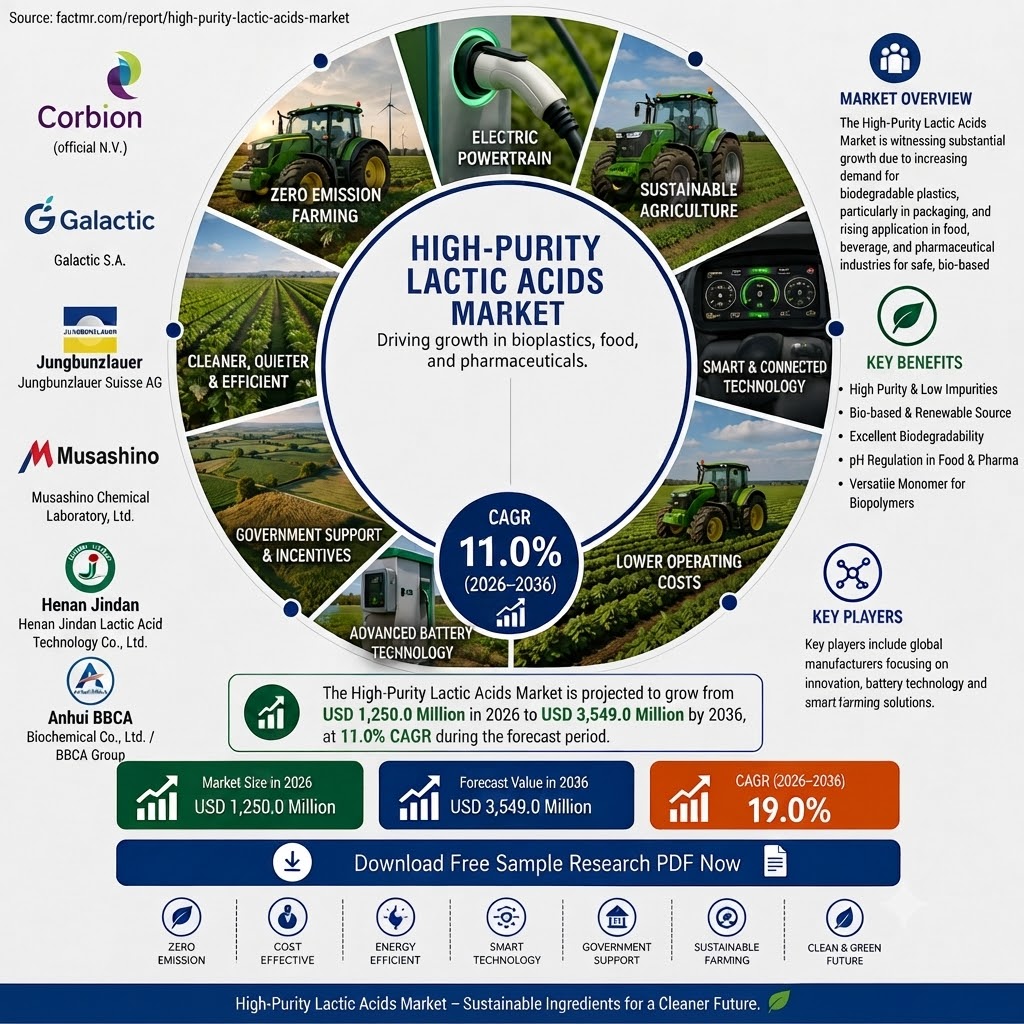
The global high-purity lactic acids market is estimated at USD 1.25 billion in 2026 and is projected to reach USD 3.55 billion by 2036, expanding at a 11.0% CAGR during the forecast period. Fact.MR estimates an absolute dollar opportunity of USD 2.30 billion between 2026 and 2036, supported by growing demand for high-purity inputs in polymers, food ingredients, coatings, and industrial chemicals.
High-purity lactic acid is increasingly used where tight impurity control, optical purity, fermentation-based sourcing, and consistent application performance are required. Polymer producers are particularly focused on stable inputs for lactide and polylactic acid (PLA) conversion, while food manufacturers require predictable purity for acidity control, taste, labeling, and microbial stability.
Get detailed market forecasts, competitive benchmarking, and pricing trends
Bio-based grade leads the product landscape
Bio-based grade is expected to account for 39.0% share of the market in 2026, making it the leading product category. Demand is supported by its use in PLA, food ingredients, and bio-based industrial inputs where renewable-content documentation and controlled impurity levels influence supplier selection.
Fermentation is projected to represent 42.0% share by process in 2026. The process provides an established route to L-lactic acid using sugar and starch feedstocks while supporting bio-based documentation. Purification remains critical because downstream polymer and food applications require consistent chemical quality.
Polymers create strong application opportunities
Polymers are estimated to account for 37.0% share of application demand in 2026. PLA producers require consistent lactic acid quality to support lactide conversion, polymerization, and resin performance. Buyers increasingly evaluate impurity levels, stereochemical consistency, and long-term supply reliability before qualifying suppliers.
Intermediate applications hold 35.0% share by function, reflecting the use of high-purity lactic acid in the production of lactides, esters, salts, and other downstream materials. Stable purity is important because conversion yield and customer approvals can depend on consistent chemical inputs.
USA, Germany, and Japan create strong country-level opportunities
The USA is projected to grow at a 12.1% CAGR through 2036, supported by corn-based fermentation capacity and polymer demand. Germany follows at 11.6% CAGR, reflecting its established chemical manufacturing base and polymer processing activity.
Japan is forecast to expand at 10.8% CAGR, supported by specialty chemical applications and food-related demand. France is expected to grow at 10.3% CAGR, while Brazil is projected to advance at 9.9% CAGR through 2036.
Purification control and bio-based sourcing reshape market priorities
PLA and lactide conversion requirements, food ingredient purity, and bio-based chemical substitution are key market drivers. Polymer manufacturers need stable optical purity and low residual impurities to maintain conversion efficiency and product consistency.
Food ingredient manufacturers are also placing greater emphasis on supplier consistency where lactic acid influences pH, flavor, microbial stability, and labeling requirements. At the same time, coatings and industrial chemical producers are evaluating lactic acid derivatives as alternatives in bio-based solvent and chemical applications.
Analyst Perspective
Shambhu Nath Jha, Principal Consultant at Fact.MR, states, “High-purity lactic acid is no longer evaluated only as an acidulant or commodity chemical. The market is expected to reward producers that combine fermentation reliability, tight purification control and clear documentation for polymer and food customers. Supply contracts are likely to favor producers with impurity control at scale and stable regional logistics.”
Bio-based polymers and specialty chemicals open new opportunities
The expansion of bio-based plastics is creating additional demand for high-purity lactic acid as polymer producers seek consistent feedstocks for PLA and lactide production. Qualification requirements around optical purity and residual impurities are likely to keep supplier reliability central to purchasing decisions.
Food ingredients, coatings, and industrial chemicals provide additional avenues for market expansion. However, purification costs, fermentation feedstock variability, and customer qualification timelines remain important factors influencing commercial adoption.
Competitive landscape
The high-purity lactic acids market includes producers competing through fermentation capabilities, purification control, product purity, derivative portfolios, production scale, and regional technical support.
Key companies profiled by Fact.MR include Corbion N.V., Galactic S.A., Jungbunzlauer Suisse AG, Musashino Chemical Laboratory, Ltd., Henan Jindan Lactic Acid Technology Co., Ltd., and Anhui BBCA Biochemical Co., Ltd. / BBCA Group.
Corbion N.V. maintains a broad position across lactic acid, derivatives, food preservation, biochemical specialties, and biomaterials. Galactic S.A. supplies fermentation-derived lactic acid and derivatives across food, personal care, animal nutrition, and industrial applications. Jungbunzlauer Suisse AG participates with fermentation-based L(+)-lactic acid, while Musashino Chemical Laboratory, Henan Jindan Lactic Acid Technology, and Anhui BBCA Biochemical participate across lactic acid production and specialty chemical supply.
Market Snapshot
The high-purity lactic acids market is valued at USD 1.25 billion in 2026 and is forecast to reach USD 3.55 billion by 2036 at an 11.0% CAGR. Bio-based grade accounts for 39.0% share, fermentation represents 42.0%, intermediate applications hold 35.0%, and polymers account for 37.0% of application demand in 2026. The USA leads country-level growth at 12.1% CAGR, followed by Germany at 11.6% and Japan at 10.8%.
The detailed High-Purity Lactic Acids Market report by Fact.MR provides forecasts through 2036, covering product type, process, function, application, regional markets, country-level trends, competitive landscape, feedstock considerations, purification requirements, and emerging opportunities.
To View Top Reports
Patient Monitoring System Market
About Fact.MR
Fact.MR is a market research and consulting company providing market intelligence, competitive analysis, and forecasting across global industries. Its research covers emerging technologies, evolving consumer trends, industrial developments, and changing business environments. Fact.MR delivers data-driven insights designed to support strategic planning, investment decisions, and market-entry initiatives.