Fact.MR projects the 3D gaming console market to grow from USD 37.8 billion in 2026 to USD 99.5 billion by 2036 at a 10.2% CAGR.
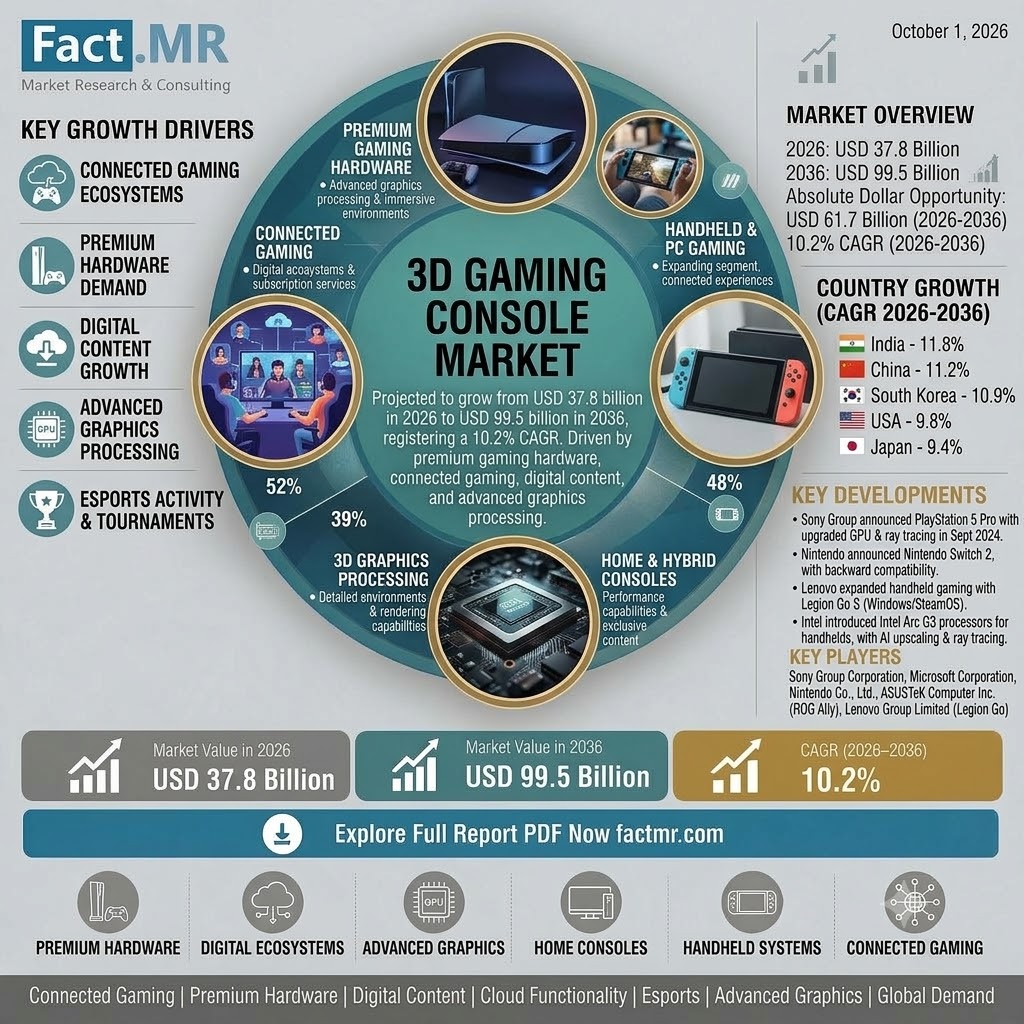
ROCKVILLE, MD — October 1, 2026 — The 3D gaming console market is projected to reach USD 99.5 billion by 2036, increasing from USD 37.8 billion in 2026 at a 10.2% CAGR, according to Fact.MR analysis. The market was valued at USD 34.3 billion in 2025, with approximately USD 61.7 billion in additional revenue expected between 2026 and 2036.
The outlook reflects continued demand for premium gaming hardware, connected gaming, digital content, and advanced graphics processing. India is projected to record the fastest growth among the major countries covered, with an 11.8% CAGR from 2026 to 2036. China follows at 11.2%, while South Korea is projected at 10.9%.
Get detailed market forecasts, competitive benchmarking, and pricing trends: https://www.factmr.com/connectus/sample?flag=S&rep_id=15134
3D Gaming Console Market Growth Tied to Connected Gaming
The 3D gaming console market covers dedicated gaming hardware designed to deliver interactive three-dimensional experiences through advanced graphics processing and immersive software environments. The study covers home, handheld, and hybrid consoles across major gaming markets.
A key factor is the growing role of digital ecosystems. Subscription services and expanding game libraries encourage continued platform engagement beyond the initial hardware purchase. Online gaming accounts for 52% of market share in 2026, making connectivity the largest segment by the supplied market breakdown.
[LINK: Fact.MR market research methodology]
Shambhu Nath Jha, Principal Consultant at Fact.MR, said, “Game console leadership will depend less on hardware specifications and more on ecosystem strength. Content libraries and cloud connectivity will increasingly shape long-term revenue generation.”
The shift is already visible across new product launches. Sony Group Corporation announced the PlayStation 5 Pro in September 2024 with an upgraded GPU, enhanced ray tracing, and AI-driven image upscaling. The launch illustrates how graphics capability continues to influence premium console positioning.
Home Consoles Account for 48% Share
Home consoles hold 48% of the 2026 market, supported by performance capabilities, exclusive content, and established digital game libraries. Dedicated systems continue to serve households seeking consistent gaming performance across high-demand titles.
Sony Group Corporation’s PlayStation 5 Pro provides a recent example of this hardware development. The console’s upgraded graphics architecture and image-processing capabilities address demand for improved visual quality.
3D graphics processing accounts for 39% share in 2026. Graphics performance remains a major factor in purchasing decisions as game developers build increasingly detailed environments and hardware manufacturers improve rendering capabilities.
ASUSTeK Computer Inc. expanded the handheld segment with the ROG Xbox Ally and ROG Xbox Ally X, featuring AMD Ryzen Z2-series processors, Xbox-integrated software, and Windows-based gaming support.
Online retail captures 41% share in 2026. E-commerce platforms give consumers broader product access and allow comparisons across gaming systems, while digital storefronts support the wider shift toward downloadable content.
Asia Pacific Emerges as a Key Growth Market
India is forecast to grow at 11.8% CAGR through 2036, supported by expanding gaming communities, rising disposable income, esports activity, and wider access to digital commerce.
China is projected to expand at 11.2% CAGR, with premium gaming hardware and higher-value entertainment spending contributing to demand. South Korea follows at 10.9% CAGR, supported by its established competitive gaming culture and advanced network infrastructure.
The United States is estimated to grow at 9.8% CAGR, reflecting strong console replacement demand and established subscription ecosystems. Japan is projected to register 9.4% CAGR, supported by its established gaming culture and domestic console industry.
Digital Ecosystems Reshape Console Competition
The market’s competitive structure increasingly extends beyond hardware specifications. Platform owners are investing in exclusive content, subscriptions, cloud functionality, and digital marketplaces to maintain engagement throughout the console lifecycle.
Lenovo Group Limited launched the Legion Go S with Windows and SteamOS versions, AMD Ryzen Z2 processors, and an 8-inch 120Hz display. The launch expanded competition in handheld gaming and demonstrated the growing connection between traditional console experiences and portable PC gaming.
Nintendo Co., Ltd. also announced Nintendo Switch 2, featuring enhanced graphics performance, a larger display, magnetic Joy-Con 2 controllers, and backward compatibility with existing Switch games.
Intel Corporation introduced Intel Arc G3 and Intel Arc G3 Extreme processors for handheld gaming systems, featuring XeSS 3 AI upscaling, ray tracing, and power-efficiency improvements. The platform supports upcoming devices from Acer, MSI, and OneXPlayer.
Market Growth Faces Hardware Cost Pressure
The projected expansion comes alongside pricing pressure. Higher development costs for next-generation consoles can increase manufacturing expenses and affect hardware pricing. This may influence purchasing decisions among price-sensitive households.
At the same time, subscription services, exclusive content, and digital distribution are creating additional revenue opportunities for platform operators. These factors are becoming increasingly relevant as manufacturers seek recurring revenue after hardware sales.
Shambhu Nath Jha, Principal Consultant at Fact.MR, added, “The hardware still matters, of course. But content access and connectivity are becoming a much bigger part of the value equation.”
View Related Reports:
About Fact.MR
Fact.MR is a market research and consulting firm providing industry analysis, market forecasts, competitive assessments, and strategic intelligence across global markets. Its research combines primary interviews, company disclosures, industry publications, shipment information, channel feedback, and proprietary forecasting models.
The 3D gaming console market report covers the 2026–2036 forecast period across console type, technology, connectivity, end user, distribution channel, and region. The study profiles Sony Group Corporation, Microsoft Corporation, Nintendo Co., Ltd., ASUSTeK Computer Inc. (ROG Ally), and Lenovo Group Limited (Legion Go).