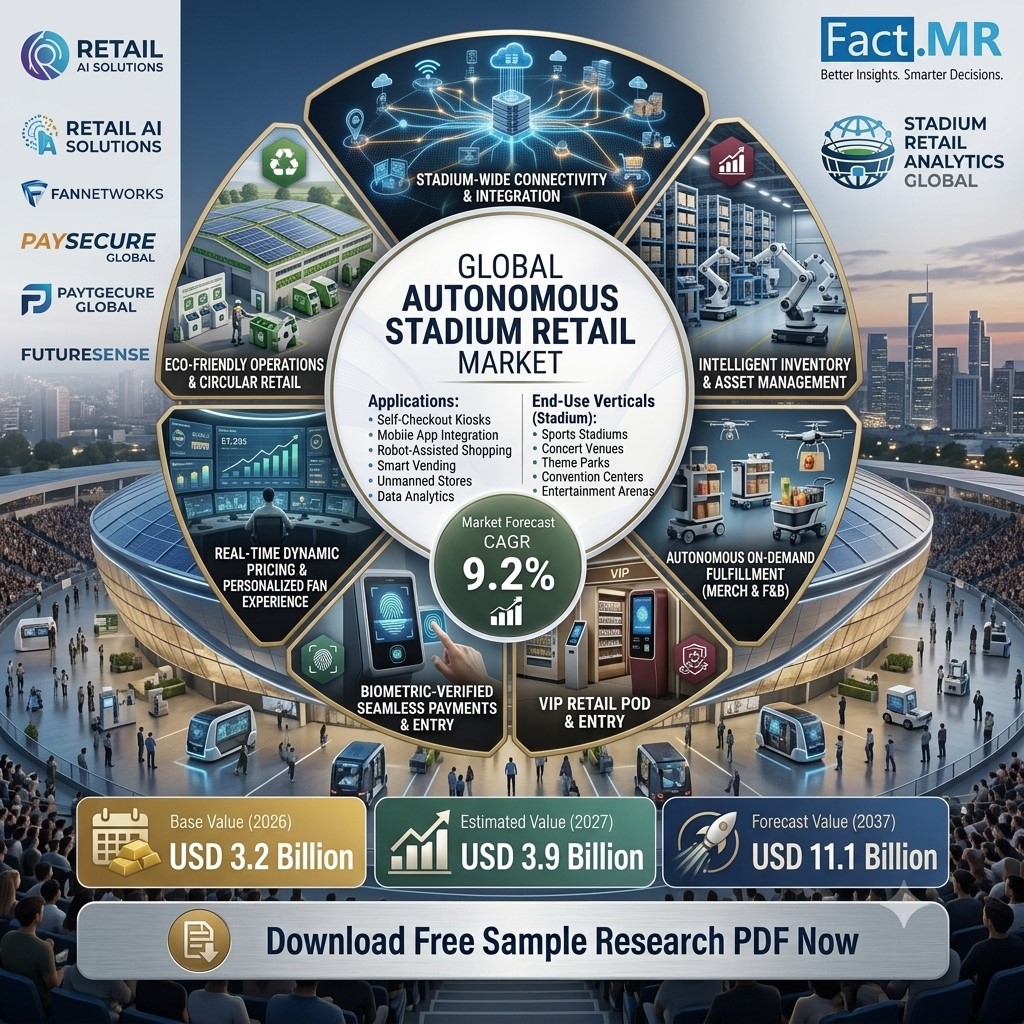
Rockville, MD., September 29, 2026 — The Autonomous Stadium Retail Market is projected to increase from USD 1.1 billion in 2026 to USD 4.6 billion by 2036, advancing at a 15.4% CAGR, according to Fact.MR. The market crossed USD 0.9 billion in 2025 and is expected to create an absolute dollar opportunity of USD 3.5 billion through 2036. The United States is projected to record the highest country growth at 18.2% CAGR, while Germany is forecast to record the lowest among the five countries analyzed, at 14.4%.
The reason is tied to event-day retail pressure. Stadium purchases often occur within short breaks, making checkout speed directly relevant to concession throughput. Autonomous stadium retail includes checkout-free stores, AI self-checkout kiosks, and smart unattended retail systems designed for sports venues.
Get detailed market forecasts, competitive benchmarking, and pricing trends
Short event windows create demand for autonomous stadium retail
Autonomous stadium retail enables fans to purchase food, beverages, merchandise, and other products with limited manual checkout involvement. The systems combine computer vision, RFID, payment integration, inventory analytics, and unattended retail formats.
The stadium environment creates a specific operating requirement. Fans may have only a few minutes to purchase refreshments before returning to their seats, so operators are evaluating retail formats that can process transactions without conventional cashier queues. Fact.MR identifies short event service windows as the primary demand driver, while integration complexity remains a key restraint.
Extractable fact: Autonomous stadium retail covers checkout-free and unattended retail systems used inside stadiums and arenas, including computer-vision stores, RFID-enabled lanes, AI checkout kiosks, and connected vending units.
A specific deployment indicator comes from AiFi. In 2024, AiFi stated that its frictionless checkout technology served customers in 20 sports stadiums and that more than 74 stadium stores were planned by the end of that year. Zippin also announced in August 2024 that AT&T Stadium had launched its checkout-free technology.
Checkout-free convenience stores hold the leading format share
Checkout-Free Convenience Stores are projected to account for 38.0% of the market in 2026. Stadium operators use the format for quick purchases of packaged drinks, snacks, and other products in high-traffic areas.
Computer Vision and RFID Systems are expected to hold 42.0% share by technology stack in 2026. Camera-based systems can track product movement and shopper activity, while RFID lanes support tagged merchandise moving through automated exit points.
New Stadium Deployment is projected to account for 36.0% of the market in 2026. New venues can incorporate camera placement, power layouts, retail zones, and connected infrastructure during the design stage, avoiding some of the constraints associated with retrofitting existing concession areas.
Food & Beverage Retail is expected to represent 51.0% of revenue in 2026. The segment benefits from concentrated concession demand during event breaks, when fans seek fast access to drinks and packaged food.
Managed Retail Operations are forecast to hold 33.0% share in 2026. Providers can support store readiness, event-day operations, and post-event issue reviews, which is relevant when autonomous systems must remain operational during narrow service windows.
United States records the highest country CAGR
The United States is projected to expand at 18.2% CAGR through 2036. Fact.MR links this growth with NFL and arena adoption of checkout-free concession formats. Amazon stated in January 2026 that Just Walk Out technology operated at more than 360 locations across five countries and introduced portable lanes for event and pop-up retail.
Saudi Arabia follows at 17.4% CAGR. New sports venues can integrate autonomous retail during construction, reducing some retrofit barriers. Japan is forecast to grow at 16.1% CAGR, supported by demand for compact, high-throughput retail zones in stadium environments.
The United Kingdom is projected to advance at 15.2% CAGR through 2036 as football venues upgrade match-day foodservice. Germany is forecast to grow at 14.4% CAGR as stadiums improve concession flow and service reliability.
Competitive landscape
Key companies profiled in the Autonomous Stadium Retail Market include Amazon Just Walk Out, AiFi, Zippin, Mashgin, and 365 Retail Markets / Cantaloupe. The report identifies these providers across checkout-free stores, autonomous stadium systems, AI self-checkout kiosks, and unattended retail solutions.
Mashgin stated in January 2025 that its AI checkout systems supported more than 440 million transactions across more than 4,000 locations during 2024. This provides a specific operating-scale reference for AI-based checkout technology beyond individual stadium deployments.
Shambhu Nath Jha, Senior Analyst at Fact.MR, states, “Autonomous stadium retail is becoming a revenue protection tool for live venues. We see stadium teams using checkout-free stores to capture purchases that were previously lost to long lines. Providers that combine accurate item recognition with event-day support will gain stronger access to venue modernization budgets.”
Competition through 2036 is expected to center on accurate item recognition, reliable payment capture, event-day support, and integration with stadium infrastructure. The report also identifies checkout-free concessions, retail pop-ups, and merchandise automation as key opportunity areas.
Top Reports:
Compostable Laminate Packaging Materials Market
About Fact.MR
Fact.MR is a market research and consulting firm providing syndicated and custom research across industries and geographies. Its research combines primary interviews, secondary research, market modeling, and data validation to support business decisions.