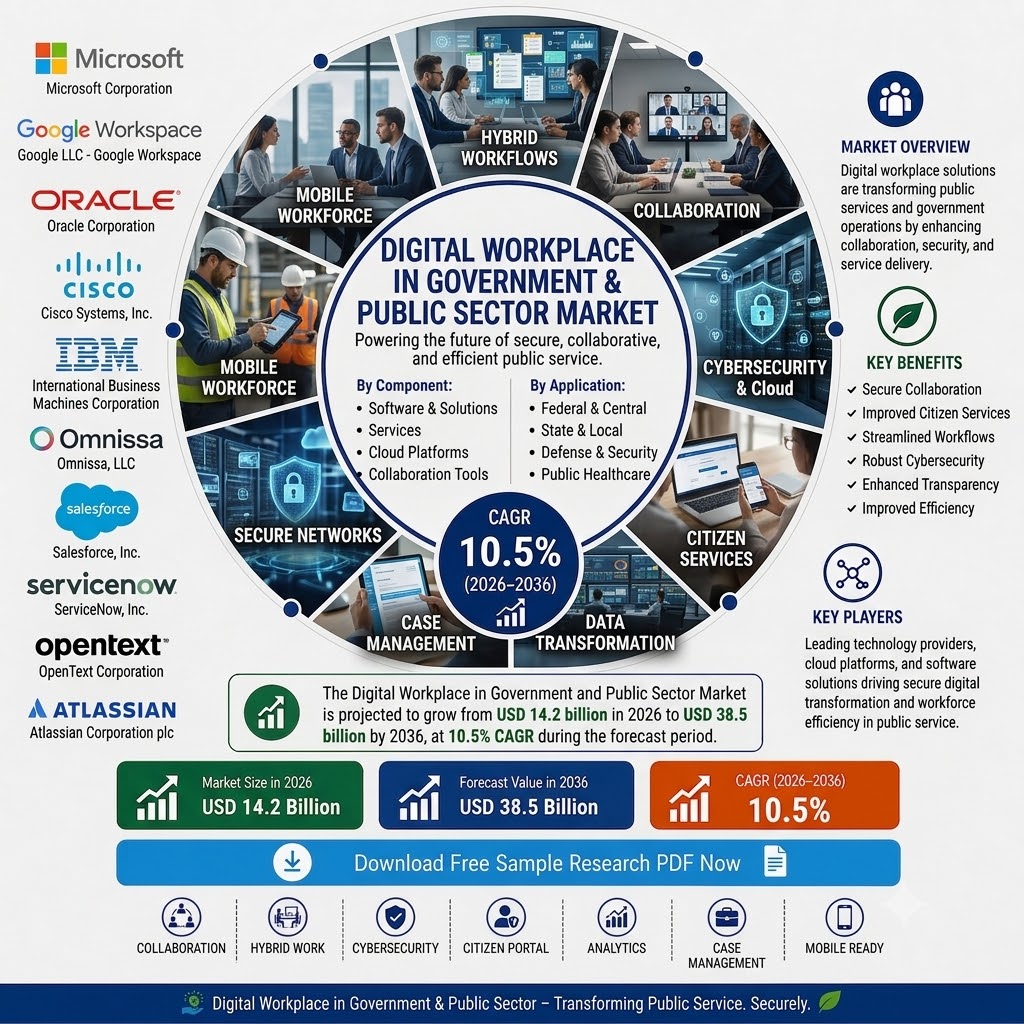
The digital workplace in government and public sector market is projected to expand from USD 14.2 billion in 2026 to USD 38.5 billion by 2036, registering a 10.5% CAGR over the forecast period. Fact.MR attributes this growth to public agencies shifting routine work from fragmented communication channels toward shared digital workspaces, secure cloud access, and structured workflow environments. The market is expected to create an absolute dollar opportunity of USD 24.5 billion through 2036.
Government organizations are increasingly digitizing forms, approvals, records, and internal communication as hybrid working models become more established. Secure access across offices and remote locations is also increasing the requirement for cloud-based workplace platforms, while document-heavy public administration is creating demand for knowledge management and searchable information systems. Adoption and integration is identified as a key growth driver, with an estimated 1.6 percentage-point impact on CAGR.
Get detailed market forecasts, competitive benchmarking, and pricing trends
Digital Collaboration Suites Maintain Leading Position
By solution type, digital collaboration suites are projected to account for 38.0% of the market in 2026. Their position reflects the everyday requirement for secure messaging, file sharing, and coordinated communication across public agencies. Employee experience platforms, knowledge management systems, and digital productivity platforms are also contributing to the transition from fragmented workplace tools toward integrated digital environments.
Document and workflow management represents the leading functional area, with a projected 40.0% market share in 2026. Public-sector operations depend heavily on approvals, records, and case files moving between departments, making digital routing important for maintaining visible responsibilities and reducing manual handoffs. Central government is expected to account for 42.0% of the market by public-sector vertical, while government agencies represent 39.0% by user category. Cloud-based digital workplaces are projected to capture 41.0% of deployment architecture demand as agencies seek wider access and reduced internal infrastructure requirements.
USA, UK, and Germany Show Strong Growth Potential
The USA is projected to register an 11.4% CAGR from 2026 to 2036, supported by federal collaboration requirements, large agency user bases, and established enterprise software adoption. Public agencies are increasingly evaluating workplace platforms based on identity controls, data protection, migration requirements, and workflow support. The country’s established software environment provides a substantial base for continued digital workplace deployment.
The UK follows with a projected 10.9% CAGR through 2036. Public-service modernization and cloud planning are supporting demand for shared workspaces that simplify forms, approvals, and service activity. Digital workflow platforms can reduce manual handoffs between teams while improving accountability across central and local government bodies.
Germany is expected to advance at a 10.4% CAGR during the same period. Public agencies place strong emphasis on data protection, access controls, and records management, creating demand for workplace platforms with clearly defined governance and storage responsibilities. Document-intensive administrative processes are also supporting adoption of digital routing and approval systems.
Japan is projected to record a 9.9% CAGR, supported by agency modernization and efforts to reduce dependence on paper-based document sharing and approvals. Canada is expected to grow at 9.5%, while Australia and Singapore are projected to expand at 9.1% and 8.6%, respectively.
Competitive Landscape
Competition in the digital workplace in government and public sector market includes major enterprise software, cloud collaboration, workflow, content management, and digital transformation providers. Key companies profiled by Fact.MR include Microsoft Corporation, Google LLC – Google Workspace, Oracle Corporation, Cisco Systems, Inc., and International Business Machines Corporation. Other companies covered include Omnissa, LLC, Salesforce, Inc., ServiceNow, Inc., OpenText Corporation, and Atlassian Corporation plc.
Providers are competing through secure collaboration capabilities, cloud productivity, workflow automation, records management, employee support, and public-sector-specific governance features. The report notes that Microsoft and Google Workspace have strong positions in secure collaboration and cloud productivity, while Oracle and Cisco contribute enterprise workflow and communication infrastructure. IBM, Salesforce, ServiceNow, OpenText, and Atlassian broaden the competitive field through hybrid cloud, service workflows, case management, content governance, and project coordination capabilities.
Cloud Adoption and Compliance Shape Market Development
Cloud-based digital workplaces are projected to hold 41.0% of deployment architecture share in 2026. Cloud delivery can reduce the infrastructure burden on individual agencies while supporting centralized updates and access for distributed teams. Hybrid workplace platforms and zero-trust workspaces remain relevant where sensitive information, identity verification, and tighter access controls require additional safeguards.
Regulatory and compliance support is another important factor, particularly in the USA, Germany, and UK. Fact.MR estimates that this driver has an approximately 1.4 percentage-point impact on CAGR. Public-sector buyers increasingly require vendors to provide security documentation, audit controls, records-management capabilities, and clear specifications before wider deployment is approved.
The market also presents opportunities through AI-assisted search, secure collaboration, specialist public-sector positioning, and channel expansion. AI-powered workplace services can support information retrieval and workflow automation, while implementation partners can help agencies migrate legacy systems and manage deployment. However, migration costs, change management, legacy integration, and compliance checks can slow adoption. Fact.MR estimates that cost and complexity has an approximately 1.1 percentage-point negative impact on CAGR.
As government organizations continue digitizing internal operations, demand is expected to extend beyond basic communication tools toward integrated workplace environments that connect collaboration, document management, workflow routing, records access, and employee support. Companies seeking detailed market estimates, segment analysis, country-level forecasts, competitive intelligence, and strategic insights can access the complete Fact.MR Digital Workplace in Government and Public Sector Market report.
To View Top Reports
About Fact.MR
Fact.MR is a market research and consulting company providing market intelligence, competitive analysis, and forecasting across global industries. Its research supports businesses with data-driven insights into emerging markets, technology trends, competitive dynamics, regional opportunities, and changing demand patterns.
The Digital Workplace in Government and Public Sector Market study analyzes solution types, functional areas, public-sector verticals, user categories, deployment architectures, regional markets, and country-level growth. The research draws on 120+ sources, 35+ company portfolios, coverage of 25+ countries, and more than 20 industry interviews.