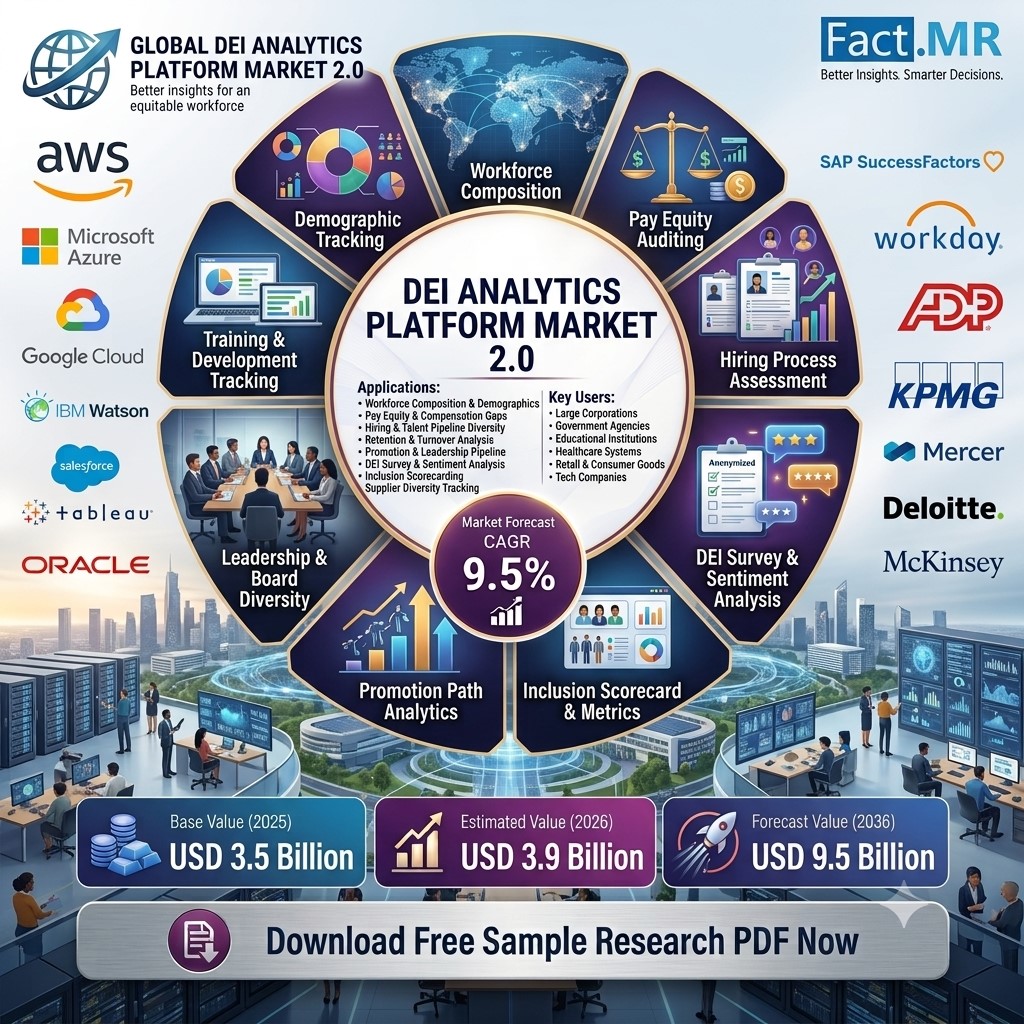
Rockville, MD., September 28, 2026 — The Diversity, Equity & Inclusion (DEI) Analytics Platform Market is projected to rise from USD 2.9 billion in 2026 to USD 8.7 billion by 2036, expanding at 11.6% CAGR, according to Fact.MR. The market reached USD 2.6 billion in 2025 and is expected to create an absolute dollar opportunity of USD 5.8 billion through 2036. The USA is forecast to record the highest country CAGR at 12.7%, while India is projected to grow at 9.4%.
Demand is being shaped by employers that need measurable workforce reporting across representation, pay equity, recruitment and employee experience. Fact.MR identifies privacy controls, HRIS and payroll integration, documented methodologies, and controlled access as important considerations when organizations evaluate these platforms.
Get detailed market forecasts, competitive benchmarking, and pricing trends
Cloud-based platforms lead as workforce reporting becomes more integrated
The Diversity, Equity & Inclusion (DEI) Analytics Platform Market covers software that measures workforce representation and pay equity using workforce, payroll, recruitment and employee-experience data. The scope includes cloud-based and on-premise platforms, employee experience platforms, and governance and compliance platforms.
Cloud-based DEI Analytics Platforms are projected to account for 40.0% of the market by platform type in 2026. Fact.MR attributes this position to faster setup, easier integration with HRIS, payroll and employee feedback systems, and controlled access to workforce information.
Extractable fact: A DEI analytics platform is software that measures diversity, equity and inclusion outcomes using workforce, payroll, recruitment and employee-experience data.
Workforce Diversity Analytics is expected to hold 42.0% share by business function in 2026. Representation measurement remains a primary reporting requirement, allowing organizations to compare hiring flows, workforce composition and promotion patterns.
Information Technology is anticipated to capture 39.0% share by end-use industry. Large digital workforces and distributed hiring models support demand for structured workforce analytics. Large Enterprises are estimated to represent 41.0% of the customer category, reflecting reporting requirements across multiple business units and job levels.
Predictive workforce analytics gains traction
Predictive Workforce Analytics is forecast to account for 38.0% share of analytics capability in 2026. These platforms provide early signals around retention and promotion patterns, while requiring controlled definitions and documented data sources.
Adoption is also being influenced by the need to bring HRIS, payroll and survey information into a single reporting layer. Fact.MR estimates that adoption and integration could contribute approximately 1.6 percentage points to CAGR, while regulatory and compliance support could contribute 1.4 percentage points.
Cost and complexity remain a restraint. Fact.MR estimates this factor could have a negative 1.1 percentage-point impact on CAGR, particularly where HR data definitions differ across payroll and recruitment systems. Specification and compliance checks could have a further negative 0.9 percentage-point impact.
USA leads country growth at 12.7%
The USA is forecast to expand at 12.7% CAGR from 2026 to 2036. Fact.MR associates this growth with enterprise software maturity and workforce reporting depth, particularly among organizations managing multiple HR, payroll and talent-management systems.
Canada follows at 12.1% CAGR, supported by structured workforce reporting and regulated employers. Privacy controls are identified as a key purchasing consideration, particularly where organizations require permission-based access and reporting across different provinces.
The UK is projected to grow at 11.6% CAGR, while Germany records 11.1%. Australia follows at 10.5%, Singapore at 10.0%, and India at 9.4%. Fact.MR links these markets with service-sector adoption, enterprise data governance, large-employer reporting, regional headquarters activity, and expanding enterprise HR systems.
The report’s country comparison spans a 3.3-percentage-point difference between the highest and lowest projected CAGRs. The USA remains 0.6 percentage points ahead of Canada, while Singapore remains 0.6 percentage points ahead of India.
Competition centers on integration and privacy controls
Key companies profiled in the Diversity, Equity & Inclusion (DEI) Analytics Platform Market include Workday, Inc.; Microsoft Corporation – Viva Glint; SAP SE; Oracle Corporation; Visier Inc.; UKG Inc.; Qualtrics; Culture Amp Pty Ltd.; Crunchr B.V.; and Syndio Solutions, Inc.
Workday and Microsoft show broad enterprise-stack relevance, while SAP and Oracle remain relevant for buyers already operating within their HR and data environments. Visier and UKG provide workforce intelligence capabilities, while Qualtrics and Culture Amp address employee experience workflows. Crunchr and Syndio strengthen pay-equity-related applications.
Competition is expected to center on integration quality, privacy controls, dashboard clarity and methodology transparency. These factors are particularly relevant because DEI analytics platforms process sensitive workforce information and must provide understandable reporting outputs.
Shambhu Nath Jha, Principal Consultant at Fact.MR, states, “Diversity Equity and Inclusion (DEI) Analytics Platform companies need to show how their products turn sensitive workforce data into usable decisions. Buyers are expected to reward platforms that explain methodology and protect employee information.”
The Fact.MR analysis draws on 120+ sources, 35+ company portfolios, 25+ countries and more than 20 industry interviews. The research combines primary interviews, government and regulatory sources, company filings, trade data, technical studies, market sizing, forecasting and data validation.
Top Reports:
Machinery Retrofit Modules Market
About Fact.MR
Fact.MR is a market research and consulting firm providing syndicated and custom research across industries and geographies. Its research combines primary interviews, secondary research, market modeling and data validation to support business decisions.