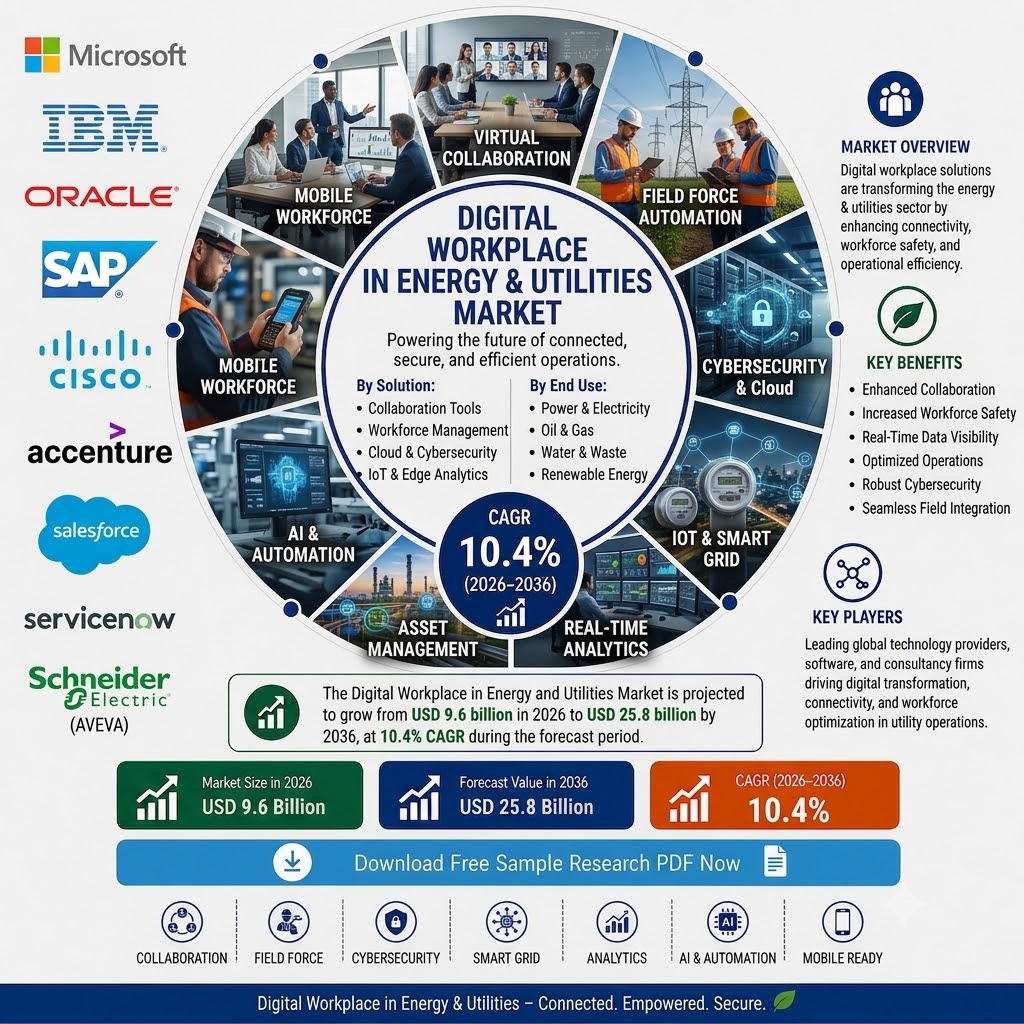
The digital workplace in energy and utilities market is estimated at USD 9.6 billion in 2026 and is projected to reach USD 25.8 billion by 2036, registering a 10.4% CAGR over the forecast period. Fact.MR estimates an absolute dollar opportunity of USD 16.2 billion through 2036 as energy and utility organizations increase their use of digital platforms to coordinate field teams, office functions, customer-service operations, and compliance activities.
Utilities are increasingly adopting digital workplace technologies where manual handoffs can slow field response and make task ownership difficult to track. Renewable energy projects, smart grid programs, and broader energy-transition activity are also increasing the flow of documents, alerts, approvals, and work tasks across distributed teams. Platforms that connect collaboration with operational workflows are therefore becoming more relevant to utility organizations.
Get detailed market forecasts, competitive benchmarking, and pricing trends
Workplace Collaboration Suites Maintain Leading Position
By solution type, workplace collaboration suites are projected to account for 38.0% of the market in 2026, making them the leading segment. Their position reflects the need for secure communication and shared records between field personnel, office teams, and customer-service functions. Centralized communication can keep operational updates consistent while searchable records support review and documentation requirements.
By business function, operations management is expected to hold a 41.0% share in 2026. Outage response, work scheduling, and customer commitments require close coordination, creating demand for platforms that allow teams to work from current asset information and coordinate decisions. Electric utilities are expected to represent 43.0% of the end-use utility segment, while large utility enterprises account for 40.0% by organization type. Cloud-based digital workplace platforms are forecast to capture 39.0% of deployment architecture demand as distributed teams seek secure access across offices, field locations, and mobile devices.
USA, Germany, and UK Show Strong Growth Potential
The USA is projected to record an 11.3% CAGR from 2026 to 2036, supported by utility cloud programs and modernization of field workforces. Large utility organizations require platforms that connect field crews, office teams, and customer-service functions while maintaining secure access and integration with existing systems. The depth of enterprise software adoption also provides an established environment for digital workplace deployment.
Germany follows with a projected 10.8% CAGR through 2036. Grid modernization and renewable energy integration are increasing the amount of documentation and coordination required across energy organizations. Buyers place emphasis on task histories, responsibility records, and compliance-ready documentation, creating opportunities for platforms designed around structured utility workflows.
The UK is expected to expand at a 10.2% CAGR during the same period. Its regulated utility environment requires coordination among customer-service teams, field personnel, and operational functions, supporting demand for systems that make approvals, workflow controls, and service records easier to manage. Canada, Japan, Australia, and India are also included in the report, with projected CAGRs of 9.7%, 9.2%, 8.8%, and 8.4%, respectively.
Competitive Landscape
Competition in the digital workplace in energy and utilities market includes enterprise software, collaboration, workflow, cybersecurity, and industrial technology providers. Key companies profiled by Fact.MR include Microsoft Corporation, IBM Corporation, Oracle Corporation, SAP SE, Cisco Systems, Inc., Accenture plc, Salesforce, Inc., ServiceNow, Inc., and Schneider Electric SE–AVEVA.
Microsoft and IBM bring enterprise collaboration, asset intelligence, and utility workflow capabilities, while Oracle and SAP focus on operational data and business-process integration. Cisco supports secure communication for distributed teams, and Accenture provides implementation and digital transformation services. Salesforce and ServiceNow address customer workflows, case management, and task automation, while Schneider Electric–AVEVA connects industrial software, grid operations, asset information, and field execution.
Utility Digitization and Integration Shape Market Development
Adoption and integration represent a key growth factor for the market. Fact.MR estimates that this driver has an approximately 1.6 percentage-point impact on CAGR, as utilities prioritize platforms that connect collaboration with field execution and reduce handoffs during urgent work. Regulatory and compliance support is another factor, with a reported approximately 1.4 percentage-point impact on CAGR in markets including the USA, Germany, and UK.
Digital workplace adoption is also being supported by the expansion of cloud-based deployment. Distributed utility teams can access common systems from offices, field locations, and mobile devices, while cloud delivery can simplify software updates and user expansion. Hybrid architectures remain relevant where sensitive operational data or energy intelligence systems require some degree of local control.
However, rollout costs and integration complexity remain considerations for buyers. Fact.MR identifies cost and complexity as a restraint with an approximately 1.1 percentage-point negative impact on CAGR. Platform implementation can require process redesign, employee training, security validation, and integration checks before operational teams are added at scale. Existing lower-cost collaboration tools can also act as alternatives, making utility-specific workflow capabilities important for specialized providers.
The market is also opening opportunities for platforms that combine workforce coordination with utility analytics, outage response, asset planning, and compliance management. Providers demonstrating clear utility-specific templates, secure access controls, and documented workflow outcomes can address procurement requirements more directly. Implementation partners can further support adoption by combining migration, training, and workflow design into a unified deployment program.
The combination of utility modernization, cloud adoption, field workforce digitization, renewable energy development, and increasing compliance requirements is expected to sustain demand through 2036. Companies seeking detailed market estimates, segment analysis, country-level forecasts, competitive intelligence, and strategic insights can access the complete Fact.MR Digital Workplace in Energy and Utilities Market report.
To View Top Reports
About Fact.MR
Fact.MR is a market research and consulting company providing market intelligence, competitive analysis, and forecasting across global industries. Its research supports businesses with data-driven insights into emerging markets, technology trends, competitive dynamics, regional opportunities, and changing demand patterns.
The Digital Workplace in Energy and Utilities Market study analyzes solution types, business functions, end-use utilities, organization types, deployment architectures, regional markets, and country-level growth. The research draws on 120+ sources, 35+ company portfolios, coverage of 25+ countries, and more than 20 industry interviews.