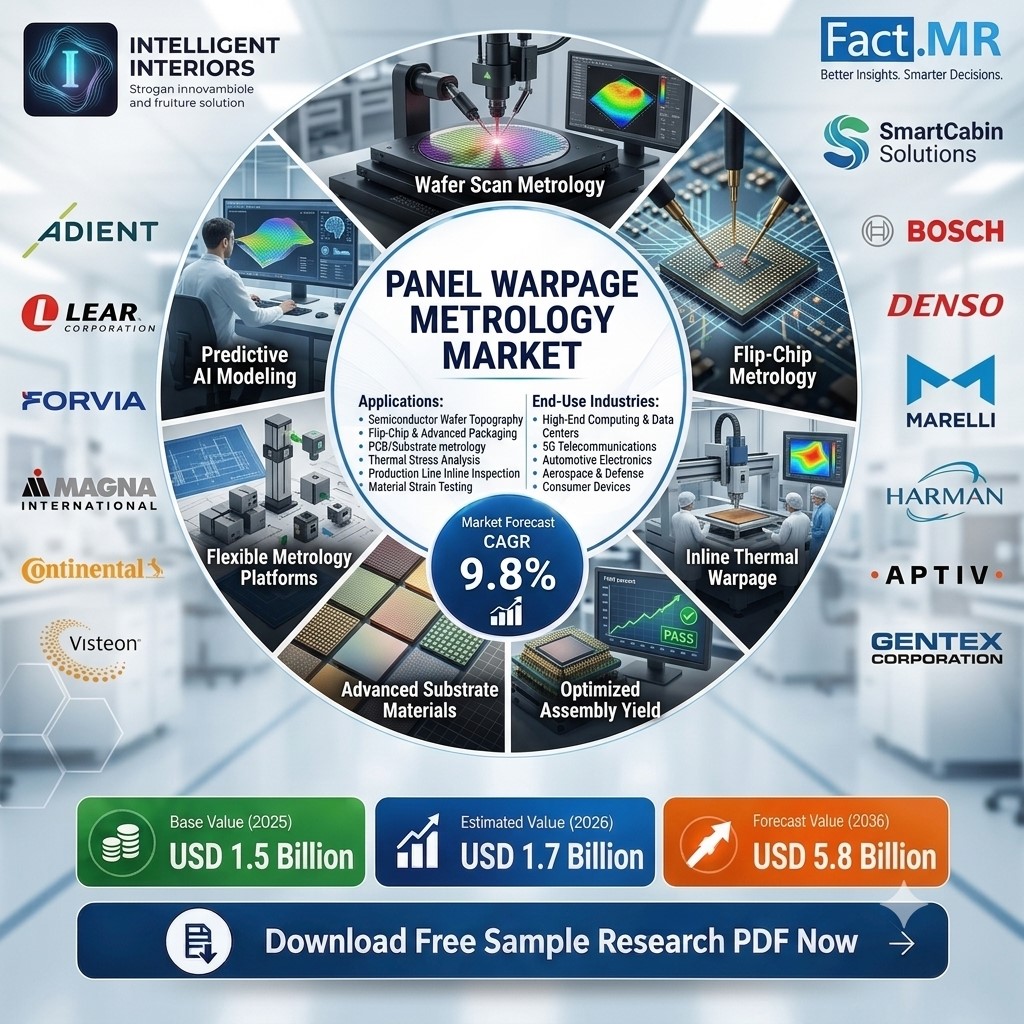
Rockville, MD., September 24, 2026 — The Panel Warpage Metrology Market is projected to rise from USD 174.0 million in 2026 to USD 645.0 million by 2036, expanding at a 14.0% CAGR, according to Fact.MR. The market was valued at USD 152.6 million in 2025 and is expected to create an absolute opportunity of USD 471.0 million through 2036. Taiwan is projected to record the fastest country growth at 15.3% CAGR, while Austria is expected to post the lowest among the five profiled markets at 13.3%.
Demand is being shaped by the need to measure deformation across larger panels and controlled thermal profiles. Fact.MR identifies repeatable thermal-warpage measurement, panel-scale deformation control, technique selection based on surface geometry, and glass-panel process control as key adoption factors.
Get detailed market forecasts, competitive benchmarking, and pricing trends
Larger panels raise the need for full-field measurement
The Panel Warpage Metrology Market covers equipment and process systems used to measure out-of-plane deformation, surface shape, and related topography on panel-level packages, IC substrates, wafers, and glass-core panels. Systems can operate at room temperature or through controlled thermal profiles. Measurement approaches include shadow moiré, digital fringe projection, interferometric profiling, confocal scanning, and laser triangulation.
Larger panel formats are changing measurement requirements. Fact.MR reports that commercial systems support panel dimensions around 600 × 600 mm or larger. Akrometrix describes warpage measurement up to 600 × 600 mm, Onto Innovation reports panel coverage up to 650 × 650 mm, and Bruker supports 600 × 600 mm panel metrology. These measurements help process teams distinguish global bow from local surface variation without reducing panels to smaller samples.
Extractable fact: Panel warpage metrology is equipment used to measure deformation, surface shape, and topography across panel-level packages, IC substrates, wafers, and glass-core panels.
Fringe projection holds the leading measurement share
Fringe projection is projected to account for 31.0% of the market by measurement technique in 2026. The method provides full-field three-dimensional measurements and can assess discontinuous surfaces and step-height features. Shadow moiré remains suited to continuous surfaces and temperature-dependent warpage measurement.
Room-temperature measurement is projected to hold 44.6% share in 2026. It supports incoming, post-process, and handling checks without requiring a thermal chamber. Elevated-temperature and full-cycle measurements remain relevant where deformation during reflow or reliability testing affects process decisions.
Large panels above 500 mm are projected to account for 43.4% share by substrate format. Fan-out packaging is expected to represent 40.9% by application, while OSAT providers are projected to hold 31.7% share among end users.
Fan-out packaging combines mold compound, redistribution layers, and embedded dies with different mechanical and thermal behavior. Warpage can affect lithography focus, carrier handling, die position, and downstream assembly. OSAT providers therefore require measurements that can support carrier, cure, reflow, and process adjustments.
Taiwan leads country-level growth
- Taiwan — 15.3% CAGR: Advanced packaging, foundry, and substrate production create demand for full-field panel measurements, thermal-profile comparison, and correlation with molding, buildup, and handling results.
- South Korea — 14.9% CAGR: Memory, HBM, and integrated semiconductor production require warpage control across substrate, molding, bonding, and assembly operations.
- Malaysia — 14.7% CAGR: Outsourced assembly and test operations require repeatable deformation checks across package handling, molding, reflow, and final assembly.
- Japan — 14.5% CAGR: The country’s semiconductor equipment and materials base supports development work involving substrates, packaging materials, and deformation control.
- Austria — 13.3% CAGR: Advanced-packaging equipment and application-engineering activity supports qualification work involving bonding, substrate handling, and process integration.
Competition centers on measurement capability
Key companies profiled by Fact.MR include Akrometrix, Onto Innovation, Camtek, Bruker, KLA, and ZEISS. The competitive landscape covers direct thermal-warpage systems, panel inspection platforms, and adjacent wafer-shape technologies.
Akrometrix supplies room-temperature and thermal warpage systems based on shadow moiré, with digital fringe projection available for discontinuous surfaces. Onto Innovation describes multifunctional glass-panel inspection and metrology with panel warpage analysis and coverage up to 650 × 650 mm. Camtek’s MicroProf PT supports automated panel inspection and metrology across common panel formats, including glass.
Bruker’s ContourSP provides large-panel optical metrology for samples up to 600 × 600 mm. KLA’s Zeta-6xx series lists full-panel mapping and panel warpage among its PCB and IC-substrate applications. ZEISS participates through wafer-shape control and integrated topography metrology, with its DUNE 100 positioned for wafer warpage.
Shambhu Nath Jha, Sr. Consultant at Fact.MR, states, “Panel warpage metrology should be selected around the surface, temperature profile and process decision being measured. Continuous and discontinuous surfaces may require different optical methods, while panel size changes field-of-view, resolution and handling requirements.”
Fact.MR identifies trade-offs among field of view, vertical resolution, measurement time, and surface compatibility as the main restraint. Thermal-profile repeatability and technique-selection complexity can also increase qualification requirements.
Top Reports:
Compostable Laminate Packaging Materials Market
Zonal Vehicle Control Unit Architectures Market
About Fact.MR
Fact.MR is a market research and consulting firm providing syndicated and custom research across industries and geographies. Its research uses structured market analysis, public information, industry evidence, company disclosures, technical literature, and market indicators to assess demand patterns, supply conditions, segment mix, country activity, company participation, and adoption trends.