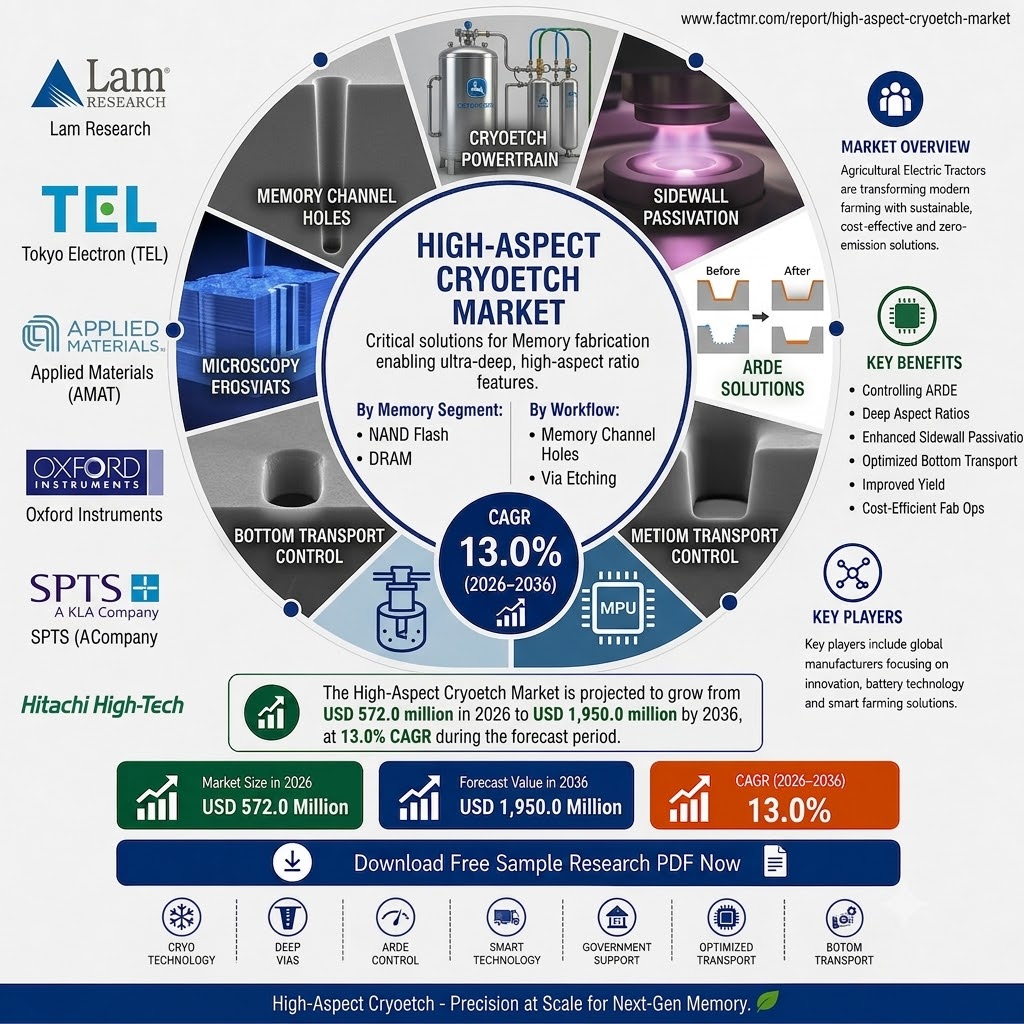
The global High-Aspect Cryoetch Market is projected to increase from USD 572.0 million in 2026 to USD 1,950.0 million by 2036, advancing at a 13.0% CAGR, according to Fact.MR. The market was valued at USD 506.2 million in 2025 as memory manufacturers increasingly address deep-feature etching requirements involving aspect-ratio-dependent etch, sidewall passivation, and bottom transport.
The market is expected to create a USD 1,378.0 million absolute opportunity through 2036. The immediate purchasing case centers on production requirements for deep and narrow features, particularly memory channel holes used in advanced 3D NAND structures.
Get detailed market forecasts, competitive benchmarking, and pricing trends
Deep etching requirements shape equipment demand
High-aspect cryoetch addresses the aspect-ratio-dependent etching problem encountered as feature depth increases. Conventional reactive ion etching can experience declining etch rates because ion flux and neutral transport become increasingly constrained at the feature bottom. Cryogenic processing changes the adsorption regime through controlled wafer temperature and gas chemistry.
Cooling architecture is another direct equipment consideration. Ultra-low wafer temperatures can be delivered through platform chillers and helium backside wafer cooling, while confined high-power plasma reactors and pulsed plasma technology help manage profile and selectivity in deep structures.
A defining production benchmark comes from 3D NAND. More than 400-layer NAND requires at least 8 micrometers per tier of channel-hole depth to support two-tier stacks, according to the supplied Tokyo Electron and Kihara references. Tokyo Electron demonstrated a 10-micrometer etch depth in 33 minutes, compared with an hours-class legacy process.
Polymer buildup at the hole top remains a named failure mode because accumulated material can restrict ion flux from reaching the feature bottom.
Fact.MR is a market research company that provides strategic intelligence on global markets, including semiconductor equipment and process technology segments.
Memory channel holes remain a core application
Memory channel holes are projected to account for 32.0% of the High-Aspect Cryoetch Market by feature type in 2026. Their extreme depth, dense repetition, and tight profile requirements create a direct production requirement for controlled cryogenic adsorption and passivation.
The 40-60:1 aspect-ratio class is projected to hold 40.8% share in 2026. This range sits between conventional deep reactive ion etching and more extreme structures, giving manufacturers a process window where cryogenic chemistry can provide measurable process benefits.
Profile and bow control leads the process-control segment with a projected 47.1% share in 2026. Silicon accounts for 45.2% of the substrate segment, while memory manufacturers represent 30.6% of end-user demand.
These figures point to a practical procurement issue. Etch speed alone does not determine equipment value. Buyers also examine depth uniformity, bow control, selectivity, sidewall roughness, chamber stability, gas delivery, and compatibility with post-etch cleaning.
USA leads country growth outlook
The USA is projected to register a 14.5% CAGR between 2026 and 2036. Leading-edge logic, high-performance computing, federally supported semiconductor R&D, and a large domestic equipment base are identified as supporting factors.
Taiwan follows at 14.2% CAGR, supported by leading foundry production, advanced packaging, and its dense OSAT and substrate supply chain. South Korea is projected to grow at 13.9% CAGR, with high-volume memory, HBM, and vertically integrated semiconductor manufacturing supporting demand.
Japan is projected to advance at 13.7% CAGR, reflecting its semiconductor equipment, materials, inspection, and memory-process expertise. Singapore is forecast to expand at 13.2% CAGR, supported by advanced-packaging R&D, specialty fabs, and regional assembly and test operations.
Chemistry innovation adds another performance dimension
HF-based etching with trace PF3 catalysis is identified as another development shaping the market. The supplied Tokyo Electron research indicates that PF3 can promote the reaction between HF and SiO2, allowing higher etch rates at lower operating temperatures while reducing global-warming potential by 84%.
That combination places chemistry development alongside cooling systems and plasma control as a purchasing consideration for cryogenic etch platforms.
Competitive landscape focuses on process capability
Lam Research and Tokyo Electron are identified as leading participants in the competitive landscape, with Applied Materials and Oxford Instruments also profiled. SPTS (KLA) and Hitachi High-Tech have specialized roles across semiconductor equipment and inspection-related applications.
The competitive discussion centers on repeatable process performance, integration with adjacent modules, installed-base service, recipe stability, defect prevention, and documented throughput. Equipment suppliers also need to demonstrate performance across production-representative wafers, dies, panels, or packages.
Shambhu Nath Jha, Sr. Consultant at Fact.MR, said, “Buyers should evaluate the complete process sequence around controlling aspect-ratio-dependent etch, sidewall passivation and bottom transport in very deep features.”
Jha added, “Suppliers that connect tool performance to measurable yield and qualification results are likely to build trust faster.”
The market’s principal restraint remains process-window sensitivity. Different substrates and mask stacks require distinct adsorption and passivation conditions, which can limit recipe portability. Thermal and mechanical effects also place pressure on bowing, twisting, and critical-dimension uniformity.
To View Top Reports
Thermal Energy Storage Materials Market
Automotive Test Equipment Market
About Fact.MR
Fact.MR is a market research and consulting firm providing market intelligence, competitive analysis, and strategic research across technology, chemicals, industrial, healthcare, and consumer markets. Its research combines market assessment, evidence review, and validation of demand and supply indicators.