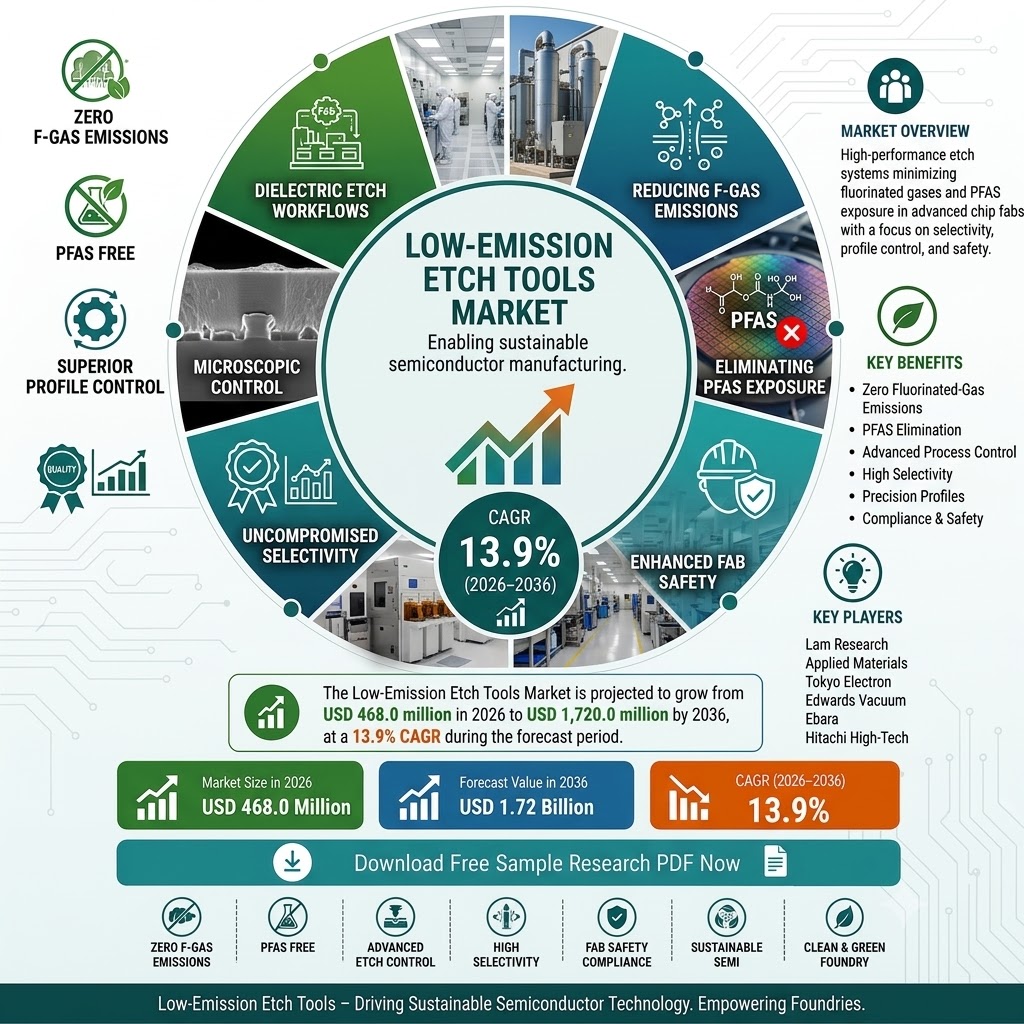
The global Low-Emission Etch Tools Market is projected to increase from USD 468.0 million in 2026 to USD 1,720.0 million by 2036, expanding at a 13.9% CAGR, according to Fact.MR. The market crossed USD 410.9 million in 2025, while the forecast period is expected to create an absolute dollar opportunity of USD 1,252.0 million.
The market is being shaped by semiconductor manufacturers seeking to reduce fluorinated-gas emissions and PFAS exposure while maintaining selectivity, profile control, fab safety, and production throughput. The regulatory backdrop is also tightening. The EU F-gas Regulation (EU) 2024/573 started applying in March 2024 and establishes a phased reduction in HFC availability, with EU production rights reaching 15% of the 2011–2013 average from 2036.
Get detailed market forecasts, competitive benchmarking, and pricing trends
Regulatory deadlines reshape etch-tool purchasing
The regulatory timeline gives fabs a concrete reason to reassess process gases and equipment. Under the EU framework, HFC production rights decline from 60% of the historical baseline for 2025–2028 to 30% for 2029–2033, 20% for 2034–2035, and 15% from 2036 onward. The regulation also strengthens requirements around emissions prevention, monitoring, and equipment containing fluorinated gases.
For semiconductor fabs, the question is no longer limited to the gas used inside a chamber. Procurement teams increasingly need to consider process emissions, abatement efficiency, by-product handling, etch selectivity, chamber uptime, and compatibility with existing exhaust systems.
Fact.MR is a market research company that provides market intelligence, forecasts, and strategic analysis across industries and geographic markets.
Dielectric etch accounts for 40.5% share
Dielectric etch is projected to account for 40.5% of the Low-Emission Etch Tools Market in 2026. The application relies heavily on fluorocarbon chemistry for sidewall passivation and oxide selectivity, making it a major area for lower-emission gas and plasma designs.
Low-GWP fluorocarbons are projected to hold 46.0% of the gas chemistry segment in 2026. These chemistries provide a nearer-term substitution route where fully fluorine-free processes cannot yet deliver the required profile and selectivity.
Alternative etch chemistries account for 31.0% of the emission-reduction approach in 2026. Unlike exhaust treatment alone, chemistry-based approaches can prevent high-global-warming-potential gases from entering the chamber, reducing the load placed on downstream abatement systems.
Corporate net-zero targets represent 38.0% of compliance drivers, while foundries account for 32.9% of end-user demand. Foundries operate high-volume production across multiple device designs, making process repeatability and environmental performance relevant to purchasing decisions.
Cryogenic HF chemistry provides a production proof point
One specific development illustrates how emission reduction can be linked with process performance. Tokyo Electron’s cryogenic channel-hole etch uses HF gas to reduce the partial pressure of conventional CF gas. The supplied Fact.MR analysis cites an 84% reduction in greenhouse-gas carbon footprint compared with the first-generation cryogenic process.
That example matters because fabs cannot simply replace a chemistry if the change compromises yield, profile control, throughput, or safety. Low-emission etch systems therefore need to demonstrate measurable process performance alongside environmental improvements.
Shambhu Nath Jha, Sr. Consultant at Fact.MR, said, “Buyers should evaluate the complete process sequence around reducing fluorinated-gas emissions and PFAS exposure without sacrificing selectivity, profile control or fab safety.” He added that technical reviews should examine repeatability, integration, defect control, and production throughput rather than relying on a single specification.
Fact.MR’s analysis indicates that procurement teams will need to compare verified emissions per wafer, abatement efficiency, process equivalence, chamber uptime, and compliance performance when evaluating competing systems.
Taiwan and the United States show double-digit growth
Taiwan is projected to expand at a 15.5% CAGR from 2026 to 2036, supported by leading foundry production, advanced packaging, and its dense OSAT and substrate supply chain.
The United States follows at 15.4%, with leading-edge logic, high-performance computing, federally supported semiconductor R&D, and a large domestic equipment base supporting demand. South Korea is projected to grow at 15.2%, supported by high-volume memory, HBM, and vertically integrated semiconductor manufacturing.
Japan is projected to record a 14.7% CAGR. The country’s semiconductor equipment, materials, inspection, and memory-process expertise support its market development.
The Netherlands and Germany are forecast to expand at 13.5% and 13.3%, respectively. Advanced semiconductor equipment and die-bonding development support the Netherlands, while precision equipment, materials engineering, and automotive and power-semiconductor demand contribute to Germany’s outlook.
Qualification remains a central adoption constraint
The transition is not without technical barriers. Fact.MR identifies qualification requirements, PFAS substitution feasibility, and alternative-chemistry safety trade-offs as restraints on adoption.
Many advanced etch and clean processes still lack drop-in non-fluorinated alternatives. Proposed options can introduce new toxicity, fire, or process-control concerns. This leaves equipment suppliers balancing environmental requirements with production performance.
Fact.MR states that competition among Lam Research, Applied Materials, Tokyo Electron, Edwards Vacuum, Ebara, and Hitachi High-Tech is expected to center on repeatable process performance, module integration, installed-base service, and documented capability.
The market’s 13.9% CAGR reflects a purchasing environment where environmental compliance increasingly intersects with semiconductor process qualification.
To View Top Reports
About Fact.MR
Fact.MR is a market research and consulting firm providing industry intelligence, market forecasts, and strategic insights across global markets. Its research covers technology, chemicals, materials, healthcare, and other sectors, with analysis spanning companies, countries, applications, and market segments.