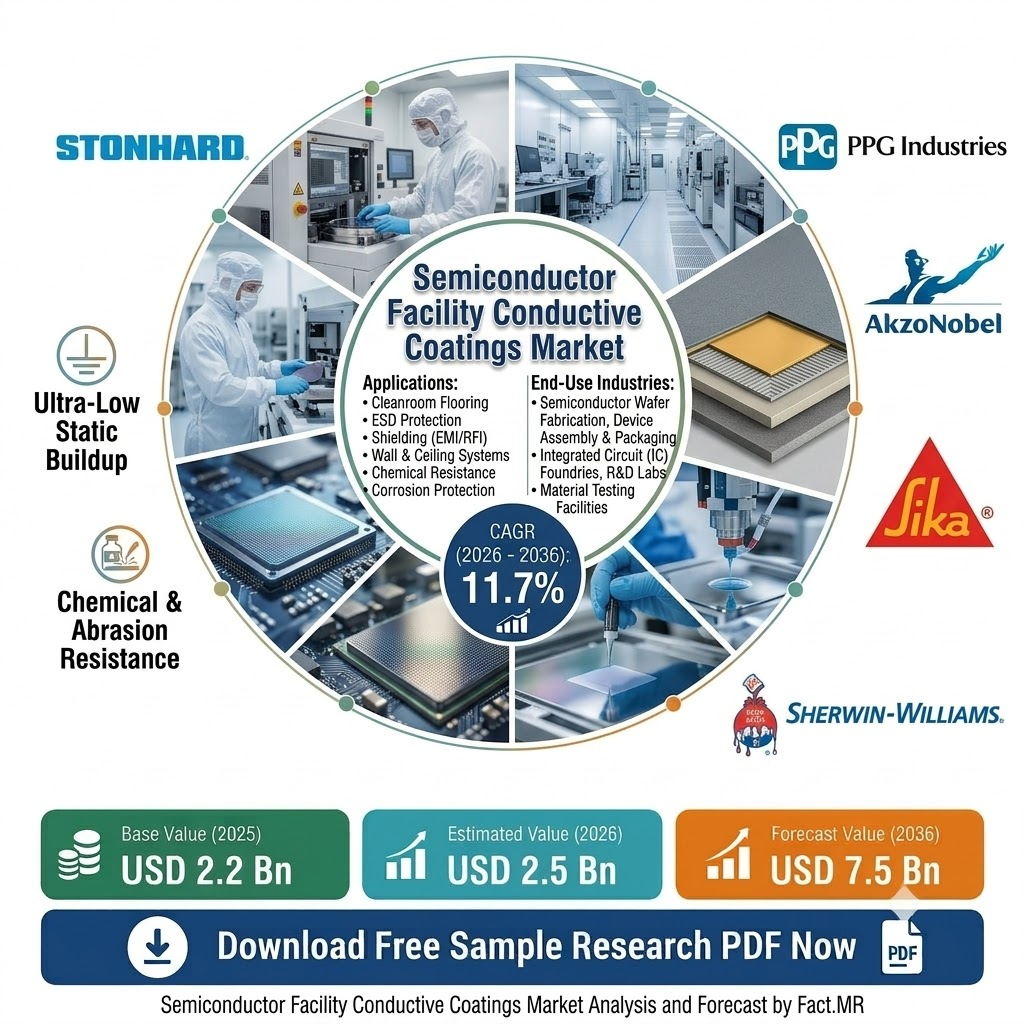
New semiconductor fabs, expanding cleanroom capacity, and rising ESD requirements are supporting demand for conductive coatings across controlled facilities.
The global semiconductor facility conductive coatings market is projected to increase from USD 2.5 billion in 2026 to USD 7.5 billion by 2036, expanding at a CAGR of 11.7% during the 2026–2036 forecast period. The market reached USD 2.2 billion in 2025, with new semiconductor fabs adding cleanroom space and static-control surfaces.
A key driver is the construction of new semiconductor fabrication facilities. On January 7, 2025, SEMI reported that 18 new semiconductor fab projects were expected to start construction during 2025, including 15 facilities based on 300 mm wafer technology. SEMI also forecast global semiconductor output at 33.6 million wafers per month in 2025, representing a 6.6% annual increase. Rising chip output increases the number of cleanroom and subfab surfaces that require durable static-control coatings.
Get detailed market forecasts, competitive benchmarking, and pricing trends:
Global Segment Leaders
- Carbon black — 34.0% share in 2026: Carbon black leads the conductive additive segment because it offers reliable current flow at a practical cost. Carbon nanotubes, graphene, conductive polymers, and metal or hybrid fillers address other electrical and physical requirements.
- Antistatic — 31.0% share in 2026: Antistatic systems lead the conductivity-target segment because many facility surfaces require controlled charge decay rather than very high current flow.
- Fabs — 36.0% share in 2026: Semiconductor fabs lead the end-use facility segment because wafer production uses sensitive electronic tools and requires ESD control, chemical resistance, low contamination, and durable flooring.
- Epoxy — 29.0% share in 2026: Epoxy leads the coating-system segment because it bonds well to floors and provides resistance to wear and chemicals.
Country-Level Performance
USA — 12.3% CAGR: The U.S. semiconductor facility conductive coatings market is forecast to expand at 12.3% CAGR through 2036. In June 2025, the U.S. Department of Commerce said Micron planned USD 200 billion in chip output and R&D investment across Idaho, New York, and Virginia. Fact.MR states that these projects add sites requiring cleanroom and ESD infrastructure.
France — 12.3% CAGR: France is also forecast to grow at 12.3% CAGR. On May 26, 2026, the French Ministry of Economy said France would invest another EUR 550 million in semiconductors. According to Fact.MR, new fabs can require ESD-safe, clean, and durable surfaces.
China — 12.1% CAGR: China’s market is projected to expand at 12.1% CAGR. The National Bureau of Statistics reported in February 2026 that integrated-circuit output reached 484.28 billion pieces in 2025, up 10.9% from 2024. Fact.MR connects this large chip production base with continuing demand for new and renewed facility surfaces.
Germany — 12.1% CAGR: Germany is forecast to grow at 12.1% CAGR. In February 2025, the European Commission reported that Infineon planned a EUR 3.5 billion plant in Dresden, backed by up to EUR 920 million in German state aid. The project adds cleanroom and static-control space.
Japan — 11.0% CAGR: Japan records an 11.0% CAGR through 2036. In April 2025, Japan’s Ministry of Economy, Trade and Industry said an additional JPY 802.5 billion in Rapidus support would bring total support to JPY 1,722.5 billion. Fact.MR states that new sites require stable resistance and clean surfaces after installation.
Regional Context
France and the USA record the highest country growth rate among the markets profiled, at 12.3% CAGR each. Fact.MR links their growth to semiconductor investment and the addition of clean output space. China and Germany follow at 12.1%, supported by China’s large chip manufacturing base and Germany’s expanding Dresden fab capacity. Japan records 11.0%, with public support for next-generation chip output supporting new facility development.
The report covers North America, Latin America, Western Europe, Eastern Europe, East Asia, South Asia & Pacific, and Middle East & Africa. Country-level analysis specifically covers the USA, France, China, Germany, and Japan, while the broader study covers 25+ countries.
Competitive Landscape
Key companies profiled in the semiconductor facility conductive coatings market include Stonhard, PPG Industries, AkzoNobel, Sika, and Sherwin-Williams. Their competitive positioning is linked to coatings used on floors, walls, enclosures, and other controlled-site surfaces where static control or electrical shielding is required.
The competitive landscape covers epoxy and polyurethane systems alongside acrylic, cementitious, and specialty hybrid coatings. Suppliers address antistatic, static-dissipative, ESD-protective, and conductive-shielding requirements across semiconductor fabs and other controlled facilities. Semiconductor fabs place particular emphasis on cleanroom compatibility, chemical resistance, durability, and dependable electrical performance.
Recent industry developments cited in the report include Micron’s USD 200 billion U.S. chip output and R&D investment announced in June 2025. In February 2025, the European Commission reported the planned EUR 3.5 billion Infineon plant in Dresden, supported by up to EUR 920 million in German state aid. France announced an additional EUR 550 million semiconductor investment in May 2026, while Japan added JPY 802.5 billion in Rapidus support in April 2025.
Shambhu Nath Jha, Principal Consultant at Fact.MR, states, “Electrical performance is becoming a core part of coating selection in semiconductor facilities.” Jha adds that fab operators evaluate surface resistance, grounding, and durability alongside cleanroom compatibility because static-control performance must remain stable after installation, cleaning, and routine traffic.
View Related Reports
Semiconductor Relay Switches Market
Semiconductor Defect Inspection Equipment Market
About Fact.MR
Fact.MR is a market research and consulting firm providing syndicated and customized research across industries including Chemical & Materials, Industrial Goods, Technology, Healthcare, Consumer Goods, Automotive, and Food & Beverage. Its research covers market sizing, segmentation, competitive landscapes, demand trends, and forecasts across global markets. Fact.MR also provides bespoke consulting, primary research, and industry-focused intelligence to support business and strategic decision-making.