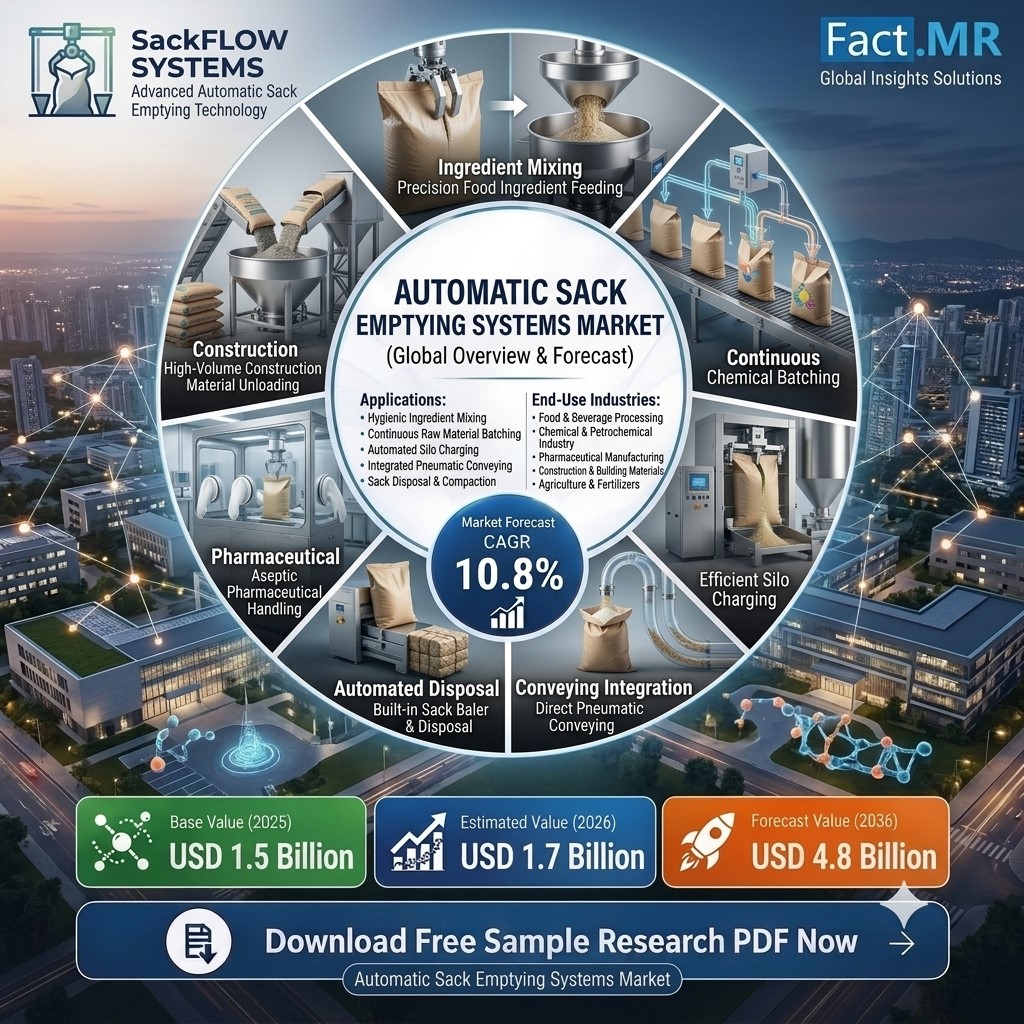
Rockville, MD., September 23, 2026 — The Automatic Sack Emptying Systems Market is projected to increase from USD 430 million in 2026 to USD 741 million by 2036, expanding at a 5.6% CAGR, according to Fact.MR. The market was valued at USD 407.2 million in 2025 and is expected to create an absolute dollar opportunity of USD 311 million between 2026 and 2036. South Korea is forecast to record the highest country CAGR at 7.8%, while Germany is projected to grow at 5.4%.
The market is being shaped by dust containment, combustible-dust requirements, hygienic processing and labor concerns around repetitive sack handling. Fact.MR identifies enclosed equipment replacing open manual tipping as a driver with an estimated +1.3% impact on CAGR, followed by combustible-dust and ATEX compliance at +1.1%.
Get detailed market forecasts, competitive benchmarking, and pricing trends
Enclosed powder intake becomes a plant-level priority
Automatic sack emptying systems are designed to open, tip and discharge powders from open-mouth sacks into downstream process equipment while controlling dust release. The market includes manual-assist tip stations, semi-automatic emptying systems and fully automatic de-baggers, along with integrated filters, central extraction and wet or scrubber-based dust-control configurations.
Why now? Processors face several practical requirements at the intake point. Fact.MR cites NFPA 652 requirements in the United States and ATEX equipment rules in Europe as factors pushing processors away from open manual tipping. Food and pharmaceutical plants also require hygienic surfaces, integrated filtration and tool-free cleaning to manage contamination and allergen risks.
Extractable fact: An automatic sack emptying system is equipment that opens, tips and discharges powder from sacks into downstream process equipment while controlling dust release at the intake point.
Manual-assist stations retain a 34.0% share
Manual-assist tip stations are projected to account for 34.0% of the Product Type segment in 2026. Fact.MR links this position to mixed pallets, variable bag constructions and frequent recipe changes that can make fully automatic sack presentation difficult. Assisted stations allow plants to contain the intake operation while retaining flexibility in upstream material handling.
Integrated filter units are expected to hold 46.0% of the Dust Control segment in 2026. The systems capture dust close to the sack-opening point and can return collected powder to the process, while also reducing reliance on general room ventilation.
Food & beverage is projected to represent 31.0% of End-Use Industry demand in 2026. Food plants receive flour, starches, dairy powders, sugar, seasonings and other ingredients in sacks, making dust control, allergen separation and cleaning important at the intake stage.
The 10-30 sacks/hr capacity category is forecast to hold 41.0% of the Capacity segment in 2026. The range fits batch-oriented production where material additions follow recipe timing rather than continuous bulk-flow requirements.
South Korea records the fastest country growth
South Korea is projected to expand at 7.8% CAGR from 2026 to 2036, the highest among the six countries analyzed by Fact.MR. The report associates this growth with expanding battery-materials, specialty-chemical and food-ingredient production, where powders require contained receiving, emptying and transfer.
The United States follows at 6.6% CAGR, supported by combustible-dust controls and food-safety requirements. France is projected to grow at 6.4%, while Italy is forecast at 5.9%. Switzerland is expected to advance at 5.7%, with pharmaceutical and fine-chemical production creating demand for containment, validated cleaning and documented material-contact surfaces.
Germany is projected to record the lowest CAGR among the six countries at 5.4%. Its established chemical, food and mechanical-engineering base continues to support modernization of powder-handling facilities, particularly where ATEX requirements apply.
Competitive landscape centers on integrated powder handling
Key companies assessed in the Automatic Sack Emptying Systems Market include Palamatic Process, Flexicon Corporation, Spiroflow, Dinnissen Process Technology, Gericke AG and Volkmann GmbH. Fact.MR notes that these suppliers differ in automation level, hygienic execution, dust capture and integration with downstream conveying.
Palamatic Process, Flexicon and Spiroflow are positioned around sack emptying linked with dust capture, hygienic handling and conveying. Dinnissen Process Technology and Gericke AG place sack emptying within broader powder-processing systems, while Volkmann GmbH connects emptying stations with vacuum conveying.
Shambhu Nath Jha, Principal Consultant at Fact.MR, states, “A sack-emptying station has to work as part of the intake line. Processors evaluate containment, filter access, cleaning time and the discharge interface together, because a fast machine still fails the application if it releases dust or interrupts material transfer.”
Fact.MR’s report assesses demand across product type, dust control, end-use industry and capacity. The analysis covers North America, Latin America, Europe, East Asia, South Asia and Oceania, and the Middle East and Africa, with detailed country projections for Germany, the United States, South Korea, Italy, France and Switzerland.
Top Reports:
Zonal Vehicle Control Unit Architectures Market
Non-silver Antimicrobial Wound Dressing Market
About Fact.MR
Fact.MR is a market research and consulting firm providing syndicated and custom research across industries and geographies. The company states that its research combines primary interviews, secondary research, market modeling and data validation to support business decisions.