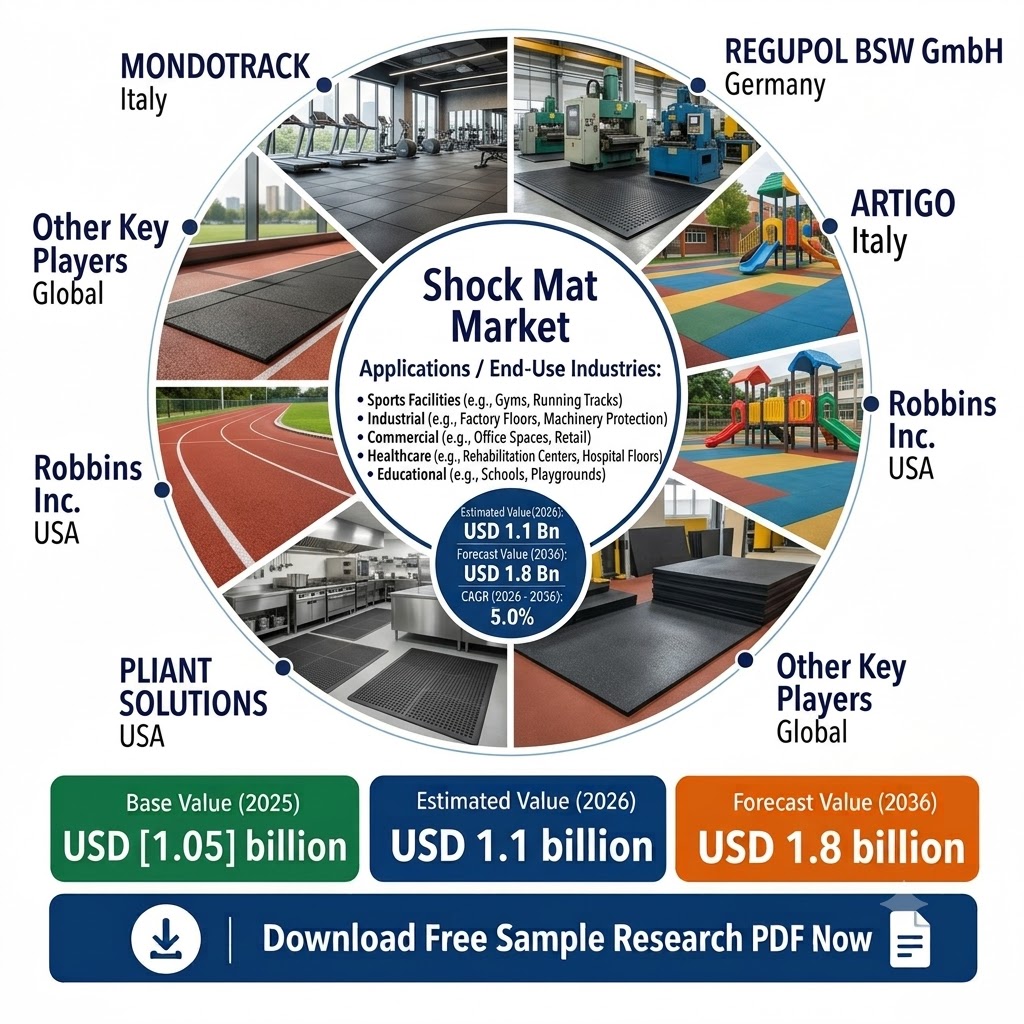
The global shock mat market is projected to grow from USD 1.1 billion in 2026 to USD 1.8 billion by 2036, expanding at a 5.0% CAGR during the forecast period, according to Fact.MR. The market reached USD 1.0 billion in 2025, creating an absolute opportunity of USD 0.7 billion through 2036.
Demand is being shaped by industrial requirements for vibration control, equipment protection, floor protection, and safer work areas. Manufacturers increasingly select mats based on load conditions, compression behavior, surface grip, chemical exposure, and installation requirements rather than cushioning alone.
Get Detailed Market Forecasts, Competitive Benchmarking, and Pricing Trends
Industrial Shock Mats Account for 68.3% of Market Demand
Industrial Shock Mats account for 68.3% of the market in 2026, making them the leading product category. Machinery and equipment-isolation applications require load-bearing materials that can reduce vibration transfer while protecting floors and supporting stable equipment operation.
Manufacturing Facilities represent 44.6% of demand by application. Production plants combine heavy equipment, operator workstations, electronic areas, and maintenance zones, creating different requirements within the same facility.
By end use, Industrial Manufacturers account for 57.8% of the market. Mat selection can affect machine stability, floor protection, workplace conditions, and maintenance requirements.
Vibration Absorption Technology holds 62.1% share by technology. Elastomeric dampening and layered cushioning address the mechanical requirements associated with machinery and equipment installations.
Rubber Formulations Remain Central to Industrial Mat Selection
Rubber Based Formulations account for 49.7% of the market in 2026. Natural and synthetic rubber systems offer combinations of grip, resilience, abrasion resistance, and adjustable hardness.
Other formulation categories include polymer composites, foam-based systems, and gel-based systems. These materials allow suppliers to adjust rebound, cushioning, temperature behavior, and chemical resistance for different work environments.
The performance requirements vary significantly by installation. A machinery-isolation mat may need controlled deflection and resistance to compression set, while a workstation mat may require footing, edge control, cleanability, and operator movement considerations.
Fact.MR Principal Consultant Shambhu Nath Jha states:
“Shock-mat purchasing starts with the load case. A mat under a machine must control deflection, creep, vibration transmission, fluid exposure, and anchoring; a workstation mat must also manage footing, edges, cleanability, and operator movement. Suppliers should document the test condition behind every performance claim.”
Direct Industrial Sales Lead Distribution
Direct Industrial Sales account for 38.9% of the market in 2026. Site dimensions, equipment loads, chemical exposure, and installation details can require direct supplier involvement before a mat is specified.
Industrial distributors and online platforms continue to serve buyers seeking stocked sizes and standardized products. Facility supply chains also support maintenance and replacement requirements.
For suppliers, validated load-deflection, compression-set, slip, chemical-resistance, and durability data can help buyers match products to specific work zones.
Performance Validation Creates New Opportunities
Industrial vibration and impact-control requirements are supporting market expansion. Operator comfort programs, equipment and floor protection, ESD requirements, and custom mat sizing add further demand across manufacturing, logistics, electronics, and automotive settings.
Validated load-specific isolation systems represent an opportunity for suppliers that can document performance under defined operating conditions. Combined anti-fatigue and ESD formats can address multiple requirements within a single workstation.
Chemical-resistant mats also offer opportunities in process facilities where oils, chemicals, moisture, or temperature exposure can shorten the service life of unsuitable materials.
However, poor load matching and unverified performance claims remain constraints. Compression set, edge curl, surface wear, chemical incompatibility, and price comparisons with basic floor coverings can also affect purchasing decisions.
Germany Records the Highest Country CAGR
Germany is projected to record a 5.8% CAGR from 2026 to 2036. Machinery, automotive, chemicals, and logistics sites create varied requirements for vibration isolation and workstation applications. Buyers assess compression behavior, machine load, floor conditions, and chemical exposure together.
The Brazil shock mat market is projected to expand at 5.2% CAGR. Manufacturing, warehousing, transport, and construction applications support demand for durable floor and equipment protection.
In the United States, the market is projected to grow at 4.8% CAGR. Large industrial and logistics networks support machinery-isolation and anti-fatigue applications.
The UK market is projected to expand at 4.2% CAGR, with workplace vibration and standing-risk management contributing to demand for documented mat selection.
Japan is projected to record a 3.8% CAGR through 2036. Precision manufacturing and dense production layouts support demand for stable, cleanable, dimensionally controlled mats.
Competitive Landscape
Competition spans manufacturers and suppliers serving industrial, logistics, construction, automotive, and electronic applications. Product positioning varies according to formulation, load capacity, vibration-control performance, surface design, sizing, and distribution coverage.
Key companies profiled in the Fact.MR study include Qingdao Finest Industry Co., Ltd., India Mart, Splendor Industrial Comp Ltd., Qingdao Emei Ind & Tech Co., Ltd., Qingdao SOL Industrial and Trade Company Ltd., and Hangzhou Green Valley Rubber Products Co., Ltd.
About the Shock Mat Market Report
The Fact.MR study evaluates the shock mat market across Product, Application, End Use, Technology, Formulation, Distribution Channel, and Region.
The market covers rubber, polymer, foam, gel, and composite mats designed to absorb impact, isolate vibration, improve standing comfort, protect equipment, or control electrostatic and floor-contact risks across industrial, logistics, construction, automotive, and electronic settings.
The forecast covers 2026 to 2036, with 2025 as the base year. Market assessment considers mat area and unit volumes, realized prices, formulation mix, installation duty, replacement cycles, end-use activity, and channel structure.
Other Related Reports:
Sweet Perception Powders Market
Smart Grid Security Market
Party Supply Rental Market
About Fact.MR
Fact.MR is a market research and consulting firm providing syndicated and customized research across industries. Its studies combine primary research, secondary research, market sizing, forecasting, and competitive analysis to support business and strategic decisions.