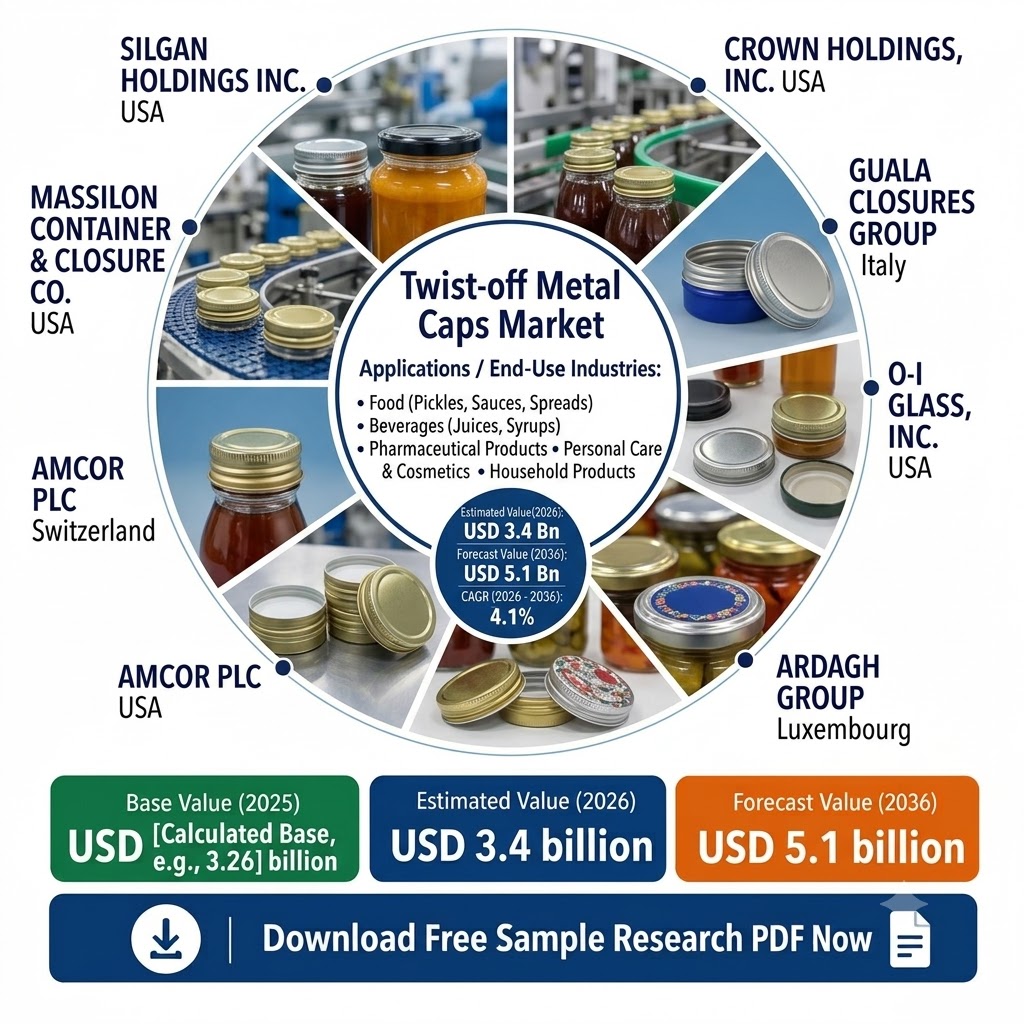
The global twist-off metal caps market is projected to grow from USD 3.4 billion in 2026 to USD 5.1 billion by 2036, expanding at a 4.1% CAGR over the forecast period, according to Fact.MR. The market was valued at USD 3.3 billion in 2025, creating an absolute opportunity of USD 1.7 billion between 2026 and 2036.
Demand remains closely tied to food packaging, where preserved and shelf-stable products require closures capable of maintaining a hermetic vacuum seal on glass containers. Food processors also qualify caps against jar finish, liner performance, application torque, vacuum retention, and thermal processing conditions.
Get Detailed Market Forecasts, Competitive Benchmarking, and Pricing Trends
Food Packaging Remains the Core Demand Base
Food Packaging Applications account for 69.7% of the twist-off metal caps market in 2026. Preserved and processed foods depend on repeatable closure performance throughout filling, capping, heat processing, cooling, distribution, and storage.
Standard Twist-off Metal Caps hold 44.8% of the market by product. Their broad installed base across food and beverage jars supports continued demand for standard lug-closure and vacuum-seal formats.
Food Manufacturers account for 57.4% of demand by end use. Closure selection is integrated into production-line requirements, including filling temperatures, capper settings, container inspection, and post-process handling.
By technology, Vacuum Sealing Technology holds 33.6% share. Maintaining negative pressure and container integrity remains central to closure performance during distribution and storage.
Food Grade Closure Systems account for 61.9% by formulation. Liners and coatings must remain compatible with product chemistry and food-contact requirements, particularly across processed and preserved food applications.
Direct Supply Gains Importance Among High-Volume Processors
Direct Manufacturer Sales represent 76.2% of the market in 2026. High-volume processors often require matched cap and capper specifications, consistent colors, liner control, technical support, and reliable replenishment schedules.
This structure also increases the importance of application trials. Suppliers need to understand the buyer’s jar finish, product chemistry, thermal process, capper configuration, and closure requirements before commercial deployment.
Decoration provides another area of differentiation. Printing and embossing allow metal closures to support shelf presentation while tamper-evidence systems add functionality beyond basic lug geometry and vacuum sealing.
Fact.MR Principal Consultant Shambhu Nath Jha notes:
“A twist-off cap is successful only when the cap, liner, glass finish, filling temperature, headspace, capper setting, and thermal process operate as one closure system. Suppliers should treat application trials, vacuum checks, lug engagement, corrosion resistance, and post-process handling as commercial requirements.”
Closure Performance Shapes Supplier Opportunities
The market presents opportunities for suppliers developing lightweight closures while maintaining verified seal performance. Recyclability-aligned metal and coating systems also offer scope for product development across North America, Europe, and Asia.
Short-run decorated caps can serve specialty food producers that require differentiated packaging without high-volume standardized formats. Liners designed for acidic and high-temperature products provide another opportunity as processors manage product-specific closure requirements.
At the same time, manufacturers face operational constraints. Seal defects can arise from capper settings or variations in glass finish. Liner and coating compliance can increase costs, while corrosion and post-process handling may affect closure performance. Plastic and alternative metal closure systems also create substitution pressure over the longer term.
Germany Leads Country Growth Outlook
Germany is projected to expand at a 4.7% CAGR from 2026 to 2036, supported by demand from processed foods, preserves, beverages, and glass packaging. Buyers assess liner compatibility, vacuum retention, decoration, recyclability, and capper performance together.
The Brazil twist-off metal caps market is projected to grow at 4.3% CAGR through 2036. Varied jar supply, product acidity, heat processing, and distribution conditions increase the need for capper setup and closure troubleshooting support.
In the United States, the market is projected to expand at 3.9% CAGR. Shelf-stable foods and acidified or low-acid products create formal requirements around container integrity, closure inspection, vacuum, capper performance, and post-process handling.
The UK market is projected to grow at 3.5% CAGR, with processors balancing food-contact compliance, line efficiency, decoration, and smaller-run economics.
Japan is projected to record a 3.1% CAGR through 2036. Quality-sensitive processors place strong emphasis on appearance, opening feel, leakage prevention, corrosion control, and lot consistency.
Competitive Landscape
Competition includes global metal-packaging groups, specialist lug-cap manufacturers, closure converters, decorators, and packaging distributors. Suppliers compete through liner technology, tooling, capper support, decoration capabilities, food-contact documentation, metal sourcing, technical service, and supply reliability.
Key companies profiled by Fact.MR include Crown Holdings Inc., Berk Company, Nippon Closures Co., Silgan White Cap, Gebrüder Leonhardt GmbH & Co. KG, Tecnocap S.p.A., Burch Bottle & Packaging, Inc., Atlas Labels & Packaging, and Fidel Fillaud Inc.
About the Twist-off Metal Caps Market Report
The Fact.MR study covers the market across Product, Application, End Use, Technology, Formulation, Distribution Channel, and Region. The assessment covers North America, Latin America, Western Europe, Eastern Europe, East Asia, South Asia & Pacific, and the Middle East & Africa.
The market definition includes lug-style metal closures applied to threaded glass containers for vacuum sealing of foods, beverages, selected pharmaceutical products, and personal-care products. Standard, lined, BPA-NI, decorated, and tamper-evident formats are included.
The forecast period covers 2026 to 2036, with 2025 as the base year. Market sizing considers cap unit volumes, realized prices, product format, application mix, liner and coating systems, end-use activity, and distribution structure.
Other Related Reports:
Office Real Estate Market
Mutual Fund Assets Market
Mining Dust Control Market
About Fact.MR
Fact.MR is a market research and consulting firm providing syndicated and customized research across industries. Its studies combine primary research, secondary research, market sizing, forecasting, and competitive analysis to support business and strategic decisions.