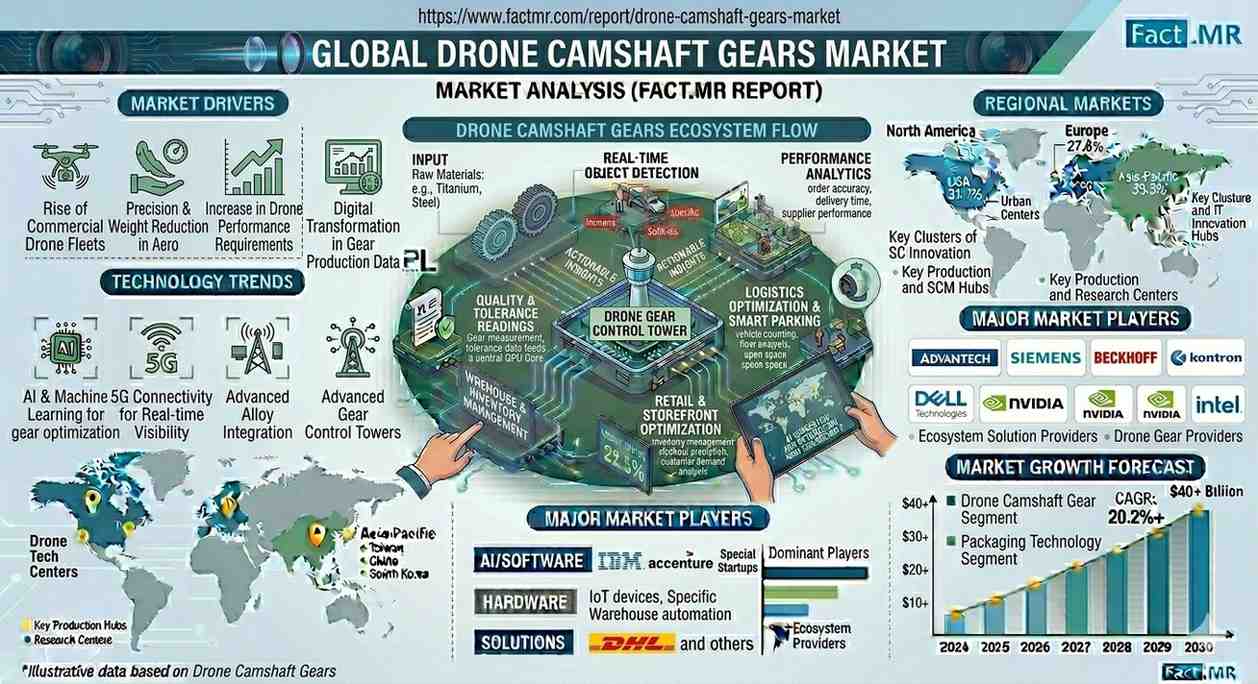
According to Fact.MR’s latest analysis, the global drone camshaft gears market is valued at USD 1.2 billion in 2025 and is projected to reach USD 1.32 billion in 2026, expanding to approximately USD 3.1 billion by 2036. The market is expected to grow at a CAGR of 8.9%, creating an incremental opportunity of nearly USD 1.9 billion over the forecast period.
The market is undergoing a structural shift from low-volume mechanical components to high-precision, aerospace-grade gear systems integrated into hybrid and combustion UAV propulsion platforms. Growth is driven by increasing reliance on long-endurance drones, tactical UAVs, and heavy-payload platforms, where timing accuracy and durability directly influence mission success.
Quick Stats
- Market Size (2025): USD 1.2 Billion
- Market Size (2026): USD 1.32 Billion
- Forecast Value (2036): USD 3.1 Billion
- CAGR (2026–2036): 8.9%
- Incremental Opportunity: USD 1.9 Billion
- Leading Segment: Helical Camshaft Gears (38.7% share)
- Leading Region: Asia Pacific (China, India)
- Key Players: The Timken Company, Schaeffler AG, UAV Engines Ltd, BRP-Rotax GmbH & Co KG, Continental Aerospace Technologies
Executive Insight for Decision Makers
The drone camshaft gears market is shifting toward high-value, low-volume aerospace manufacturing, where precision engineering and certification define competitive advantage.
Strategic Imperatives:
- Invest in aerospace-grade metallurgy and heat treatment technologies
- Build OEM-level partnerships with UAV propulsion developers
- Expand aftermarket service and overhaul capabilities
Risk of Inaction:
- Exclusion from certified UAV programs
- Loss of long-term contracts due to lack of compliance
- Inability to compete in high-margin aerospace supply chains
Market Dynamics
Key Growth Drivers
- Expansion of BVLOS (Beyond Visual Line of Sight) UAV operations
- Rising demand for hybrid and heavy-fuel propulsion systems
- Growth in defense, cargo, and industrial UAV deployments
- Increasing emphasis on mission reliability and engine efficiency
Key Restraints
- Rapid shift toward battery-electric drones reducing addressable market
- High certification and qualification costs
- Limited production volumes compared to automotive sectors
Emerging Trends
- Integration of gear systems within propulsion modules
- Adoption of advanced materials such as nitriding steel and Pyrowear alloys
- Rise of mission assurance-based procurement models
- Growth of aftermarket overhaul and maintenance ecosystems
Segment Analysis
- Leading Segment: Helical camshaft gears hold 38.7% share (2026) due to reduced noise and enhanced durability
- Fastest-Growing Segment: Hybrid propulsion-compatible gear systems
Breakdown
- Product Types: Helical gears, spur gears, split gear sets
- Workflow: OEM installation (58.6% share), aftermarket replacement
- End-use: Defense UAVs, cargo drones, industrial inspection UAVs
Strategic Importance:
OEM integration dominates as gear systems are locked during engine design, creating long-term supplier dependency and high switching costs.
Supply Chain Analysis (Critical Insight)
Raw Material Suppliers
- Aerospace-grade steel providers (carburizing steel, alloy steel)
- Specialty metallurgy and heat-treatment companies
Manufacturers / Producers
- Precision gear manufacturers and aerospace component firms
- Companies like The Timken Company and Schaeffler AG
Distributors
- Specialized aerospace distributors
- Direct OEM supply contracts dominate over open distribution
End-Users
- UAV engine manufacturers
- Defense contractors
- Industrial drone OEMs
Who Supplies Whom
- Material suppliers → Precision gear manufacturers
- Gear manufacturers → UAV engine OEMs (e.g., UAV Engines Ltd)
- Engine OEMs → Drone manufacturers and defense integrators
- Aftermarket suppliers → Maintenance and overhaul service providers
Insight:
The supply chain is highly integrated and certification-driven, with long-term contracts and minimal vendor switching once systems are validated.
Pricing Trends
- Commodity vs Premium:
- Standard gears: Low-margin, limited use
- Aerospace-grade gears: High-margin, precision-engineered
- Key Influencing Factors:
- Material quality and heat treatment
- Certification (AS9100, aerospace compliance)
- Production volume and customization
- Integration complexity
- Margin Insights:
- Premium aerospace gears command 2x–4x margins over industrial equivalents
- Aftermarket services provide recurring revenue streams
Regional Analysis
Top 5 Countries by CAGR (2026–2036)
- China – 9.6%
- India – 9.2%
- United States – 8.5%
- Germany – 8.1%
- United Kingdom – 7.8%
Regional Growth Drivers
- Asia Pacific: UAV manufacturing scale and government incentives
- North America: Defense UAV programs and FAA regulatory expansion
- Europe: Standardized drone regulations and aerospace innovation
Developed vs Emerging Markets
- Developed markets focus on high-performance UAV systems
- Emerging markets drive volume growth and cost optimization
Competitive Landscape
- Market Structure: Moderately consolidated at the aerospace tier
- Key Players:
- The Timken Company
- Schaeffler AG
- UAV Engines Ltd
- BRP-Rotax GmbH & Co KG
- Hirth Engines GmbH
- Austro Engine GmbH
- Continental Aerospace Technologies
- Gleason Corporation
- Bharat Gears Ltd
Competitive Strategies
- Precision engineering and tight tolerance manufacturing
- Long-term OEM integration contracts
- Expansion of aftermarket and overhaul services
- Investment in advanced materials and gear technologies
Strategic Takeaways
For Manufacturers
- Focus on certification, durability, and precision machining
- Develop integrated propulsion component capabilities
For Investors
- Target firms with aerospace-grade manufacturing and OEM relationships
- Prioritize companies with aftermarket service revenues
For Marketers / Distributors
- Position offerings around reliability, mission assurance, and lifecycle value
- Build credibility through certification and compliance expertise
Future Outlook
The market is expected to evolve toward high-performance, integrated propulsion ecosystems, where camshaft gears play a critical role in engine efficiency and reliability.
- Increased adoption of hybrid UAV propulsion systems
- Continued demand from defense and long-endurance drone applications
- Sustainability focus on fuel efficiency and reduced emissions
Long-term opportunity lies in low-volume, high-margin aerospace programs with strong aftermarket potential.
Conclusion
The global drone camshaft gears market is transitioning into a precision-driven aerospace niche, where value is defined by engineering excellence rather than volume. Companies that align with OEM ecosystems, certification standards, and lifecycle service models will secure long-term growth.
As UAV applications expand into critical infrastructure, logistics, and defense, reliable propulsion components will remain indispensable, positioning this market as a high-value opportunity for specialized manufacturers and investors.
Why This Market Matters
- Enables mission-critical UAV performance and reliability
- Supports growth of defense, logistics, and industrial drone ecosystems
- Drives innovation in aerospace-grade precision engineering
- Offers high-margin opportunities in a specialized, defensible market
Browse full report: https://www.factmr.com/report/drone-camshaft-gears-market