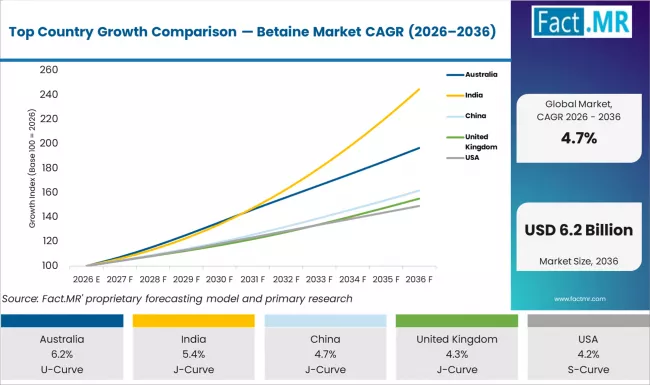
The United Kingdom betaine market is experiencing stable and value-driven growth, supported by rising demand across personal care, animal nutrition, and functional food sectors. The market is estimated at USD 210 million in 2026, projected to reach USD 219 million in 2027, and is forecast to expand to approximately USD 315 million by 2036, registering a CAGR of 4.3% over the forecast period. The market is expected to generate an incremental opportunity of around USD 105 million.
The UK market is undergoing a structural shift toward high-purity, specialty-grade betaine, particularly in premium personal care formulations and regulated food and supplement applications. Increasing consumer preference for sustainable, plant-based ingredients is further accelerating market transformation.
Quick Stats
- Market Size (2026): USD 210 Million
- Market Size (2027): USD 219 Million
- Forecast Value (2036): USD 315 Million
- CAGR (2026–2036): 4.3%
- Incremental Opportunity: USD 105 Million
- Leading Segment: Natural Betaine (≈71% share)
- Leading Product Type: Cocamidopropyl Betaine (≈42% share)
- Leading Application: Personal Care & Animal Feed
- Leading Country: United Kingdom
- Key Players: BASF SE, Solvay SA, Clariant AG, The Lubrizol Corporation, Croda International Plc
Executive Insight for Decision Makers
The UK betaine market is evolving from a commodity-driven supply model to a high-value specialty ingredient ecosystem.
- Manufacturers must prioritize high-purity formulations aligned with cosmetic and food-grade standards
- Personal care brands should integrate betaine into clean-label and sustainable product lines
- Investors should focus on companies with advanced formulation and regulatory compliance capabilities
Strategic risk: Companies that fail to upgrade product quality and sustainability credentials risk losing relevance in premium personal care and regulated food markets.
Market Dynamics
Key Growth Drivers
- Rising demand for mild, skin-friendly surfactants in personal care products
- Increasing focus on functional feed additives for livestock efficiency
- Expansion of clean-label and plant-based ingredient trends
- Growth in nutritional supplements and fortified food products
Key Restraints
- High compliance requirements under UK and EU chemical and cosmetic regulations
- Raw material dependency on imported feedstock and agricultural inputs
- Competitive pressure from alternative surfactants and feed additives
Emerging Trends
- Rapid adoption of sustainable and bio-based ingredients
- Innovation in premium skincare and haircare formulations
- Increased use of betaine in wellness and nutraceutical products
- Shift toward low-irritation and multifunctional ingredients
Segment Analysis
- Natural Betaine dominates with ~71% share due to demand for plant-based ingredients
- Cocamidopropyl Betaine leads with ~42% share, widely used in shampoos and cleansers
- Personal Care Applications represent a key demand driver in the UK market
Fastest-Growing Segment
- Premium Personal Care & Cosmetics, driven by clean beauty trends
Strategic Importance
- Personal care segment drives value growth and margins
- Animal feed ensures steady volume demand
Supply Chain Analysis (Critical Insight)
Raw Material Suppliers
- Sugar beet processors (primarily from Europe)
- Coconut oil suppliers (for surfactant production)
- Chemical intermediates suppliers
Manufacturers / Producers
- Specialty chemical companies producing betaine and derivatives
- UK-based formulation companies focusing on cosmetic-grade ingredients
Distributors
- Specialty ingredient distributors
- Cosmetic ingredient suppliers
- Feed additive distribution networks
End-Users
- Personal care manufacturers (skincare, haircare brands)
- Animal feed producers
- Food and supplement companies
Who Supplies Whom
- European sugar processors → supply feedstock → chemical manufacturers
- Chemical producers → supply refined betaine → UK cosmetic and feed manufacturers
- Distributors → ensure localized supply to brands and industrial users
Pricing Trends
- Feed-grade betaine: moderately priced, volume-driven
- Cosmetic-grade betaine: premium pricing due to purity and formulation standards
Key Influencing Factors
- Import costs of raw materials
- Regulatory compliance and certification costs
- Demand from premium personal care brands
Margin Insights
- High margins in cosmetics and nutraceutical applications
- Moderate margins in animal feed segment
Regional Analysis: United Kingdom Focus
The United Kingdom represents a mature yet innovation-driven market within Europe.
Growth Drivers
- Strong personal care and cosmetics industry
- Increasing demand for clean-label and sustainable ingredients
- Expansion of nutritional and wellness product markets
Market Positioning
- Developed market with high regulatory standards
- Focus on quality, safety, and sustainability over volume
Competitive Landscape
The UK betaine market is moderately concentrated, with global and regional players competing on quality and innovation.
Key Players
- BASF SE
- Solvay SA
- Clariant AG
- The Lubrizol Corporation
- Croda International Plc
- Evonik Industries AG
Competitive Strategies
- Development of high-performance specialty ingredients
- Investment in sustainable and bio-based formulations
- Strengthening distribution partnerships in Europe
- Focus on regulatory compliance and product certifications
Strategic Takeaways
For Manufacturers
- Invest in cosmetic-grade and high-purity betaine production
- Strengthen sustainable sourcing and supply chains
For Investors
- Focus on companies aligned with clean beauty and wellness trends
For Marketers / Distributors
- Position betaine as a premium multifunctional ingredient
- Expand presence in high-value personal care segments
Future Outlook
The UK betaine market is expected to transition toward a premium, innovation-led ecosystem, driven by:
- Growth in clean beauty and sustainable formulations
- Expansion of functional nutrition markets
- Increasing regulatory emphasis on ingredient safety and transparency
Conclusion: Why This Market Matters
The United Kingdom betaine market stands at the intersection of specialty chemicals, personal care innovation, and sustainable ingredient demand. While traditional applications provide stability, the future lies in high-value, formulation-driven growth.
For industry stakeholders, success will depend on innovation, compliance, and alignment with evolving consumer preferences, positioning the UK as a key hub for premium betaine applications in Europe.