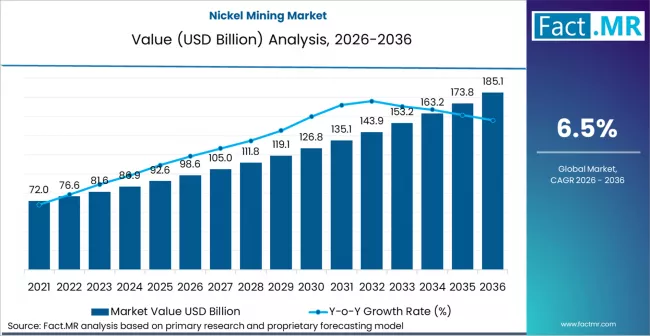
Japan’s nickel mining ecosystem, while limited in domestic resource extraction, plays a critical strategic role in the global nickel value chain through downstream processing, advanced manufacturing, and long-term sourcing agreements. In 2025, the global nickel mining market stood at USD 90.8 billion, with demand rising to USD 98.6 billion in 2026 and projected to reach USD 184.9 billion by 2036, growing at a CAGR of 6.5%.Within this landscape, Japan is expected to grow at a CAGR of 6.4% through 2036, supported by demand for high-performance alloys, stainless steel, and battery-grade nickel. The country’s transformation is driven by its focus on secure imports, refining capabilities, and integration with EV and electronics supply chains.
Quick Stats (Japan Focus)
- Global Market Size (2026): USD 98.6 Billion
- Global Forecast Value (2036): USD 184.9 Billion
- Japan CAGR (2026–2036): 6.4%
- Incremental Opportunity (Global): USD 86.0 Billion
- Leading Segment: Underground Mining (Global – 55% share)
- Leading Product Type: Nickel Sulfide (Global – 46% share)
- Japan Market Nature: Import-driven, downstream-focused
- Key Players Impacting Japan: Sumitomo Metal Mining, BHP Group Limited, Vale S.A.
Executive Insight for Decision Makers
Japan’s nickel strategy is centered on supply security rather than domestic extraction.
- Manufacturers must secure long-term supply agreements with global miners to ensure stable input for alloys and batteries.
- Battery and electronics companies should diversify sourcing to mitigate geopolitical risks.
- Investors should focus on companies with strong refining capabilities and global procurement networks.
Failure to secure consistent supply may disrupt high-value manufacturing sectors, including automotive, electronics, and energy storage.
Market Dynamics
Key Growth Drivers
- Strong demand for nickel-based alloys in automotive and electronics manufacturing
- Expansion of EV battery production and energy storage systems
- Long-term supply agreements with global mining companies
- Growth in advanced materials and specialty metals
Key Restraints
- High dependence on imported nickel ore and refined materials
- Exposure to global price volatility and supply disruptions
- Limited domestic mining capabilities
Emerging Trends
- Increasing focus on battery-grade nickel sourcing
- Strategic partnerships with mining companies in Indonesia, Australia, and Canada
- Growth in nickel recycling and circular economy practices
- Investment in refining and processing technologies
Segment Analysis
- Leading Segment (Global Influence): Underground mining (55% share) supports high-grade supply for Japan’s requirements
- Product Leadership: Nickel sulfide (46% share), preferred for battery-grade applications
Japan-Specific Demand Breakdown
- Applications:
- Stainless steel manufacturing (primary volume driver)
- EV batteries (fastest-growing segment)
- Specialty alloys and electronics
- End-Users:
- Automotive OEMs
- Electronics manufacturers
- Industrial equipment producers
Japan’s strategic focus lies in high-value applications rather than raw extraction, making it a premium-demand market.
Supply Chain Analysis (Japan-Centric)
Japan operates within a globally integrated nickel supply chain:
- Raw Material Sources: Indonesia, Philippines, Australia, Canada
- Suppliers: Global mining companies exporting nickel ore and intermediates
- Japanese Role: Refining, processing, and manufacturing
- End-Users: Automotive, electronics, and battery manufacturers
Who Supplies Whom
Global miners supply nickel ore and intermediates to Japanese refiners, which process them into high-purity nickel products. These are then used by battery producers and advanced manufacturers, positioning Japan as a high-value downstream hub.
Pricing Trends
- Japan primarily operates in the premium pricing segment, driven by demand for high-purity nickel.
Key Influencing Factors
- Global nickel prices and supply constraints
- Import costs and logistics
- Quality and purity requirements for advanced applications
- Long-term contract pricing mechanisms
Margin Insights
- Higher margins achieved in battery-grade and specialty alloy segments
- Stable pricing through long-term procurement contracts
Regional Analysis: Japan in Focus
- CAGR (2026–2036): 6.4%
- Growth driven by advanced manufacturing and battery demand
Key Growth Factors
- Strong automotive and electronics industries
- Increasing EV adoption and battery production
- Dependence on secure and diversified import channels
Developed Market Characteristics
- High regulatory standards
- Focus on sustainability and recycling
- Integration with global supply chains
Compared to emerging markets, Japan emphasizes value-added processing over volume growth.Competitive Landscape
The Japanese nickel ecosystem is shaped by both domestic processors and global mining giants.Key Players
- Sumitomo Metal Mining
- BHP Group Limited
- Vale S.A.
- Glencore plc
- Norilsk Nickel
- First Quantum Minerals
Competitive Strategies
- Long-term supply agreements with Japanese firms
- Investment in refining and processing facilities
- Focus on high-quality nickel production
- Strategic alliances with battery manufacturers
Strategic Takeaways
For Manufacturers
- Strengthen global sourcing partnerships
- Invest in advanced refining and battery-grade processing
For Investors
- Focus on companies with strong supply chain integration and ESG compliance
- Target opportunities in battery materials and specialty alloys
For Distributors
- Build resilient supply networks
- Align with high-growth sectors such as EVs and electronics
Future Outlook
Japan will continue to play a critical downstream role in the global nickel market, driven by innovation and demand for high-performance materials.
- Technology Impact: Advanced refining and material science innovations
- Sustainability: Increased adoption of recycling and low-carbon sourcing
- Opportunity: Growing integration into global EV and energy storage supply chains
Conclusion: Why Japan Matters in the Nickel Market
Japan’s nickel market underscores the importance of supply chain strategy over resource ownership. As global demand for battery-grade nickel rises, Japan’s role as a high-value processing and manufacturing hub will become increasingly critical.For decision-makers, success in this market depends on securing supply, investing in innovation, and aligning with the evolving clean energy ecosystem, where Japan continues to lead in precision, quality, and technological advancement.