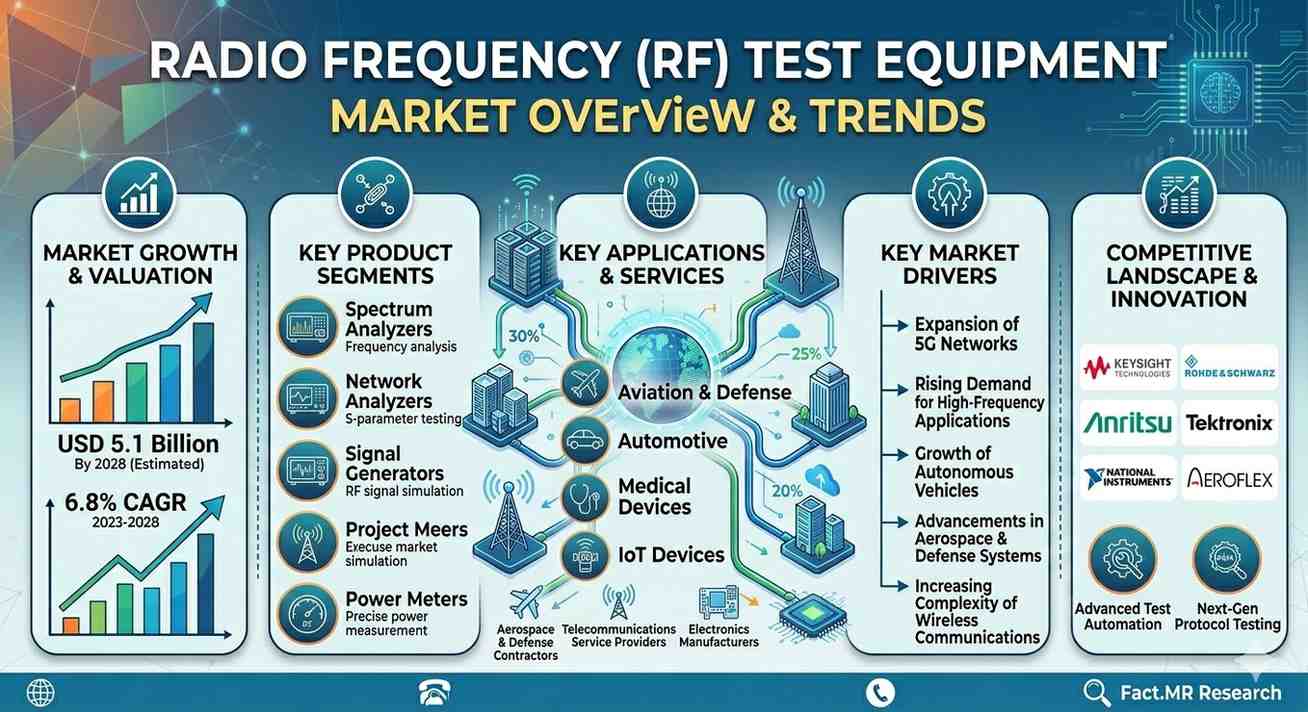
According to Fact.MR’s latest analysis, the global radio frequency (RF) test equipment market is valued at USD 4.3 billion in 2026 and is projected to reach approximately USD 4.7 billion in 2027, expanding to USD 10.0 billion by 2036. The market is expected to grow at a CAGR of 8.7% from 2026 to 2036, generating an incremental opportunity of USD 5.7 billion.
This growth reflects a fundamental transformation in the global communications ecosystem. The shift from 4G to 5G and early-stage 6G development, combined with increasing device complexity and spectrum congestion, is driving demand for high-frequency, high-precision RF testing solutions. RF test equipment is evolving into a mission-critical validation layer across telecom, aerospace, defense, and advanced electronics manufacturing.
Quick Stats
- Market Size (2026): USD 4.3 billion
- Market Size (2027): USD 4.7 billion
- Forecast Value (2036): USD 10.0 billion
- CAGR (2026–2036): 8.7%
- Incremental Opportunity: USD 5.7 billion
- Leading Segment: Portable Equipment (55% share)
- Leading Test Function: Radio Receiver Servicing (45% share)
- Leading Region: East Asia (China-led growth)
- Key Players: Keysight Technologies, Rohde & Schwarz, Anritsu, Viavi Solutions, National Instruments
Executive Insight for Decision Makers
The RF test equipment market is shifting toward software-defined, AI-enabled, and high-frequency testing ecosystems. As wireless technologies evolve, testing complexity increases exponentially, requiring integrated hardware-software platforms.
Strategic Imperatives:
- Invest in AI-driven test automation and digital twin validation tools
- Expand capabilities for high-frequency (FR3 and beyond) testing
- Align product portfolios with 5G-Advanced and emerging 6G standards
Risk of Inaction:
Failure to upgrade testing capabilities will lead to inaccurate validation, delayed product launches, and non-compliance with global wireless standards, directly impacting competitiveness.
Market Dynamics
Key Growth Drivers
- Rapid global rollout of 5G networks and infrastructure
- Increasing complexity of wireless devices and communication systems
- Strong demand from telecom, aerospace, and defense sectors
- Regulatory pressure for spectrum efficiency and compliance testing
Key Restraints
- High cost of advanced RF testing equipment
- Complexity in integration with legacy systems
- Skilled workforce requirement for advanced testing operations
Emerging Trends
- AI-powered test automation and predictive analytics
- Development of 6G-ready RF testing solutions (FR3 spectrum)
- Adoption of digital twin-based network validation
- Growth of modular and software-defined testing platforms
Segment Analysis
- Leading Segment: Portable RF test equipment holds 55% share, driven by field testing and mobility needs
- Fastest-Growing Segment: Modular and software-defined systems due to scalability and automation
Breakdown:
- Product Type: Network analyzers, spectrum analyzers, oscilloscopes, signal generators
- Test Function: Radio receiver servicing (45%), field strength testing, antenna maintenance
- End-Use: Telecommunications, automotive, broadcasting, satellite, industrial, research
Strategic Importance:
Portable devices enable on-site diagnostics and rapid deployment, while advanced analyzers support high-frequency validation in R&D and manufacturing environments.
Supply Chain Analysis (Critical Insight)
Value Chain Structure
- Raw Material & Component Suppliers:
Semiconductor manufacturers, RF components, precision electronics suppliers - Equipment Manufacturers:
Develop analyzers, signal generators, and integrated RF test systems - System Integrators & Distributors:
Provide customized solutions and integrate with automated test environments - End-Users:
- Telecom operators
- Device manufacturers (smartphones, IoT devices)
- Aerospace & defense organizations
- Research institutions
Who Supplies Whom
- Semiconductor firms supply high-frequency components to RF equipment manufacturers
- Companies like Keysight Technologies and Rohde & Schwarz deliver systems to OEMs and telecom operators
- Integrators deploy solutions within automated production and testing environments
Insight:
The supply chain is technology-intensive and innovation-driven, with strong interdependence between component innovation and testing capability advancement.
Pricing Trends
- High-end RF test equipment operates in a premium pricing model
- Entry-level and portable devices follow a mid-range pricing structure
Key Influencers
- Frequency range and accuracy requirements
- Integration with software and automation platforms
- Compliance with global standards (5G, 6G readiness)
- After-sales services and calibration support
Margin Insight:
Margins are high for advanced systems due to technological complexity, while competitive pricing pressures exist in portable and mid-range segments.
Regional Analysis
Top Countries by CAGR (2026–2036)
- China: 11.8%
- India: 10.9%
- Germany: 10.1%
- Brazil: 9.2%
- USA: 8.3%
Regional Insights
- East Asia: Dominates due to large-scale electronics manufacturing and 5G deployment
- South Asia: Rapid growth driven by telecom expansion and government initiatives
- North America: Innovation hub for advanced RF technologies
- Europe: Strong demand from industrial and automotive sectors
- Latin America: Emerging demand linked to telecom infrastructure growth
Developed vs Emerging Markets:
- Developed markets focus on advanced testing and innovation
- Emerging markets emphasize infrastructure deployment and volume growth
Competitive Landscape
- Market Structure: Moderately consolidated with strong global leaders
Key Players
- Keysight Technologies, Inc.
- Rohde & Schwarz GmbH & Co. KG
- Anritsu Corporation
- Viavi Solutions Inc.
- National Instruments Corporation
- Yokogawa Electric Corporation
- Teledyne Technologies Incorporated
Competitive Strategies
- Continuous R&D investment in high-frequency testing
- Integration of AI and software-defined platforms
- Expansion of global service and calibration networks
- Strategic partnerships with telecom and device manufacturers
Strategic Takeaways
For Manufacturers
- Focus on high-frequency and AI-enabled test platforms
- Strengthen software ecosystem and automation capabilities
For Investors
- Target companies leading in 5G/6G testing innovation
- Invest in firms with strong R&D and global service infrastructure
For Marketers & Distributors
- Highlight precision, compliance, and performance advantages
- Build strong relationships with telecom and OEM clients
Future Outlook
The RF test equipment market is heading toward fully automated, AI-driven testing ecosystems. The transition to 6G and advanced wireless technologies will further increase demand for high-frequency, high-precision testing solutions.
Key future opportunities include:
- Digital twin-based network simulation
- Expansion into autonomous systems and IoT testing
- Integration with cloud-based testing platforms
Conclusion
The global RF test equipment market is evolving into a high-value, innovation-driven sector critical to the future of connectivity. As wireless technologies become more complex, the role of RF testing will expand from validation to strategic enablement of next-generation communication systems.
Why This Market Matters
RF test equipment underpins the entire wireless ecosystem, ensuring reliability, performance, and compliance across billions of connected devices. As the world transitions toward hyper-connectivity and 6G, this market becomes a cornerstone of global digital infrastructure and technological advancement.
Browse Full Report –
https://www.factmr.com/report/radio-frequency-test-equipment-market